Unidad de Enfermedades Desmielinizantes, Servicio de Neurología, Hospital Universitario de La Princesa, Madrid, Spain.
Unidad de Esclerosis Múltiple, Servicio de Neurología, Hospital Clínico Universitario, Valencia, Spain.
Neurol Sci. 2021 Dec;42(12):5183-5193. doi: 10.1007/s10072-021-05165-7. Epub 2021 Apr 1.
Cognitive impairment (CI) has a prevalence of 45-70% in people with multiple sclerosis (MS), producing a negative impact on their quality of life, personal life, and work. Early detection of CI has become an important aspect to be considered for an adequate follow-up, to optimize social adaptation and to implement specific cognitive rehabilitation strategies. The aim of this work is to propose a suitable cognitive evaluation of patients with MS based on available and efficient tools for diagnosis and monitoring purposes well supported by literature review and clinical experience.
A multidisciplinary panel of professionals from the field of neurology, neuropsychology, and neuroimaging performed a literature review of the topic of cognitive impairment assessment. This was combined and completed with their clinical experience to produce a set of recommendations.
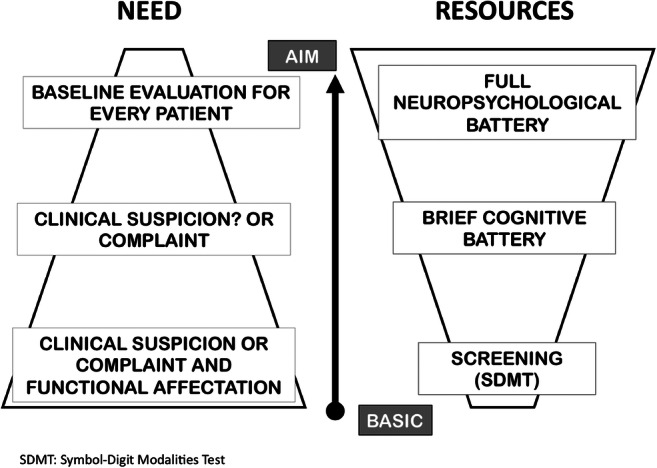
Some limitations to cognitive evaluation are described: shortage of time and resources during the neurology consultation, scarceness or absence of specialized professionals' availability, importance of tests adaptation, and doubts about its use to define therapeutic efficiency. We recommend a baseline and annual screening evaluation, and we suggest a baseline and periodic neuropsychological assessment. The latter ought to change to a recommendation with the presence of either positive screening test, or subjective to cognitive complaints, screening-test results and patient or family report mismatch, or in specific social/work situations.
Cognitive evaluation should be performed on all patients diagnosed with MS and throughout follow-up. It is necessary to support the creation of multidisciplinary MS teams to optimize the evaluation and follow-up of MS patients.
认知障碍(CI)在多发性硬化症(MS)患者中的患病率为 45-70%,对其生活质量、个人生活和工作产生负面影响。早期发现 CI 已成为充分随访、优化社会适应和实施特定认知康复策略的重要方面。这项工作的目的是根据文献综述和临床经验,提出一种基于现有和有效的诊断和监测工具的、适合 MS 患者的认知评估方法。
神经病学、神经心理学和神经影像学领域的多学科专业人员小组对认知障碍评估的主题进行了文献回顾。将其与他们的临床经验相结合,并完成了一套建议。
描述了认知评估的一些局限性:神经病学咨询期间时间和资源短缺、专业人员可用性不足或缺乏、测试适应的重要性以及对其用于定义治疗效果的疑虑。我们建议进行基线和年度筛查评估,并建议进行基线和定期神经心理学评估。如果出现阳性筛查测试、主观认知主诉、筛查测试结果与患者或家属报告不符、或在特定的社会/工作情况下,应将后者改为建议。
应在诊断为 MS 的所有患者和整个随访过程中进行认知评估。有必要支持创建多学科 MS 团队,以优化 MS 患者的评估和随访。