From the Department of Surgery (M.B., D.S.) and Department of Laboratory Medicine (A.T., B.Y.M., L.R.V., M.K., H.Z., P.P., S.P.), University of California, San Francisco; Cerus Corporation (A.B., M.G.G.), Concord, California; and Shock Trauma Center (R.K.), University of Maryland School of Medicine, Baltimore, Maryland.
J Trauma Acute Care Surg. 2021 Jun 1;90(6):1022-1031. doi: 10.1097/TA.0000000000003164.
Plasma has been shown to mitigate the endotheliopathy of trauma. Protection of the endothelium may be due in part to fibrinogen and other plasma-derived proteins found in cryoprecipitate; however, the exact mechanisms remain unknown. Clinical trials are underway investigating early cryoprecipitate administration in trauma. In this study, we hypothesize that cryoprecipitate will inhibit endothelial cell (EC) permeability in vitro and will replicate the ability of plasma to attenuate pulmonary vascular permeability and inflammation induced by hemorrhagic shock and trauma (HS/T) in mice.
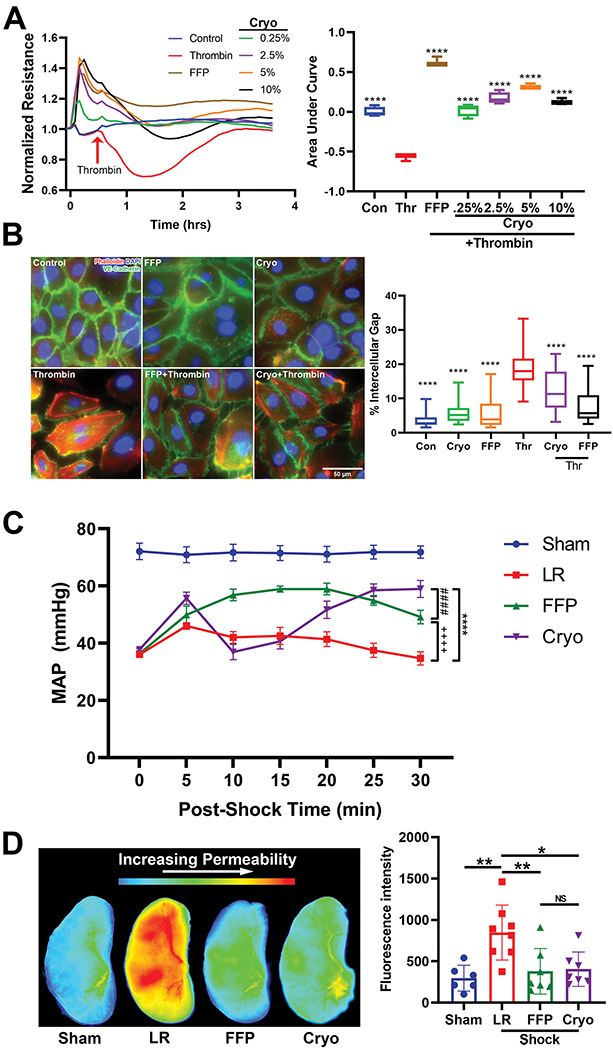
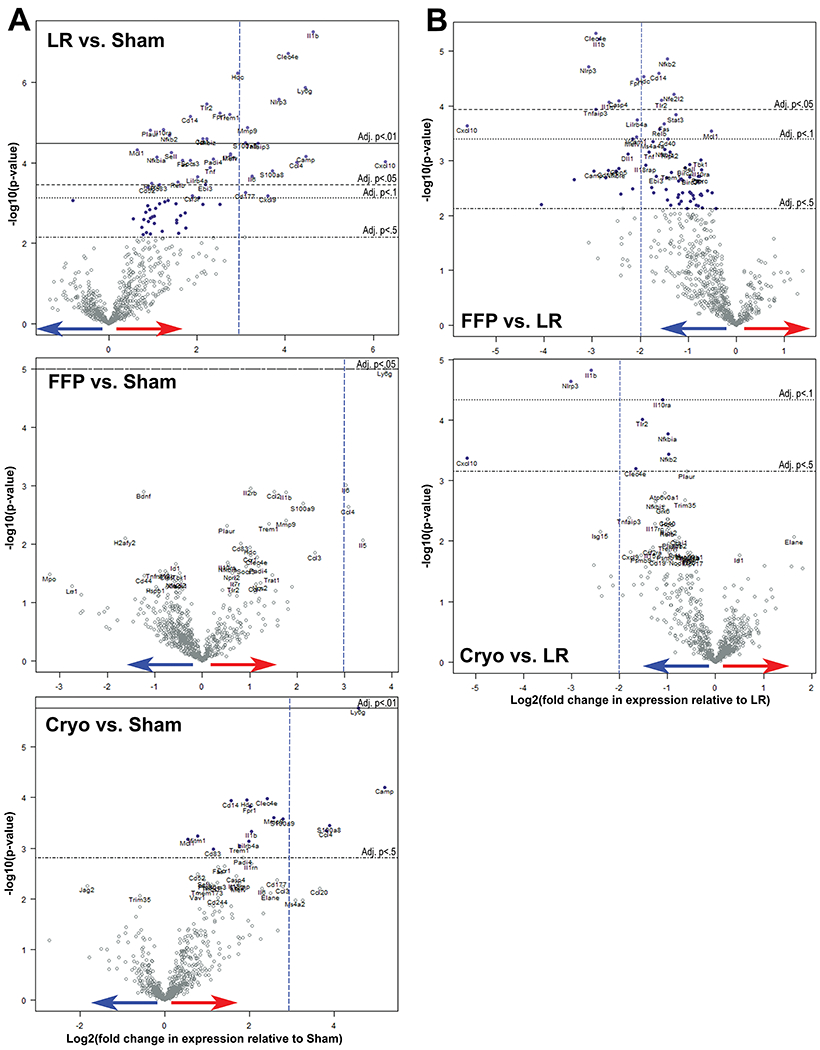
In vitro, barrier permeability of ECs subjected to thrombin challenge was measured by transendothelial electrical resistance. In vivo, using an established mouse model of HS/T, we compared pulmonary vascular permeability among mice resuscitated with (1) lactated Ringer's solution (LR), (2) fresh frozen plasma (FFP), or (3) cryoprecipitate. Lung tissue from the mice in all groups was analyzed for markers of vascular integrity, inflammation, and inflammatory gene expression via NanoString messenger RNA quantification.
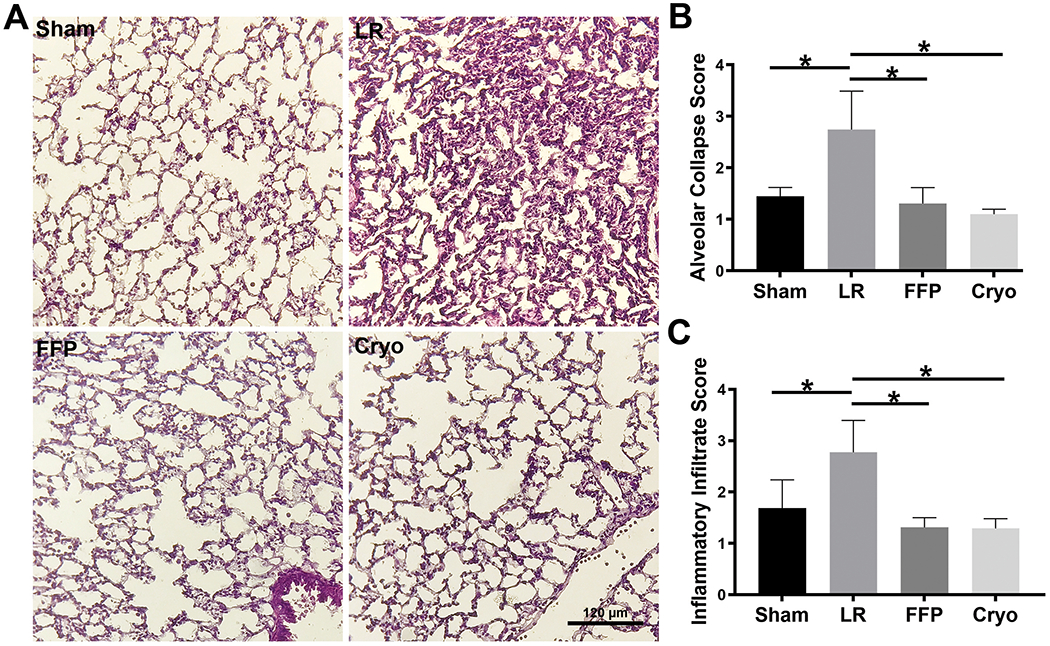
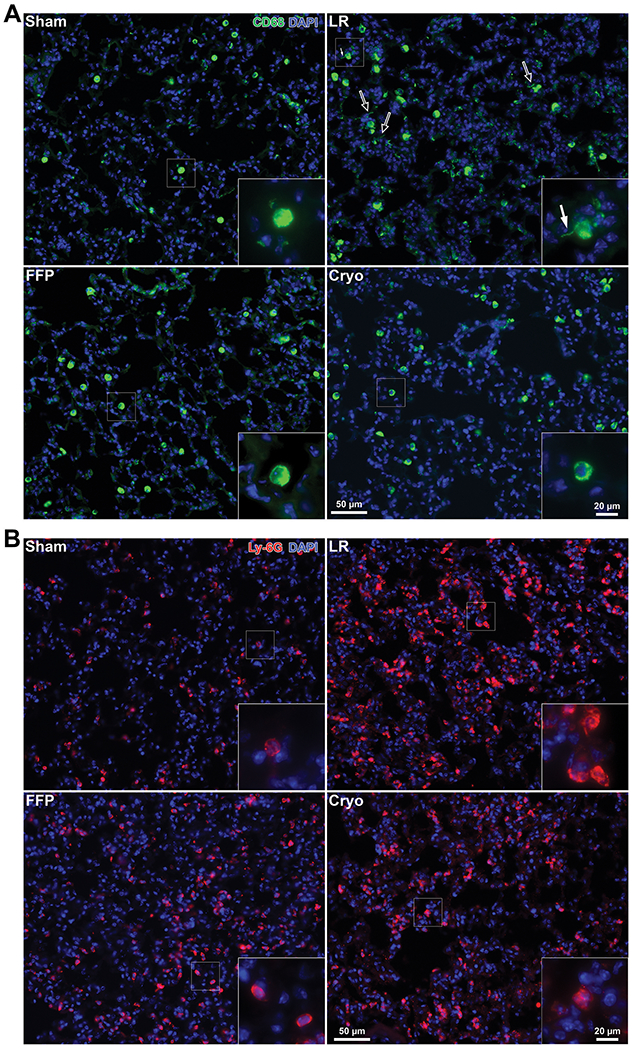
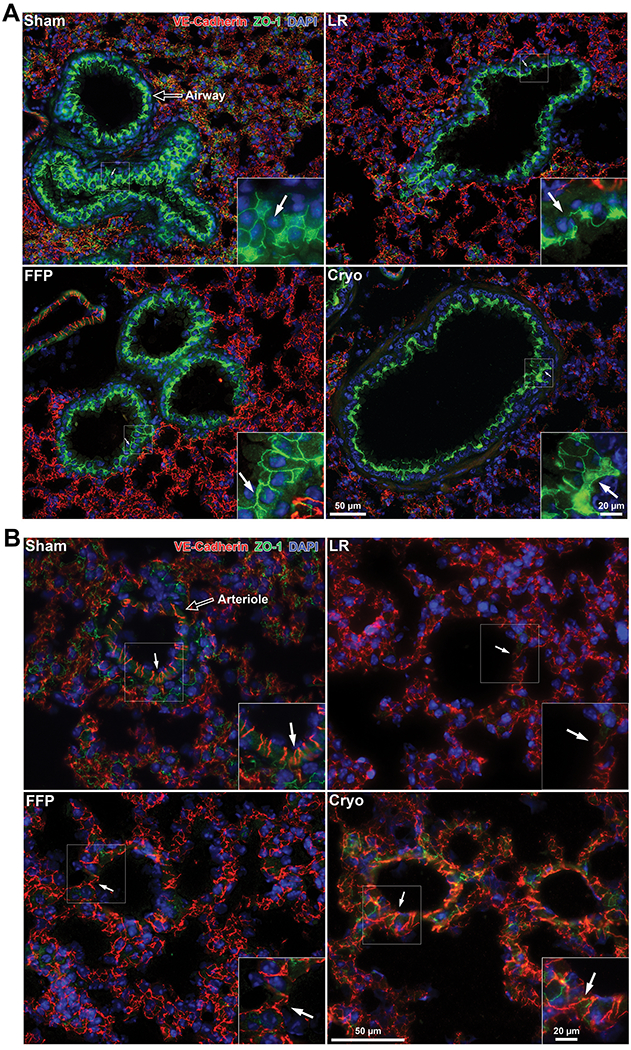
Cryoprecipitate attenuates EC permeability and EC junctional compromise induced by thrombin in vitro in a dose-dependent fashion. In vivo, resuscitation of HS/T mice with either FFP or cryoprecipitate attenuates pulmonary vascular permeability (sham, 297 ± 155; LR, 848 ± 331; FFP, 379 ± 275; cryoprecipitate, 405 ± 207; p < 0.01, sham vs. LR; p < 0.01, LR vs. FFP; and p < 0.05, LR vs. cryoprecipitate). Lungs from cryoprecipitate- and FFP-treated mice demonstrate decreased lung injury, decreased infiltration of neutrophils and activation of macrophages, and preserved pericyte-endothelial interaction compared with LR-treated mice. Gene analysis of lung tissue from cryoprecipitate- and FFP-treated mice demonstrates decreased inflammatory gene expression, in particular, IL-1β and NLRP3, compared with LR-treated mice.
Our data suggest that cryoprecipitate attenuates the endotheliopathy of trauma in HS/T similar to FFP. Further investigation is warranted on active components and their mechanisms of action.
已有研究表明,血浆可减轻创伤引起的内皮病变。纤维蛋白原和其他血浆衍生蛋白在冷沉淀中被发现,这可能部分保护了内皮细胞;然而,确切的机制仍不清楚。目前正在进行临床试验,以调查创伤早期应用冷沉淀的效果。在这项研究中,我们假设冷沉淀在体外将抑制内皮细胞(EC)通透性,并复制血浆减轻失血性休克和创伤(HS/T)诱导的肺血管通透性和炎症的能力。
在体外,通过跨内皮电阻测量凝血酶刺激下 EC 的屏障通透性。在体内,使用已建立的 HS/T 小鼠模型,我们比较了用(1)乳酸林格氏液(LR)、(2)新鲜冰冻血浆(FFP)或(3)冷沉淀复苏的小鼠的肺血管通透性。所有组别的小鼠肺组织均通过 NanoString 信使 RNA 定量分析血管完整性、炎症和炎症基因表达的标志物。
冷沉淀以剂量依赖的方式体外减轻凝血酶诱导的 EC 通透性和 EC 连接的破坏。在体内,FFP 或冷沉淀复苏 HS/T 小鼠可减轻肺血管通透性(假手术组,297 ± 155;LR 组,848 ± 331;FFP 组,379 ± 275;冷沉淀组,405 ± 207;p < 0.01,假手术组 vs. LR 组;p < 0.01,LR 组 vs. FFP 组;p < 0.05,LR 组 vs. 冷沉淀组)。与 LR 治疗的小鼠相比,冷沉淀和 FFP 治疗的小鼠的肺组织显示出肺损伤减少、中性粒细胞浸润和巨噬细胞激活减少以及周细胞-内皮细胞相互作用得到保留。冷沉淀和 FFP 治疗的小鼠肺组织的基因分析显示,与 LR 治疗的小鼠相比,炎症基因表达减少,特别是 IL-1β 和 NLRP3。
我们的数据表明,冷沉淀在 HS/T 中减轻创伤性内皮病变的作用与 FFP 相似。需要进一步研究活性成分及其作用机制。