Kidney Research Center and Department of Nephrology, Linkou Chang Gung Memorial Hospital, Taoyuan 333, Taiwan.
Department of Medicine, Chang Gung University, Taoyuan 333, Taiwan.
Viruses. 2021 Mar 14;13(3):476. doi: 10.3390/v13030476.
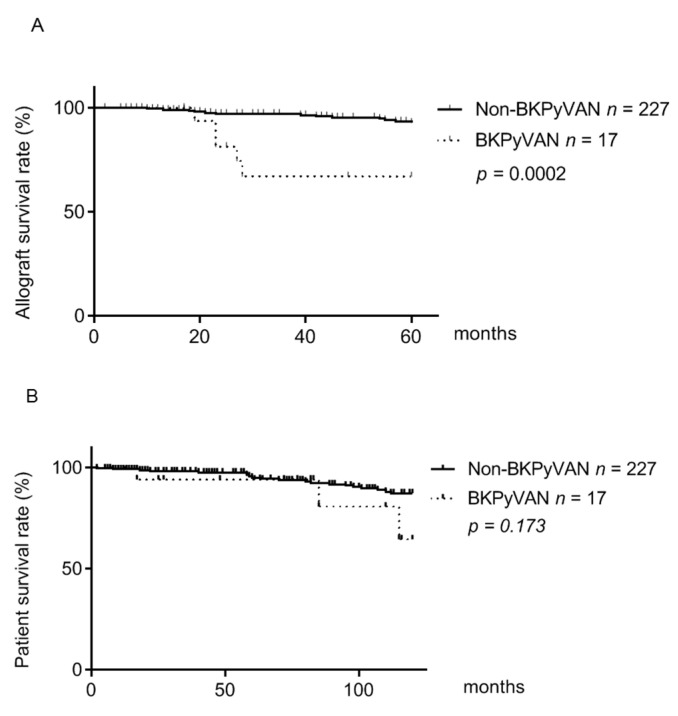
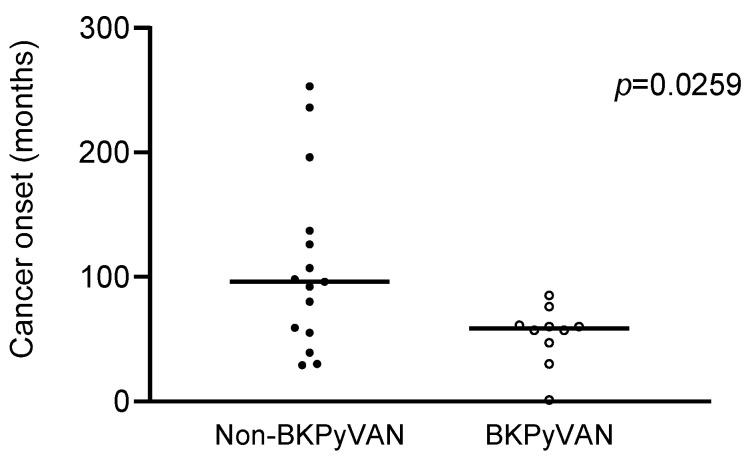
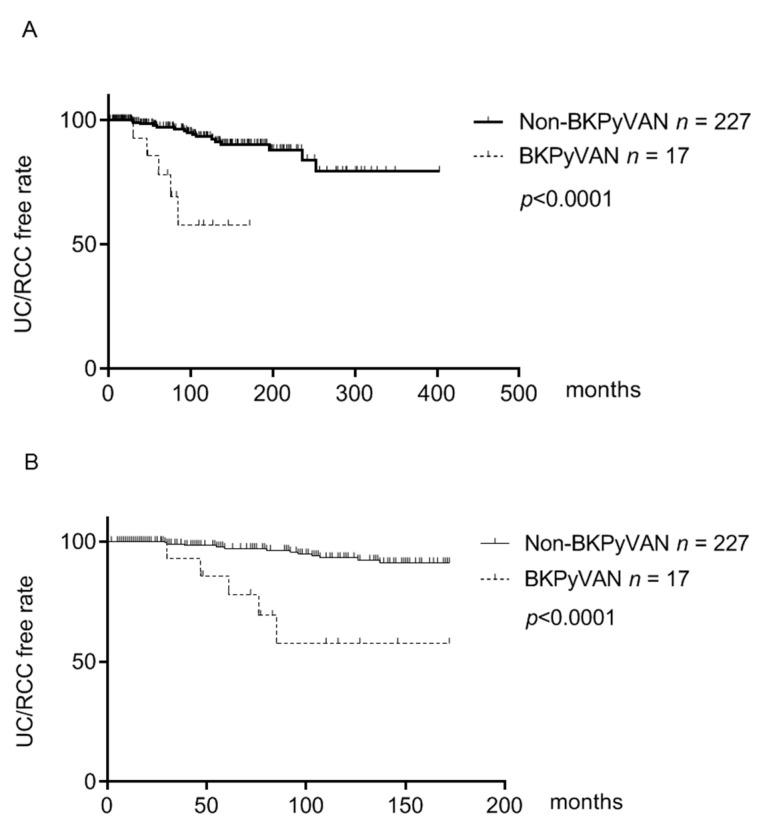
Over-immunosuppressed kidney transplant recipients are susceptible to malignancies and BK polyomavirus (BKPyV)-associated nephropathy (BKPyVAN). This study aimed to verify the association between BKPyV infection and urinary tract cancers (UTC). A total of 244 kidney transplant recipients were enrolled at Chang Gung Memorial Hospital from June 2000 to February 2020. Biopsy-proven BKPyVAN patients ( = 17) had worse kidney function (eGFR: 26 ± 13.7 vs. 47.8 ± 31.0 mL/min/1.73 m). The 5-year allograft survival rates for patients with and without BKPyVAN were 67% and 93%, respectively ( = 0.0002), while the 10-year patient survival was not different between the two groups. BKPyVAN patients had a significantly higher incidence of UTC compared to the non-BKPyVAN group (29.4% vs. 6.6%). Kaplan-Meier analysis showed that the UTC-free survival rate was significantly lower in BKPyVAN patients, and the onset of UTC was significantly shorter in BKPyVAN patients (53.4 vs. 108.9 months). The multivariate logistic regression analysis demonstrated that age (RR = 1.062) and BKVAN (RR = 6.459) were the most significant risk factors for the development of UTC. Our study demonstrates that BKPyVAN patients have greater allograft losses, higher incidence, a lower cancer-free survival rate, and an earlier onset with a higher relative risk of developing UTC compared to non-BKPyVAN patients.
免疫抑制过度的肾移植受者易患恶性肿瘤和 BK 多瘤病毒(BKPyV)相关肾病(BKPyVAN)。本研究旨在验证 BKPyV 感染与尿路上皮癌(UTC)之间的关联。共纳入 2000 年 6 月至 2020 年 2 月在长庚纪念医院接受肾移植的 244 例患者。经活检证实的 BKPyVAN 患者(=17)的肾功能更差(eGFR:26±13.7 与 47.8±31.0 mL/min/1.73 m)。有和没有 BKPyVAN 的患者 5 年移植物存活率分别为 67%和 93%(=0.0002),而两组 10 年患者存活率无差异。与非 BKPyVAN 组相比,BKPyVAN 患者 UTC 的发生率明显更高(29.4%与 6.6%)。Kaplan-Meier 分析显示,BKPyVAN 患者的 UTC 无复发生存率明显较低,且 UTC 发病时间明显较早(53.4 与 108.9 个月)。多变量逻辑回归分析表明,年龄(RR=1.062)和 BKVAN(RR=6.459)是 UTC 发展的最显著危险因素。本研究表明,与非 BKPyVAN 患者相比,BKPyVAN 患者的移植物丢失更多、发病率更高、无癌症生存率更低、发病更早且相对风险更高。