Peseschkian Tara, Cordts Isabell, Günther René, Stolte Benjamin, Zeller Daniel, Schröter Carsten, Weyen Ute, Regensburger Martin, Wolf Joachim, Schneider Ilka, Hermann Andreas, Metelmann Moritz, Kohl Zacharias, Linker Ralf A, Koch Jan Christoph, Büchner Boriana, Weiland Ulrike, Schönfelder Erik, Heinrich Felix, Osmanovic Alma, Klopstock Thomas, Dorst Johannes, Ludolph Albert C, Boentert Matthias, Hagenacker Tim, Deschauer Marcus, Lingor Paul, Petri Susanne, Schreiber-Katz Olivia
Department of Neurology, Hannover Medical School, 30625 Hannover, Germany.
Department of Neurology, Klinikum Rechts der Isar, Technical University of Munich, 81675 Munich, Germany.
Brain Sci. 2021 Mar 14;11(3):372. doi: 10.3390/brainsci11030372.
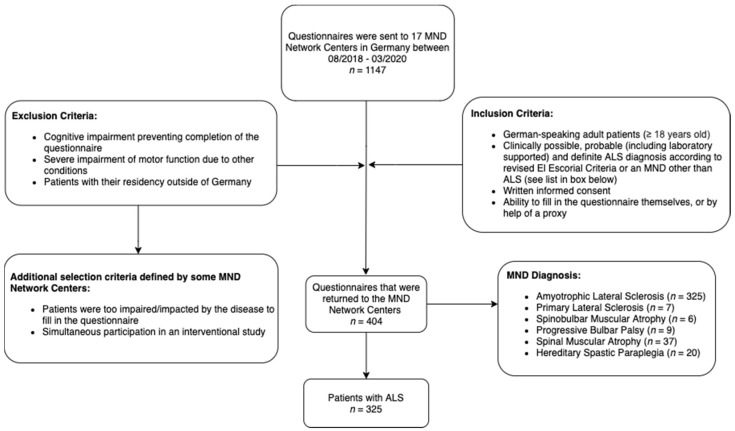
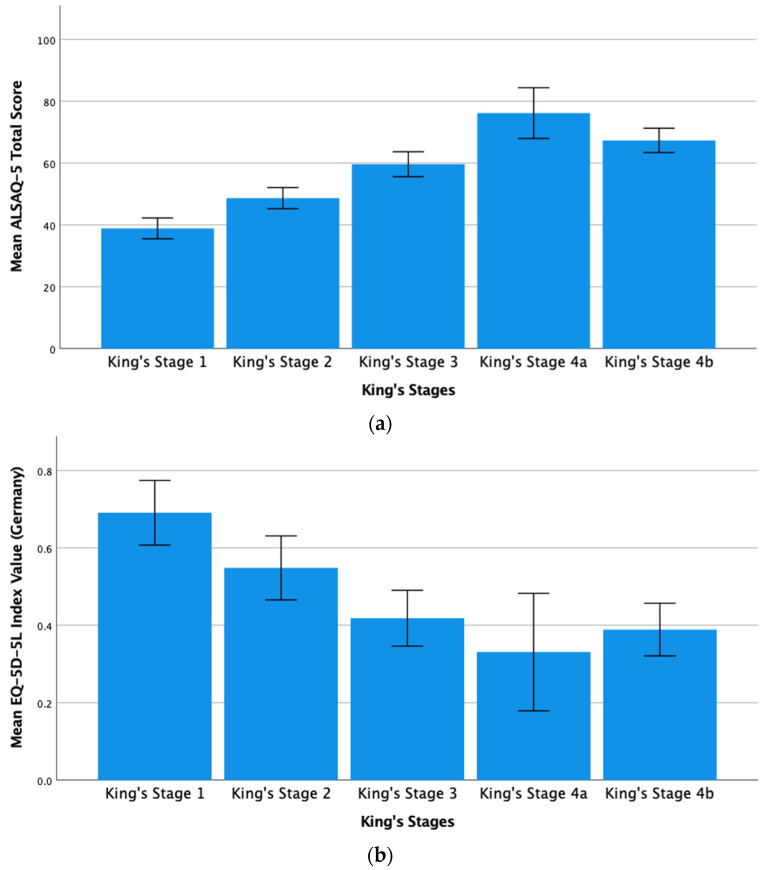
Improving quality of life (QoL) is central to amyotrophic lateral sclerosis (ALS) treatment. This Germany-wide, multicenter cross-sectional study analyses the impact of different symptom-specific treatments and ALS variants on QoL. Health-related QoL (HRQoL) in 325 ALS patients was assessed using the Amyotrophic Lateral Sclerosis Assessment Questionnaire 5 (ALSAQ-5) and EuroQol Five Dimension Five Level Scale (EQ-5D-5L), together with disease severity (captured by the revised ALS Functional Rating Scale (ALSFRS-R)) and the current care and therapies used by our cohort. At inclusion, the mean ALSAQ-5 total score was 56.93 (max. 100, best = 0) with a better QoL associated with a less severe disease status (β = -1.96 per increase of one point in the ALSFRS-R score, < 0.001). "Limb-onset" ALS (ALS) was associated with a better QoL than "bulbar-onset" ALS (ALS) (mean ALSAQ-5 total score 55.46 versus 60.99, = 0.040). Moreover, with the ALSFRS-R as a covariate, using a mobility aid (β = -7.60, = 0.001), being tracheostomized (β = -14.80, = 0.004) and using non-invasive ventilation (β = -5.71, = 0.030) were associated with an improved QoL, compared to those at the same disease stage who did not use these aids. In contrast, antidepressant intake (β = 5.95, = 0.007), and increasing age (β = 0.18, = 0.023) were predictors of worse QoL. Our results showed that the ALSAQ-5 was better-suited for ALS patients than the EQ-5D-5L. Further, the early and symptom-specific clinical management and supply of assistive devices can significantly improve the individual HRQoL of ALS patients. Appropriate QoL questionnaires are needed to monitor the impact of treatment to provide the best possible and individualized care.
提高生活质量(QoL)是肌萎缩侧索硬化症(ALS)治疗的核心。这项德国范围内的多中心横断面研究分析了不同症状特异性治疗和ALS变体对生活质量的影响。使用肌萎缩侧索硬化症评估问卷5(ALSAQ - 5)和欧洲五维五级量表(EQ - 5D - 5L)对325例ALS患者的健康相关生活质量(HRQoL)进行评估,并结合疾病严重程度(由修订的ALS功能评定量表(ALSFRS - R)衡量)以及我们队列中目前使用的护理和治疗方法。纳入研究时,ALSAQ - 5总分平均为56.93(满分100,最佳 = 0),疾病状态越轻,生活质量越好(ALSFRS - R评分每增加1分,β = -1.96,<0.001)。“肢体起病型”ALS患者的生活质量优于“延髓起病型”ALS患者(ALSAQ - 5总分平均为55.46对60.99, = 0.040)。此外,以ALSFRS - R作为协变量,与处于相同疾病阶段但未使用这些辅助设备的患者相比,使用移动辅助设备(β = -7.60, = 0.001)、进行气管切开术(β = -14.80, = 0.004)和使用无创通气(β = -5.71, = 0.030)与生活质量改善相关。相比之下,服用抗抑郁药(β = 5.95, = 0.007)和年龄增长(β = 0.18, = 0.023)是生活质量较差的预测因素。我们的结果表明,对于ALS患者,ALSAQ - 5比EQ - 5D - 5L更适用。此外,早期和症状特异性的临床管理以及辅助设备的供应可以显著改善ALS患者的个体HRQoL。需要合适的生活质量问卷来监测治疗效果,以提供尽可能最佳的个性化护理。