Mirabelli Maria, Chiefari Eusebio, Tocci Vera, Caroleo Patrizia, Giuliano Stefania, Greco Emanuela, Luque Raul Miguel, Puccio Luigi, Foti Daniela Patrizia, Aversa Antonio, Brunetti Antonio
Department of Health Sciences, University "Magna Græcia" of Catanzaro, 88100 Catanzaro, Italy.
Unit of Endocrinology, Azienda Ospedaliera Mater-Domini, 88100 Catanzaro, Italy.
J Clin Med. 2021 Mar 2;10(5):985. doi: 10.3390/jcm10050985.
The aim of this monocentric retrospective observational study was to evaluate the 18-month safety and effectiveness of GLP-1 receptor agonist (GLP-1 RA) dulaglutide (DU) 1.5 mg/once weekly as an add-on to metformin (MET) or MET plus conventional insulin secretagogues in a study cohort with excess body weight and type 2 diabetes (T2D). Comparative efficacy versus liraglutide (LIRA) 1.2-1.8 mg/once daily in a study sample naïve to GLP-1 RAs, frequency matching for age, gender, T2D duration, degree of glycemic impairment, cardiovascular comorbidities, and medications, was addressed as a secondary aim. Clinical and biochemical data for efficacy outcomes and information on drug discontinuation due to adverse events (AEs) were collected from digital records.
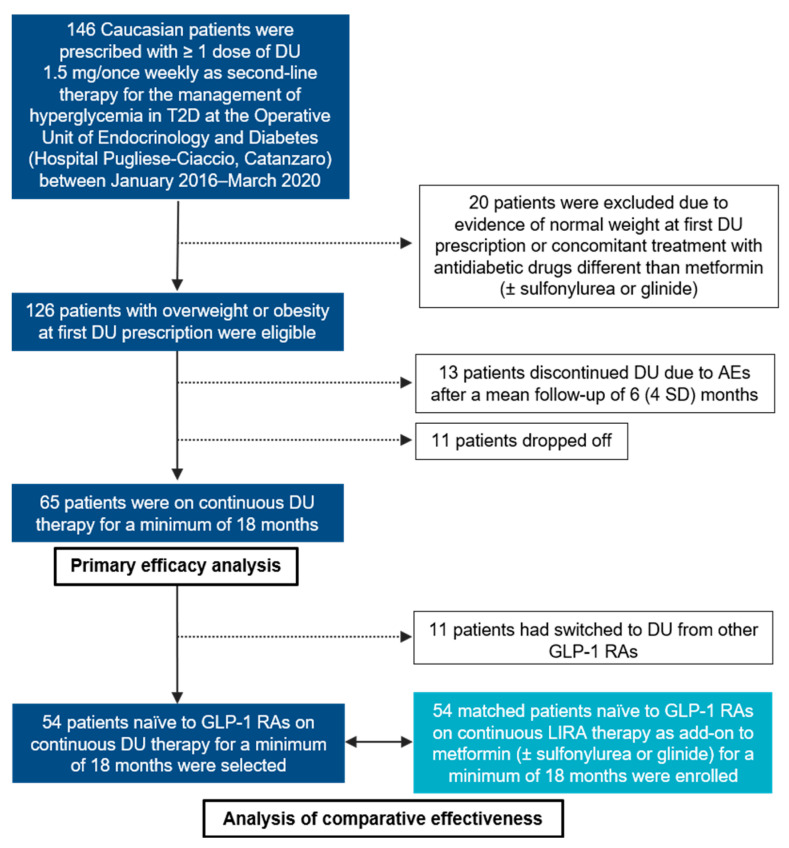
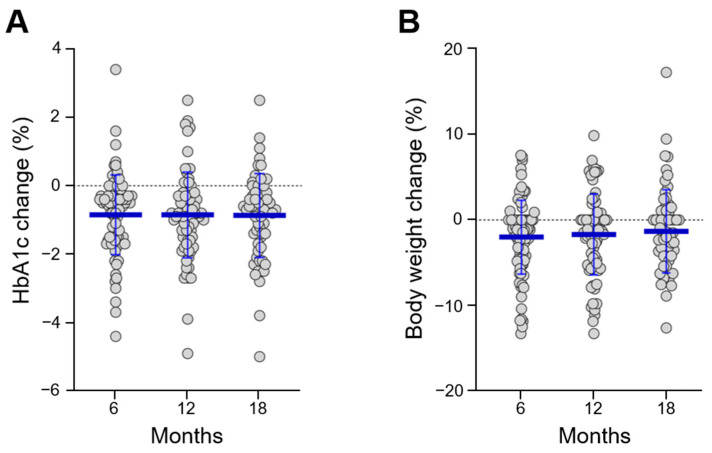
Initial analysis included 126 overweight and obese T2D patients (48.4% females). Out of these, 13 discontinued DU due to moderate-severe gastrointestinal AEs after a mean follow-up of 6 (4 standard deviations (SD)) months, while 65 completed 18 months of continuous therapy. At 6 months, there was a significant mean HbA1c reduction of -0.85% (1.17 SD) with respect to baseline values ( < 0.001), which remained stable during 18 months follow-up. These results were accompanied by a moderate weight loss sustained over time, with a mean reduction of -2.0% (4.3 SD) at 6 months and -1.3% (4.8 SD) at 18 months ( = 0.091). At univariate analysis, a negative correlation between baseline body mass index (BMI) and risk of drug discontinuation due to gastrointestinal AEs was observed. The protective effect of obesity against drug discontinuation was confirmed by logistic regression analysis. Neither gender, nor age, nor T2D duration, nor concomitant conventional insulin secretagogue use, nor switching to DU from other GLP-1 RAs influenced its long-term effectiveness. However, higher baseline HbA1c values emerged as predictors of clinically relevant efficacy outcomes, either in terms of HbA1c reduction ≥ 0.5% or body weight loss ≥ 5%. The efficacy outcomes were corroborated by head-to-head comparison with LIRA, a GLP-1 RA with durable beneficial effects on glycemic control and body weight in real-world experiences. With the advantage of once-weekly administration, at 18-month follow-up, a significantly larger fraction of patients on DU therapy reached glycemic targets (HbA1c ≤ 7.0%) when compared to those on LIRA: from 14.8% at baseline (both groups) to 64.8% with DU and 42.6% with LIRA ( = 0.033).
Although limited by a retrospective design and lack of constant up-titration for LIRA to the highest dose, these findings indicate that the beneficial responses to DU on a background of MET or MET plus insulin secretagogues are durable, especially in the presence of obesity and greater HbA1c impairment.
本单中心回顾性观察研究的目的是评估胰高血糖素样肽-1受体激动剂(GLP-1 RA)度拉糖肽(DU)1.5毫克/每周一次作为二甲双胍(MET)或MET加传统胰岛素促泌剂的附加治疗,在超重和2型糖尿病(T2D)研究队列中的18个月安全性和有效性。作为次要目的,在对GLP-1 RAs初治的研究样本中,针对年龄、性别、T2D病程、血糖损害程度、心血管合并症和药物进行频率匹配,比较与利拉鲁肽(LIRA)1.2 - 1.8毫克/每日一次的疗效。从数字记录中收集疗效结果的临床和生化数据以及因不良事件(AE)导致停药的信息。
初始分析纳入126例超重和肥胖的T2D患者(48.4%为女性)。其中,13例在平均随访6(4个标准差(SD))个月后因中度至重度胃肠道AE停用DU,而65例完成了18个月的持续治疗。在6个月时,相对于基线值,平均糖化血红蛋白(HbA1c)显著降低-0.85%(1.17 SD)(<0.001),在18个月的随访期间保持稳定。这些结果伴随着随时间持续的适度体重减轻,6个月时平均减轻-2.0%(4.3 SD),18个月时减轻-1.3%(4.8 SD)(P = 0.091)。在单因素分析中,观察到基线体重指数(BMI)与因胃肠道AE停药风险之间呈负相关。逻辑回归分析证实了肥胖对停药的保护作用。性别、年龄、T2D病程、是否同时使用传统胰岛素促泌剂以及从其他GLP-1 RAs转换为DU均不影响其长期有效性。然而,较高的基线HbA1c值成为临床相关疗效结果的预测指标,无论是HbA1c降低≥0.5%还是体重减轻≥5%。与LIRA进行的头对头比较证实了疗效结果,LIRA是一种在现实世界经验中对血糖控制和体重具有持久有益作用的GLP-1 RA。由于每周一次给药的优势,在18个月随访时,与接受LIRA治疗的患者相比,接受DU治疗的患者中有显著更高比例达到血糖目标(HbA1c≤7.0%):从基线时的14.8%(两组)升至接受DU治疗的64.8%和接受LIRA治疗的42.6%(P = 0.033)。
尽管受回顾性设计以及LIRA未持续滴定至最高剂量的限制,但这些发现表明,在MET或MET加胰岛素促泌剂背景下,DU的有益反应是持久的,尤其是在存在肥胖和更高HbA1c损害的情况下。