Department of Reproductive Health, Centre of Postgraduate Medical Education, 01-004 Warsaw, Poland.
Medicina (Kaunas). 2021 Mar 2;57(3):228. doi: 10.3390/medicina57030228.
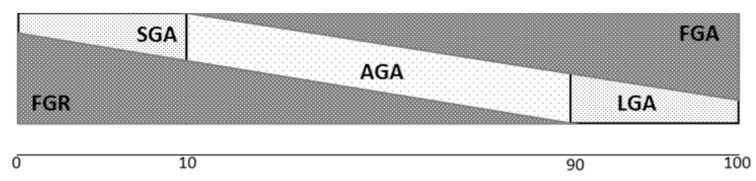
: Fetal overgrowth is related to many perinatal complications, including stillbirth, cesarean section, maternal and neonatal injuries, and shoulder dystocia. It is related to maternal diabetes, obesity, and gestational weight gain but also happens in low-risk pregnancies. There is ongoing discussion regarding definitions, methods of detection, and classification. The method used for detection is crucial as it draws a line between those at risk and low-risk popula-tions. : For this narrative review, relevant evidence was identified through PubMed search with one of the general terms (macrosomia, large-for-gestational-age) combined with the outcome of interest. : This review summarizes evidence on the relation of fetal overgrowth with stillbirth, cesarean sections, shoulder dystocia, anal sphincter injury, and hem-orrhage. Customized growth charts help to detect mothers and fetuses at risk of those complica-tions. Relations between fetal overgrowth and diabetes, maternal weight, and gestational weight gain were investigated. : a substantial proportion of complications are an effect of the fetus growing above its potential and should be recognized as a new dangerous condition of Fetal Growth Acceleration.
胎儿生长过度与许多围产期并发症有关,包括死产、剖宫产、母婴损伤和肩难产。它与母体糖尿病、肥胖和妊娠体重增加有关,但也发生在低风险妊娠中。目前正在讨论定义、检测方法和分类。检测方法至关重要,因为它划定了高危人群和低危人群之间的界限。
在这篇叙述性综述中,通过 PubMed 搜索,使用了一个通用术语(巨大儿、大于胎龄儿)与感兴趣的结果相结合,确定了相关证据。
本综述总结了胎儿生长过度与死产、剖宫产、肩难产、肛门括约肌损伤和出血之间的关系。定制的生长图表有助于发现有这些并发症风险的母亲和胎儿。还研究了胎儿生长过度与糖尿病、母亲体重和妊娠体重增加之间的关系。
相当一部分并发症是胎儿生长超过其潜力的结果,应将其视为胎儿生长加速的一种新的危险状况。