Green Chemical Engineering Research Center, Shanghai Advanced Research Institute, Chinese Academy of Sciences, Shanghai 201210, China.
University of Chinese Academy of Sciences, Beijing 100049, China.
Molecules. 2021 Mar 10;26(6):1507. doi: 10.3390/molecules26061507.
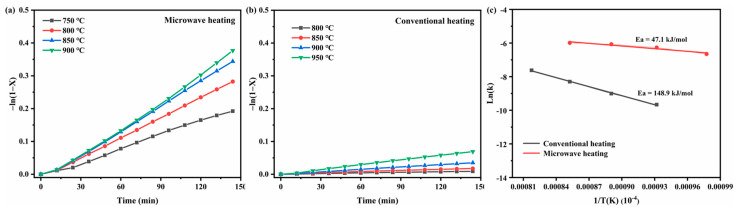
The conversion of CO into more synthetically flexible CO is an effective and potential method for CO remediation, utilization and carbon emission reduction. In this paper, the reaction of carbon-carbon dioxide (the Boudouard reaction) was performed in a microwave fixed bed reactor using semi-coke (SC) as both the microwave absorber and reactant and was systematically compared with that heated in a conventional thermal field. The effects of the heating source, SC particle size, CO flow rate and additives on CO conversion and CO output were investigated. By microwave heating (MWH), CO conversion reached more than 99% while by conventional heating (CH), the maximum conversion of CO was approximately 29% at 900 °C. Meanwhile, for the reaction with 5 wt% barium carbonate added as a promoter, the reaction temperature was significantly reduced to 750 °C with an almost quantitative conversion of CO. Further kinetic calculations showed that the apparent activation energy of the reaction under microwave heating was 46.3 kJ/mol, which was only one-third of that observed under conventional heating. The microwave-assisted Boudouard reaction with catalytic barium carbonate is a promising method for carbon dioxide utilization.
将 CO 转化为更具合成灵活性的 CO 是一种有效且有潜力的 CO 减排、利用和减排方法。本文在微波固定床反应器中使用半焦(SC)作为微波吸收剂和反应物进行了碳-二氧化碳(博多反应)反应,并与常规热场加热进行了系统比较。考察了加热源、SC 粒径、CO 流速和添加剂对 CO 转化率和 CO 产量的影响。通过微波加热(MWH),CO 转化率超过 99%,而通过常规加热(CH),在 900°C 时 CO 的最大转化率约为 29%。同时,对于添加 5wt%碳酸钡作为促进剂的反应,反应温度显著降低至 750°C,CO 几乎定量转化。进一步的动力学计算表明,微波加热下反应的表观活化能为 46.3 kJ/mol,仅为常规加热下观察到的三分之一。具有催化碳酸钡的微波辅助博多反应是一种有前途的二氧化碳利用方法。