Institute of Pharmacy, Pharmaceutical and Medicinal Chemistry, Freie Universität Berlin, Königin-Luise-Straße 2+4, 14195 Berlin, Germany.
Laboratorio Antidoping FMSI, Largo Giulio Onesti 1, 00197 Rome, Italy.
Molecules. 2021 Mar 3;26(5):1354. doi: 10.3390/molecules26051354.
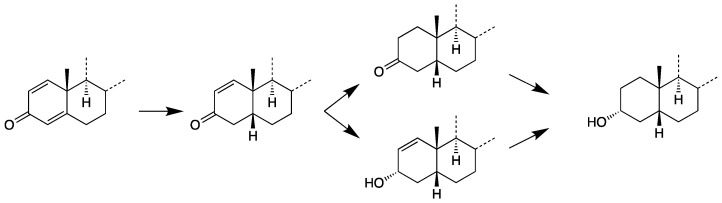
Metandienone and methyltestosterone are orally active anabolic-androgenic steroids with a 17α-methyl structure that are prohibited in sports but are frequently detected in anti-doping analysis. Following the previously reported detection of long-term metabolites with a 17ξ-hydroxymethyl-17ξ-methyl-18-nor-5ξ-androst-13-en-3ξ-ol structure in the chlorinated metandienone analog dehydrochloromethyltestosterone ("oral turinabol"), in this study we investigated the formation of similar metabolites of metandienone and 17α-methyltestosterone with a rearranged D-ring and a fully reduced A-ring. Using a semi-targeted approach including the synthesis of reference compounds, two diastereomeric substances, viz. 17α-hydroxymethyl-17β-methyl-18-nor-5β-androst-13-en-3α-ol and its 5α-analog, were identified following an administration of methyltestosterone. In post-administration urines of metandienone, only the 5β-metabolite was detected. Additionally, 3α,5β-tetrahydro-epi-methyltestosterone was identified in the urines of both administrations besides the classical metabolites included in the screening procedures. Besides their applicability for anti-doping analysis, the results provide new insights into the metabolism of 17α-methyl steroids with respect to the order of reductions in the A-ring, the participation of different enzymes, and alterations to the D-ring.
美雄酮和甲睾酮是具有 17α-甲基结构的口服活性同化雄性甾体激素,在运动中被禁止,但在反兴奋剂分析中经常被检测到。在先前报道的氯代美雄酮类似物去氯甲基睾酮(“口服特力补”)中检测到具有 17ξ-羟甲基-17ξ-甲基-18-降-5ξ-雄甾-13-烯-3ξ-醇结构的长期代谢物之后,在这项研究中,我们研究了美雄酮和 17α-甲基睾酮具有重排的 D 环和完全还原的 A 环的类似代谢物的形成。使用包括合成参考化合物的半靶向方法,在给予甲睾酮后,鉴定出两种非对映异构体物质,即 17α-羟甲基-17β-甲基-18-降-5β-雄甾-13-烯-3α-醇及其 5α-类似物。在美雄酮给药后的尿液中,仅检测到 5β-代谢物。此外,除了筛选程序中包含的经典代谢物外,在两种给药的尿液中还鉴定出 3α,5β-四氢-表甲基睾酮。除了它们在反兴奋剂分析中的适用性外,这些结果还提供了对具有 17α-甲基结构的甾体激素代谢的新见解,涉及 A 环的还原顺序、不同酶的参与以及 D 环的改变。