The Key Laboratory of Model Animals and Stem Cell Biology in Hunan Province, School of Medicine, Hunan Normal University, 371 Tongzipo Road, Changsha 410013, China.
The NHC Key Laboratory of Male Reproduction and Genetics, Family Planning Research Institute of Guangdong Province, Guangzhou 510600, China.
Cells. 2021 Mar 17;10(3):666. doi: 10.3390/cells10030666.
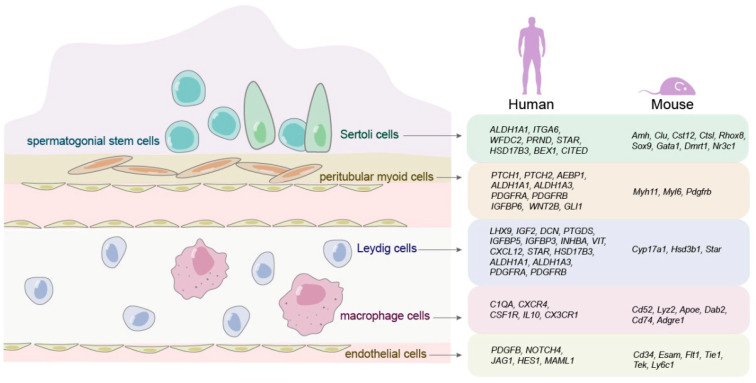
Spermatogenesis is a complex and dynamic process which is precisely controlledby genetic and epigenetic factors. With the development of new technologies (e.g., single-cell RNA sequencing), increasingly more regulatory genes related to spermatogenesis have been identified. In this review, we address the roles and mechanisms of novel genes in regulating the normal and abnormal spermatogenesis. Specifically, we discussed the functions and signaling pathways of key new genes in mediating the proliferation, differentiation, and apoptosis of rodent and human spermatogonial stem cells (SSCs), as well as in controlling the meiosis of spermatocytes and other germ cells. Additionally, we summarized the gene regulation in the abnormal testicular microenvironment or the niche by Sertoli cells, peritubular myoid cells, and Leydig cells. Finally, we pointed out the future directions for investigating the molecular mechanisms underlying human spermatogenesis. This review could offer novel insights into genetic regulation in the normal and abnormal spermatogenesis, and it provides new molecular targets for gene therapy of male infertility.
精子发生是一个复杂而动态的过程,受到遗传和表观遗传因素的精确控制。随着新技术(例如单细胞 RNA 测序)的发展,越来越多与精子发生相关的调节基因被鉴定出来。在这篇综述中,我们探讨了新型基因在调节正常和异常精子发生中的作用和机制。具体而言,我们讨论了关键新基因在调节啮齿动物和人类精原干细胞(SSC)的增殖、分化和凋亡,以及调控精母细胞和其他生殖细胞的减数分裂中的功能和信号通路。此外,我们总结了睾丸支持细胞、小管周肌样细胞和间质细胞在异常睾丸微环境或小生境中对基因的调控作用。最后,我们指出了研究人类精子发生分子机制的未来方向。本综述为正常和异常精子发生的遗传调控提供了新的见解,并为男性不育的基因治疗提供了新的分子靶点。