Department of Microbiology and Immunology, Institute of Biomedicine, Sahlgrenska Academy, University of Gothenburg, 405 30 Gothenburg, Sweden.
Bioscience In Vivo, Research and Early Development, Respiratory & Immunology, BioPharmaceuticals R&D, AstraZeneca, 405 30 Gothenburg, Sweden.
Int J Mol Sci. 2021 Mar 17;22(6):3084. doi: 10.3390/ijms22063084.
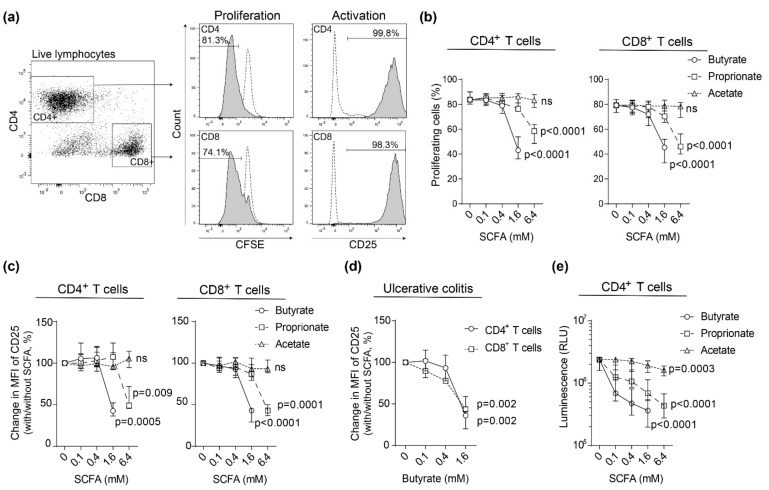
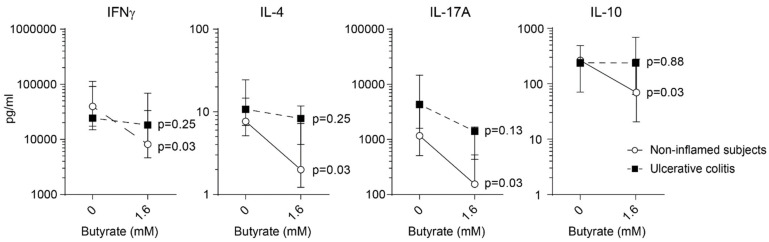
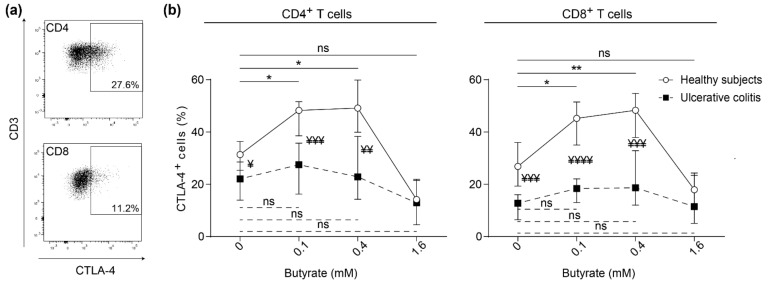
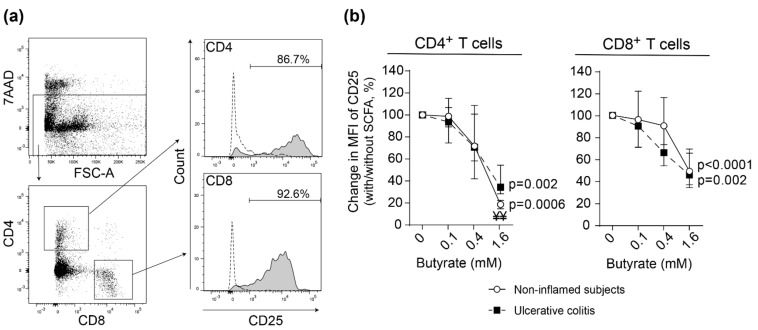
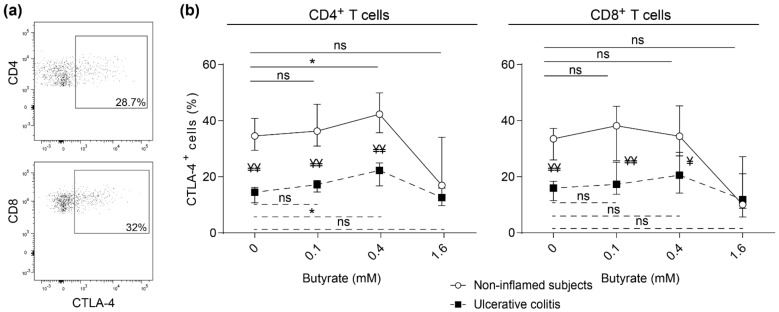
Patients with ulcerative colitis (UC) have reduced intestinal levels of short-chain fatty acids (SCFAs), including butyrate, which are important regulators of host-microbiota crosstalk. The aim was therefore to determine effects of butyrate on blood and intestinal T cells from patients with active UC. T cells from UC patients and healthy subjects were polyclonally stimulated together with SCFAs and proliferation, activation, cytokine secretion, and surface expression of cytotoxic T lymphocyte-associated antigen-4 (CTLA-4) were analyzed. Butyrate induced comparable, dose dependent inhibition of activation and proliferation in blood T cells and activation in intestinal T cells from UC patients and healthy subjects. However, surface expression of the inhibitory molecule CTLA-4 on stimulated blood and intestinal T cells was impaired in UC patients and was not restored following butyrate treatment. Furthermore, unlike intestinal T cells from healthy subjects, butyrate was unable to downregulate secretion of interferon gamma (IFNγ), interleukin (IL)-4, IL-17A, and IL-10 in UC patients. Although seemingly normal inhibitory effects on T cell activation and proliferation, butyrate has an impaired ability to reduce cytokine secretion and induce surface expression of CTLA-4 in T cells from UC patients with active disease. Overall, these observations indicate a dysfunction in butyrate induced immune regulation linked to CTLA-4 signaling in T cells from UC patients during a flare.
溃疡性结肠炎(UC)患者的肠道短链脂肪酸(SCFA)水平降低,包括丁酸,丁酸是宿主-微生物群相互作用的重要调节剂。因此,本研究旨在确定丁酸对活动期 UC 患者血液和肠道 T 细胞的影响。将 UC 患者和健康受试者的 T 细胞与 SCFA 一起进行多克隆刺激,分析增殖、激活、细胞因子分泌和细胞毒性 T 淋巴细胞相关抗原-4(CTLA-4)的表面表达。丁酸诱导 UC 患者和健康受试者的血液 T 细胞和肠道 T 细胞的激活和增殖呈剂量依赖性抑制,但 CTLA-4 抑制分子在 UC 患者的刺激血液和肠道 T 细胞上的表面表达受损,且经丁酸处理后未恢复。此外,与健康受试者的肠道 T 细胞不同,丁酸不能下调 UC 患者 IFNγ、IL-4、IL-17A 和 IL-10 的分泌。尽管丁酸对 T 细胞的激活和增殖有明显的正常抑制作用,但在活动期 UC 患者的 T 细胞中,丁酸降低细胞因子分泌和诱导 CTLA-4 表面表达的能力受损。总之,这些观察结果表明,在 UC 患者疾病发作期间,丁酸诱导的免疫调节与 CTLA-4 信号转导有关,存在功能障碍。