Nakajo Ko, Nishiura Hiroshi
Kyoto University School of Public Health, Yoshida-Konoe-cho, Sakyo-ku, Kyoto 606-8501, Japan.
Graduate School of Medicine, Hokkaido University, Kita 15 Jo Nishi 7 Chome, Kita-ku, Sapporo-shi, Hokkaido 060-8638, Japan.
J Clin Med. 2021 Mar 18;10(6):1256. doi: 10.3390/jcm10061256.
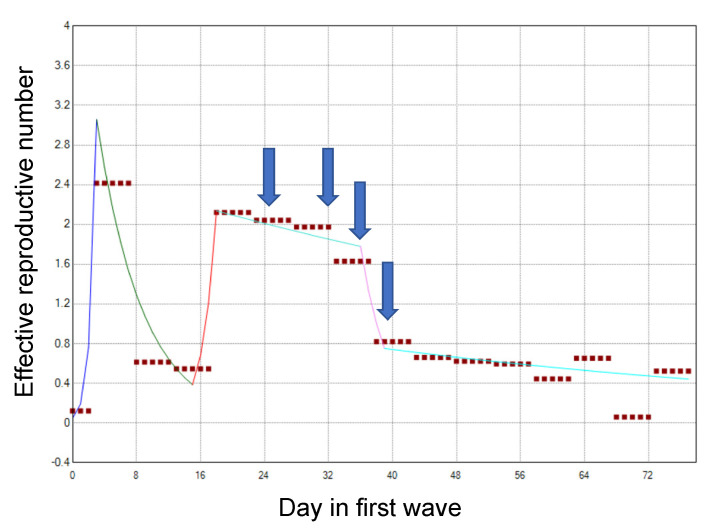
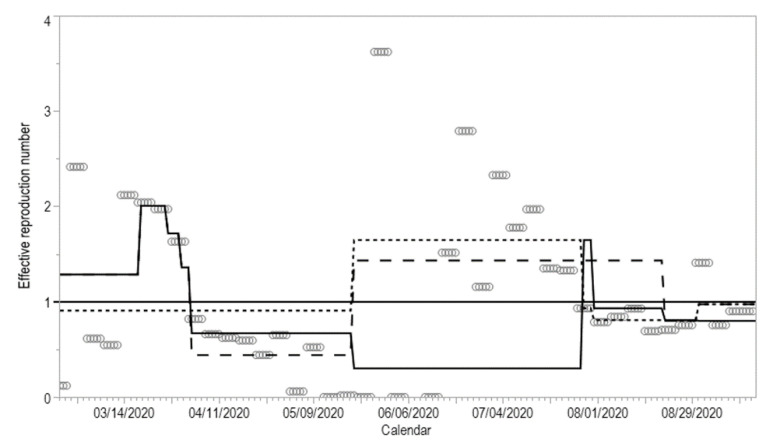
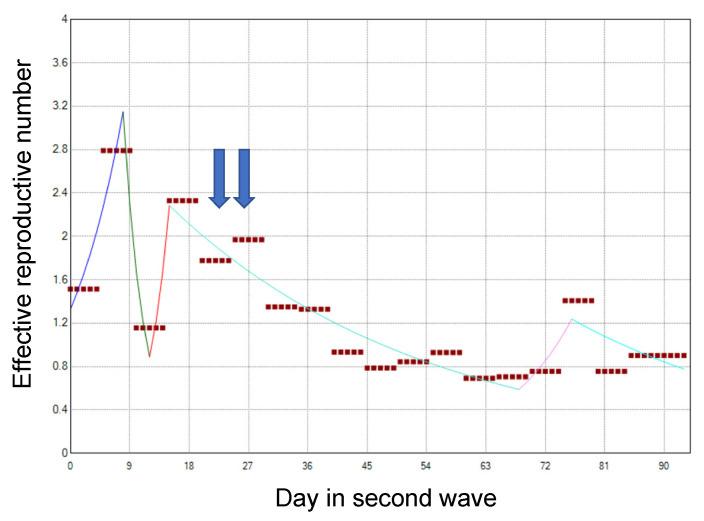
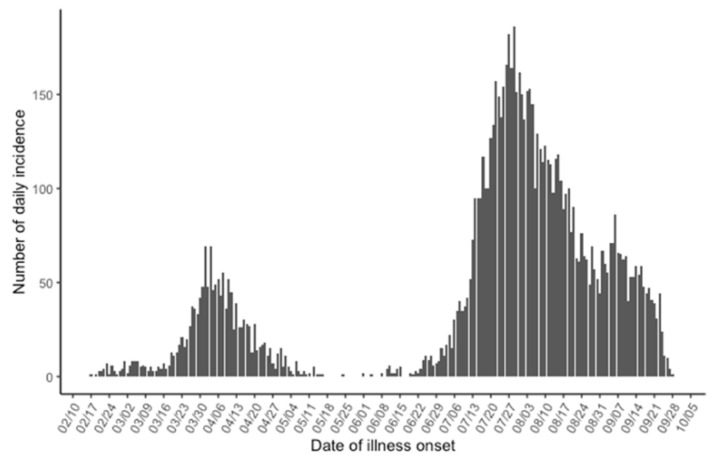
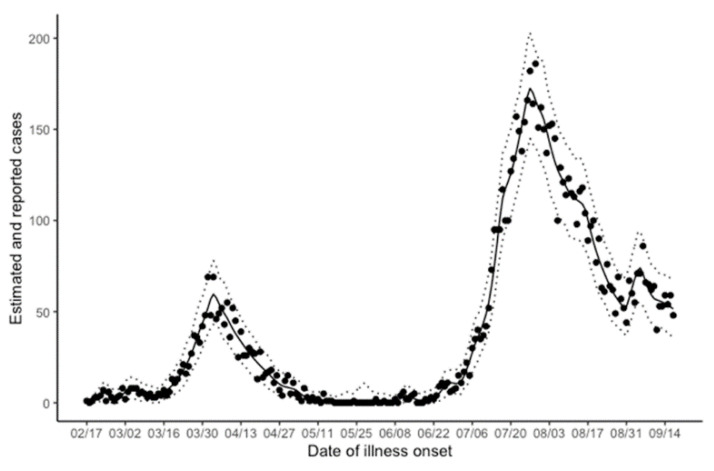
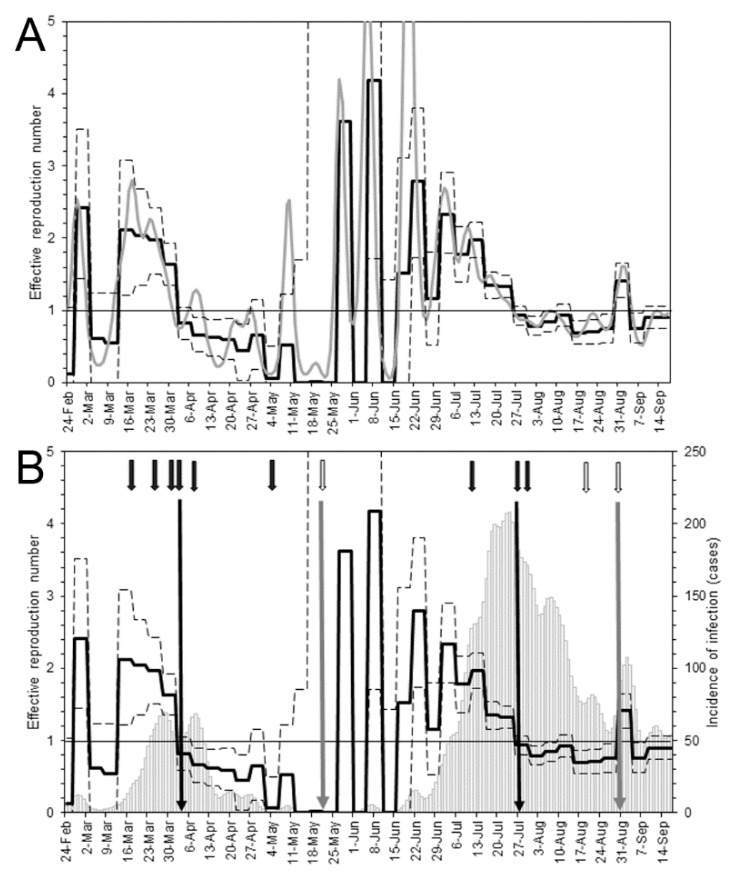
Estimation of the effective reproduction number, (), of coronavirus disease (COVID-19) in real-time is a continuing challenge. () reflects the epidemic dynamics based on readily available illness onset data, and is useful for the planning and implementation of public health and social measures. In the present study, we proposed a method for computing the () of COVID-19, and applied this method to the epidemic in Osaka prefecture from February to September 2020. We estimated () as a function of the time of infection using the date of illness onset. The epidemic in Osaka came under control around 2 April during the first wave, and 26 July during the second wave. () did not decline drastically following any single intervention. However, when multiple interventions were combined, the relative reductions in () during the first and second waves were 70% and 51%, respectively. Although the second wave was brought under control without declaring a state of emergency, our model comparison indicated that relying on a single intervention would not be sufficient to reduce () < 1. The outcome of the COVID-19 pandemic continues to rely on political leadership to swiftly design and implement combined interventions capable of broadly and appropriately reducing contacts.
实时估计冠状病毒病(COVID-19)的有效繁殖数()是一项持续的挑战。()基于易于获得的发病数据反映疫情动态,对公共卫生和社会措施的规划与实施很有用。在本研究中,我们提出了一种计算COVID-19()的方法,并将此方法应用于2020年2月至9月大阪府的疫情。我们使用发病日期将()估计为感染时间的函数。大阪的疫情在第一波于4月2日左右得到控制,第二波于7月26日得到控制。()在任何单一干预后都没有急剧下降。然而,当多种干预措施结合时,第一波和第二波期间()的相对降幅分别为70%和51%。尽管第二波疫情在未宣布紧急状态的情况下得到了控制,但我们的模型比较表明,仅依靠单一干预不足以将()降至<1。COVID-19大流行的结果仍然依赖于政治领导力,以迅速设计和实施能够广泛且适当地减少接触的联合干预措施。