Nicoletti Arturo, Pregel Paola, Starvaggi Cucuzza Laura, Cannizzo Francesca Tiziana, Sereno Alessandra, Scaglione Frine Eleonora
Department of Veterinary Sciences, University of Turin, Largo P. Braccini 2, 10095 Grugliasco, Italy.
Animals (Basel). 2021 Mar 1;11(3):649. doi: 10.3390/ani11030649.
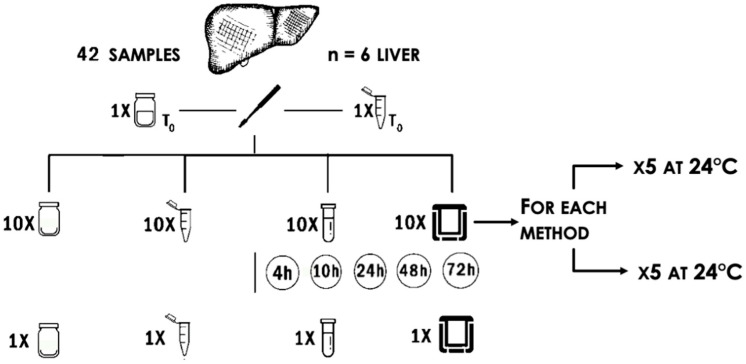
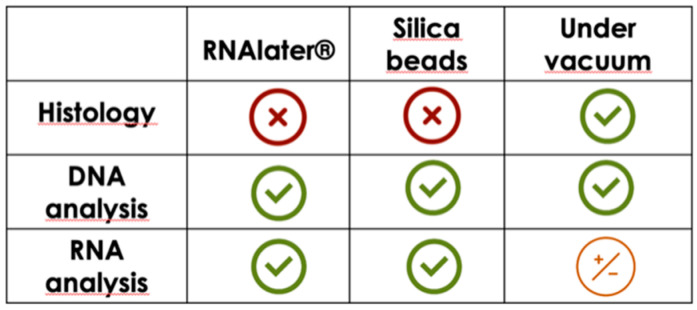
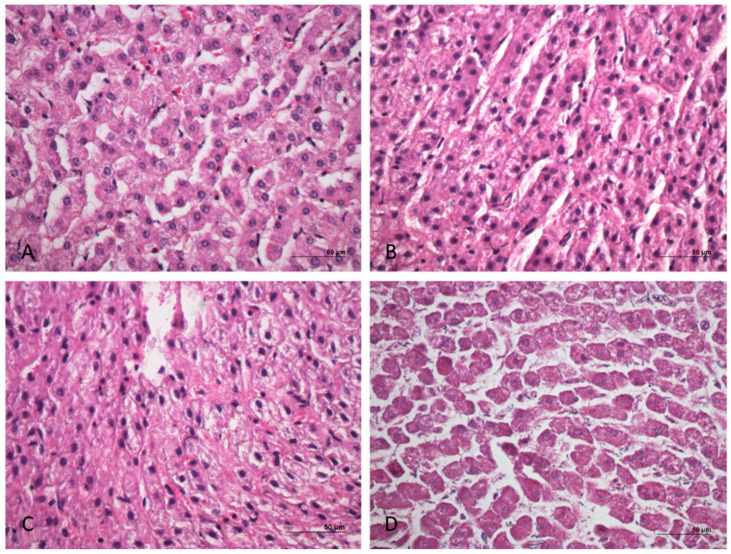
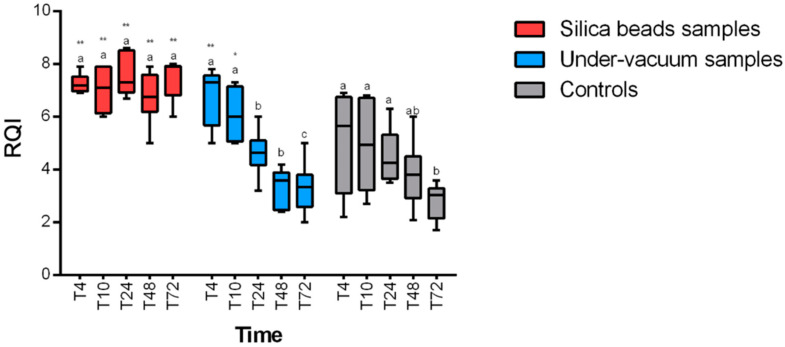
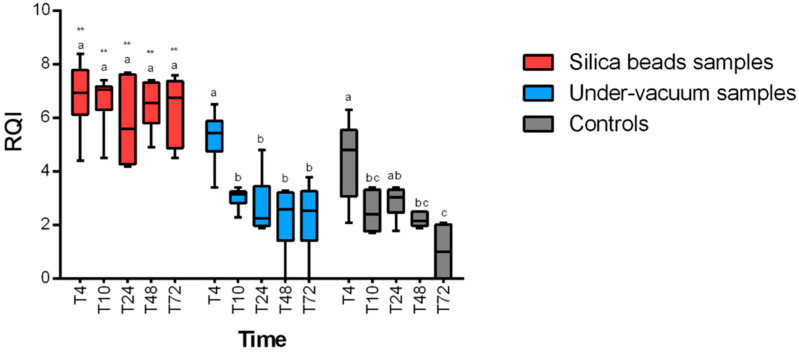
A high quality of samples is crucial for the success of the analysis and diagnostic purposes, and therefore the right method of conservation is vitally important for an optimal preservation of tissues. Indeed, the time to deliver the sample to the laboratory could be remarkably long, especially under suboptimal conditions, and the use of specific fixatives or cold storage may not be possible. Moreover, the portability and cost of storage equipment, their toxicity, and their ease of use play a central role when choosing the correct preservation method. The aim of this study was the identification of a reliable and economic method for tissue preservation, to be used in "in-field" sampling, suitable for both histological and molecular analysis. Punch biopsies were collected from six cattle livers. Comparisons among methods of preservation using RNAlater, silica beads, and under-vacuum was carried out. These methods were tested through considering different times and temperatures, assuming three days as a maximum time interval from sampling to laboratory and choosing 4 °C and 24 °C as references for refrigeration temperature and room temperature, respectively. Histologically, the integrity of nucleus, cytoplasm, preservation of liver structure, and easiness of recognition of inflammatory infiltrate were evaluated. The integrity of the extracted DNA and RNA was evaluated through PCR and by means of an automated electrophoresis station, respectively. RNAlater and silica beads poorly preserved the histological parameters evaluated, independently from the temperature. Conversely, the vacuum-sealed samples showed a good grade of preservation until 48 h. DNA quality was acceptable for each sample. RNA integrity showed promising results only for samples preserved with silica beads.
高质量的样本对于分析和诊断目的的成功至关重要,因此正确的保存方法对于组织的最佳保存至关重要。实际上,将样本送到实验室的时间可能非常长,尤其是在不理想的条件下,而且可能无法使用特定的固定剂或进行冷藏。此外,在选择正确的保存方法时,存储设备的便携性、成本、毒性及其易用性起着核心作用。本研究的目的是确定一种可靠且经济的组织保存方法,用于“现场”采样,适用于组织学和分子分析。从六个牛肝脏中采集了打孔活检样本。对使用RNA Later、硅胶珠和真空保存方法进行了比较。通过考虑不同的时间和温度来测试这些方法,假设从采样到实验室的最长时间间隔为三天,并分别选择4℃和24℃作为冷藏温度和室温的参考。在组织学上,评估了细胞核、细胞质的完整性、肝脏结构的保存以及炎性浸润的识别难易程度。分别通过PCR和自动电泳仪评估了提取的DNA和RNA的完整性。无论温度如何,RNA Later和硅胶珠对所评估的组织学参数保存不佳。相反,真空密封的样本在48小时内显示出良好的保存等级。每个样本的DNA质量均可接受。仅对于用硅胶珠保存的样本,RNA完整性显示出有希望的结果。