Drug Delivery, Disposition and Dynamics, Monash Institute of Pharmaceutical Sciences, Monash University, Melbourne 3800, Australia.
Department of Biochemistry and Molecular Biology, Monash Biomedicine Discovery Institute, Melbourne 3800, Australia.
Int J Mol Sci. 2021 Mar 24;22(7):3310. doi: 10.3390/ijms22073310.
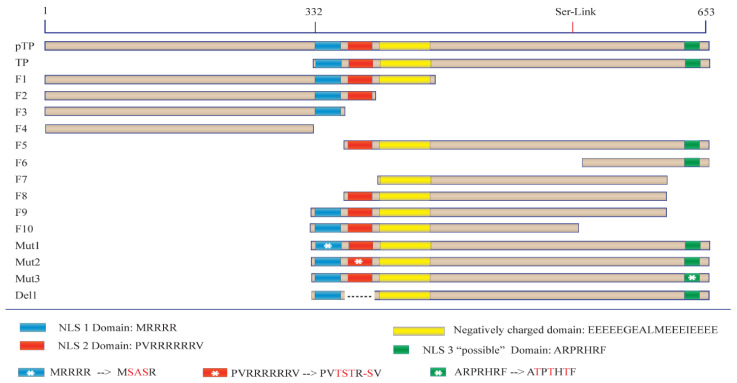
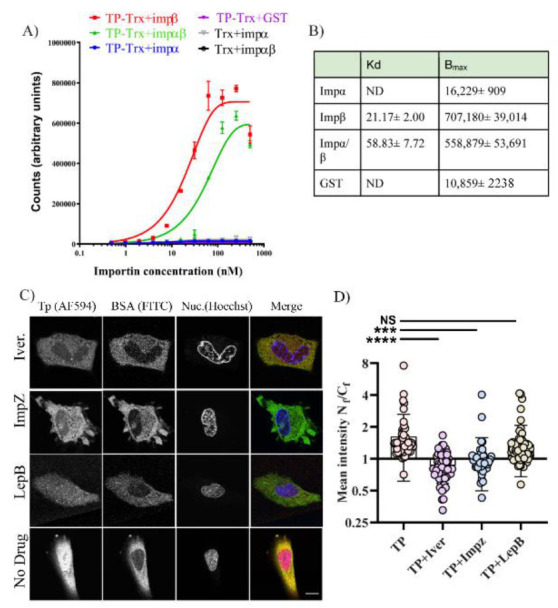
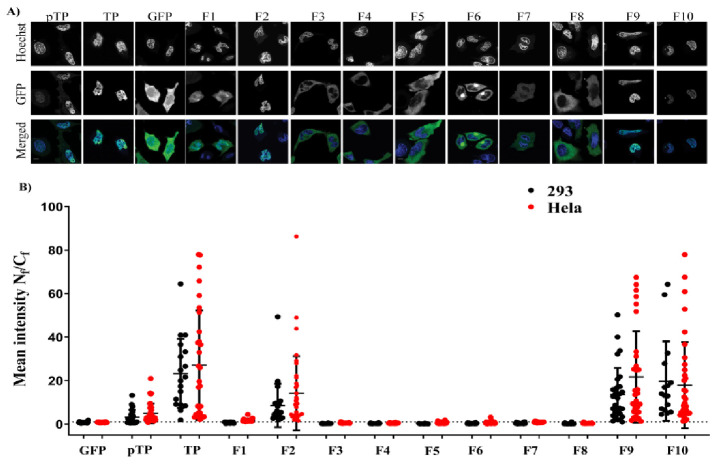
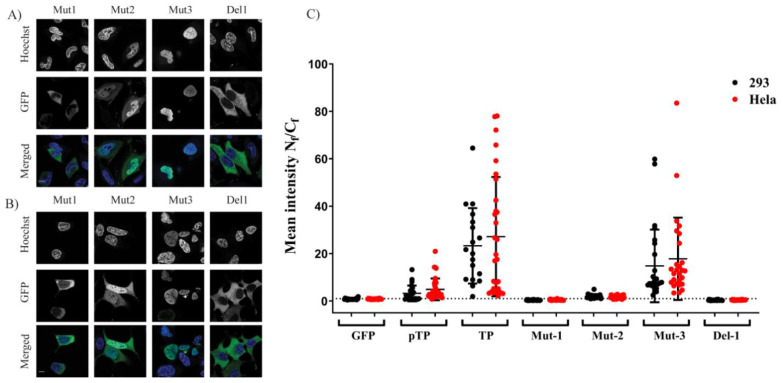
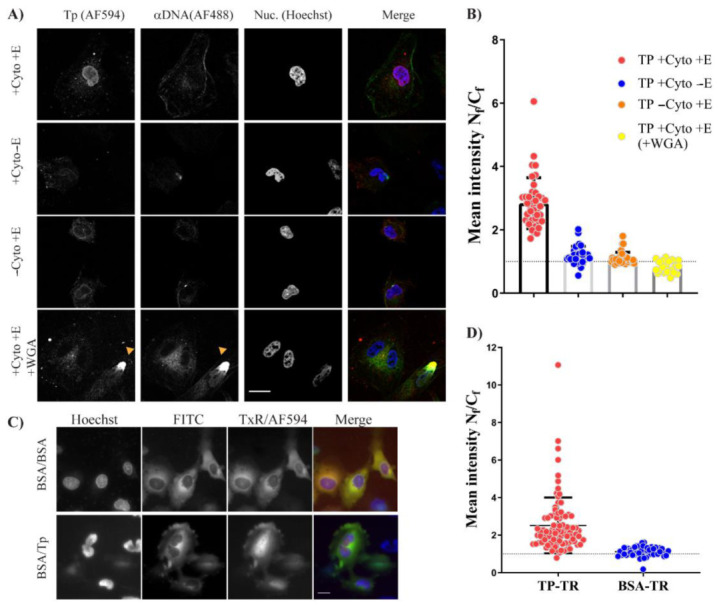
Adenoviruses contain dsDNA covalently linked to a terminal protein (TP) at the 5'end. TP plays a pivotal role in replication and long-lasting infectivity. TP has been reported to contain a nuclear localisation signal (NLS) that facilitates its import into the nucleus. We studied the potential NLS motifs within TP using molecular and cellular biology techniques to identify the motifs needed for optimum nuclear import. We used confocal imaging microscopy to monitor the localisation and nuclear association of GFP fusion proteins. We identified two nuclear localisation signals, PV(R)6VP and MRRRR, that are essential for fully efficient TP nuclear entry in transfected cells. To study TP-host interactions further, we expressed TP in (). Nuclear uptake of purified protein was determined in digitonin-permeabilised cells. The data confirmed that nuclear uptake of TP requires active transport using energy and shuttling factors. This mechanism of nuclear transport was confirmed when expressed TP was microinjected into living cells. Finally, we uncovered the nature of TP binding to host nuclear shuttling proteins, revealing selective binding to Imp β, and a complex of Imp α/β but not Imp α alone. TP translocation to the nucleus could be inhibited using selective inhibitors of importins. Our results show that the bipartite NLS is required for fully efficient TP entry into the nucleus and suggest that this translocation can be carried out by binding to Imp β or Imp α/β. This work forms the biochemical foundation for future work determining the involvement of TP in nuclear delivery of adenovirus DNA.
腺病毒包含共价连接到 5' 端末端蛋白 (TP) 的 dsDNA。TP 在复制和持久感染性中发挥关键作用。据报道,TP 含有一个核定位信号 (NLS),有助于其进入细胞核。我们使用分子和细胞生物学技术研究了 TP 中的潜在 NLS 基序,以确定核输入所需的最佳基序。我们使用共聚焦成像显微镜监测 GFP 融合蛋白的定位和核关联。我们确定了两个核定位信号,PV(R)6VP 和 MRRRR,它们对于在转染细胞中完全有效地进行 TP 核进入是必需的。为了进一步研究 TP-宿主相互作用,我们在 () 中表达了 TP。在去污剂通透细胞中测定纯化蛋白的核摄取。数据证实,TP 的核摄取需要使用能量和穿梭因子进行主动运输。当表达的 TP 被微注射到活细胞中时,证实了这种核转运机制。最后,我们揭示了 TP 与宿主核穿梭蛋白结合的性质,揭示了与 Imp β 的选择性结合,以及 Imp α/β 的复合物,但不是单独的 Imp α。可以使用进口抑制剂选择性抑制 TP 向核的易位。我们的结果表明,二聚体 NLS 是 TP 完全有效地进入细胞核所必需的,并表明这种易位可以通过与 Imp β 或 Imp α/β 结合来完成。这项工作为未来确定 TP 在腺病毒 DNA 的核递送上的参与的生化基础奠定了基础。