Lyu Dongmei, Zajonc Jonathan, Pagé Antoine, Tanney Cailun A S, Shah Ateeq, Monjezi Nadia, Msimbira Levini A, Antar Mohammed, Nazari Mahtab, Backer Rachel, Smith Donald L
Department of Plant Science, Macdonald Campus, McGill University, Montréal, QC H9X 3V9, Canada.
National Research Council Canada, Aquatic and Crop Resource Development (ACRD), Montréal, QC H4P 2R2, Canada.
Microorganisms. 2021 Mar 24;9(4):675. doi: 10.3390/microorganisms9040675.
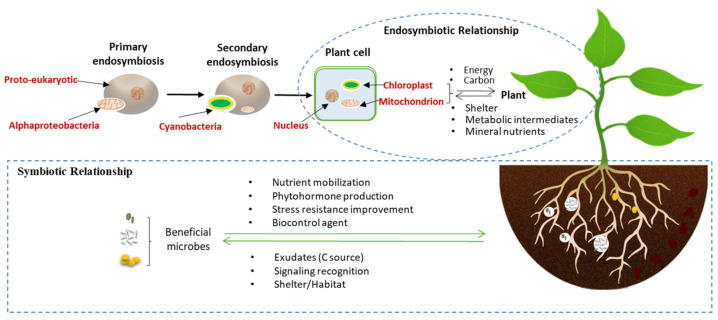
Under natural conditions, plants are always associated with a well-orchestrated community of microbes-the phytomicrobiome. The nature and degree of microbial effect on the plant host can be positive, neutral, or negative, and depends largely on the environment. The phytomicrobiome is integral for plant growth and function; microbes play a key role in plant nutrient acquisition, biotic and abiotic stress management, physiology regulation through microbe-to-plant signals, and growth regulation via the production of phytohormones. Relationships between the plant and phytomicrobiome members vary in intimacy, ranging from casual associations between roots and the rhizosphere microbial community, to endophytes that live between plant cells, to the endosymbiosis of microbes by the plant cell resulting in mitochondria and chloroplasts. If we consider these key organelles to also be members of the phytomicrobiome, how do we distinguish between the two? If we accept the mitochondria and chloroplasts as both members of the phytomicrobiome and the plant (entrained microbes), the influence of microbes on the evolution of plants becomes so profound that without microbes, the concept of the "plant" is not viable. This paper argues that the holobiont concept should take greater precedence in the plant sciences when referring to a host and its associated microbial community. The inclusivity of this concept accounts for the ambiguous nature of the entrained microbes and the wide range of functions played by the phytomicrobiome in plant holobiont homeostasis.
在自然条件下,植物总是与精心编排的微生物群落——植物微生物组相关联。微生物对植物宿主的影响性质和程度可能是积极的、中性的或消极的,并且在很大程度上取决于环境。植物微生物组对于植物生长和功能不可或缺;微生物在植物养分获取、生物和非生物胁迫管理、通过微生物与植物信号进行生理调节以及通过植物激素产生进行生长调节方面发挥着关键作用。植物与植物微生物组成员之间的关系亲密程度各不相同,从根与根际微生物群落之间的偶然关联,到生活在植物细胞之间的内生菌,再到植物细胞对微生物的内共生从而形成线粒体和叶绿体。如果我们认为这些关键细胞器也是植物微生物组的成员,那么我们如何区分这两者呢?如果我们将线粒体和叶绿体既视为植物微生物组的成员又视为植物(共生微生物)的一部分,那么微生物对植物进化的影响就变得如此深远,以至于没有微生物,“植物”的概念就无法成立。本文认为,在提及宿主及其相关微生物群落时,全生物概念在植物科学中应具有更高的优先级。这一概念的包容性解释了共生微生物的模糊性质以及植物微生物组在植物全生物体内稳态中所发挥的广泛功能