Delapaz Noah R, Hor William K, Gilbert Michael, La Andrew D, Liang Feiran, Fan Peihao, Qi Xiguang, Guo Xiaojiang, Ying Jian, Sakolsky Dara, Kirisci Levent, Silverstein Jonathan C, Wang Lirong
University of Pittsburgh School of Pharmacy, Pittsburgh, PA 15213, USA.
Department of Pharmaceutical Sciences, Computational Chemical Genomics Screening Center, University of Pittsburgh School of Pharmacy, Pittsburgh, PA 15213, USA.
J Pers Med. 2021 Mar 4;11(3):178. doi: 10.3390/jpm11030178.
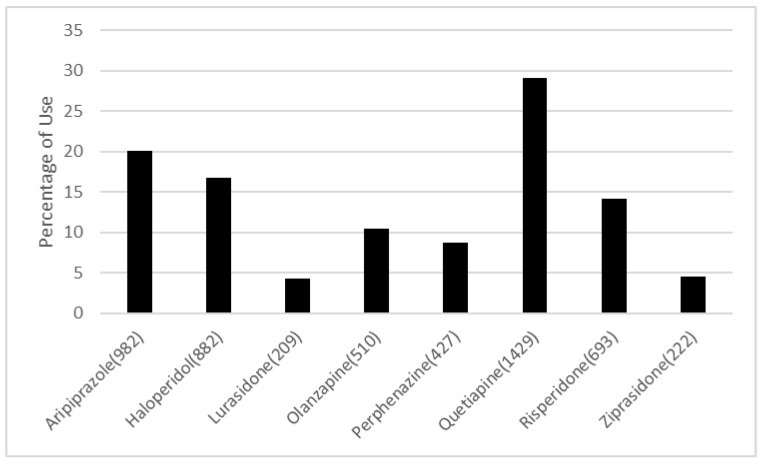
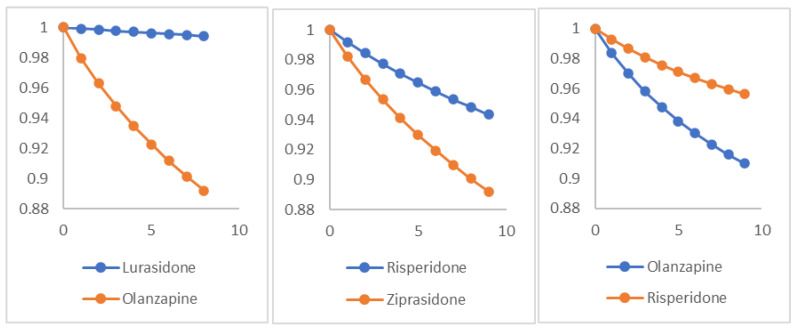
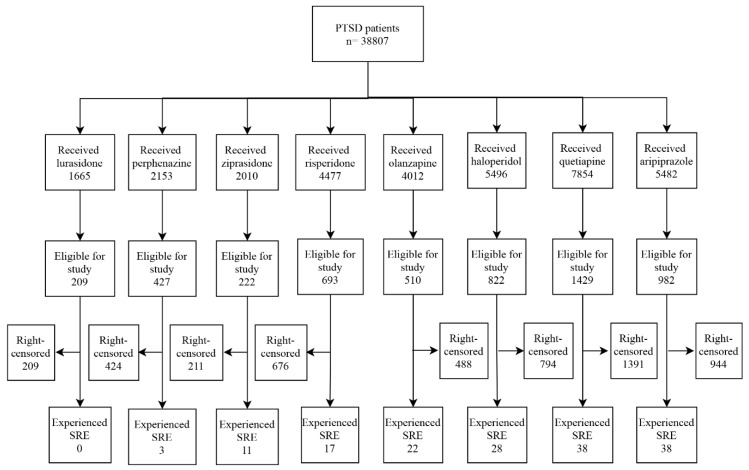
Post-traumatic stress disorder (PTSD) is a prevalent mental disorder marked by psychological and behavioral changes. Currently, there is no consensus of preferred antipsychotics to be used for the treatment of PTSD. We aim to discover whether certain antipsychotics have decreased suicide risk in the PTSD population, as these patients may be at higher risk. A total of 38,807 patients were identified with a diagnosis of PTSD through the ICD9 or ICD10 codes from January 2004 to October 2019. An emulation of randomized clinical trials was conducted to compare the outcomes of suicide-related events (SREs) among PTSD patients who ever used one of eight individual antipsychotics after the diagnosis of PTSD. Exclusion criteria included patients with a history of SREs and a previous history of antipsychotic use within one year before enrollment. Eligible individuals were assigned to a treatment group according to the antipsychotic initiated and followed until stopping current treatment, switching to another same class of drugs, death, or loss to follow up. The primary outcome was to identify the frequency of SREs associated with each antipsychotic. SREs were defined as ideation, attempts, and death by suicide. Pooled logistic regression methods with the Firth option were conducted to compare two drugs for their outcomes using SAS version 9.4 (SAS Institute, Cary, NC, USA). The results were adjusted for baseline characteristics and post-baseline, time-varying confounders. A total of 5294 patients were eligible for enrollment with an average follow up of 7.86 months. A total of 157 SREs were recorded throughout this study. Lurasidone showed a statistically significant decrease in SREs when compared head to head to almost all the other antipsychotics: aripiprazole, haloperidol, olanzapine, quetiapine, risperidone, and ziprasidone ( < 0.0001 and false discovery rate-adjusted value < 0.0004). In addition, olanzapine was associated with higher SREs than quetiapine and risperidone, and ziprasidone was associated with higher SREs than risperidone. The results of this study suggest that certain antipsychotics may put individuals within the PTSD population at an increased risk of SREs, and that careful consideration may need to be taken when prescribed.
创伤后应激障碍(PTSD)是一种以心理和行为改变为特征的常见精神障碍。目前,对于用于治疗PTSD的首选抗精神病药物尚无共识。我们旨在探究某些抗精神病药物是否能降低PTSD患者的自杀风险,因为这些患者可能处于更高风险之中。通过ICD9或ICD10编码,在2004年1月至2019年10月期间共识别出38807例诊断为PTSD的患者。进行了一项模拟随机临床试验,以比较PTSD患者在诊断为PTSD后曾使用八种单独抗精神病药物之一后的自杀相关事件(SREs)结果。排除标准包括有SREs病史以及在入组前一年内有抗精神病药物使用史的患者。符合条件的个体根据起始使用的抗精神病药物被分配到治疗组,并随访至停止当前治疗、换用另一类相同药物、死亡或失访。主要结局是确定与每种抗精神病药物相关的SREs频率。SREs被定义为自杀观念、自杀未遂和自杀死亡。使用SAS 9.4版本(美国北卡罗来纳州卡里的SAS研究所)采用带有Firth选项的汇总逻辑回归方法比较两种药物的结果。结果针对基线特征以及基线后随时间变化的混杂因素进行了调整。共有5294例患者符合入组条件,平均随访7.86个月。在整个研究过程中总共记录了157例SREs。与几乎所有其他抗精神病药物(阿立哌唑、氟哌啶醇、奥氮平、喹硫平、利培酮和齐拉西酮)相比,鲁拉西酮显示出SREs在统计学上有显著降低(<0.0001且错误发现率调整后的值<0.0004)。此外,奥氮平与喹硫平和利培酮相比,与更高的SREs相关,齐拉西酮与利培酮相比,与更高的SREs相关。这项研究的结果表明,某些抗精神病药物可能会使PTSD患者群体中的个体面临更高的SREs风险,并且在开处方时可能需要谨慎考虑。