Sánchez-Sánchez M Luz, Arnal-Gómez Anna, Cortes-Amador Sara, Pérez-Alenda Sofía, Carrasco Juan J, Climent-Toledo Assumpta, Espí-López Gemma Victoria, Ruescas-Nicolau Maria-Arantzazu
Physiotherapy in Motion, Multispeciality Research Group (PTinMOTION), Department of Physiotherapy, University of Valencia, 46010 Valencia, Spain.
Research Unit in Clinical biomechanics-UBIC, Department of Physiotherapy, University of Valencia, 46010 Valencia, Spain.
J Clin Med. 2021 Mar 23;10(6):1320. doi: 10.3390/jcm10061320.
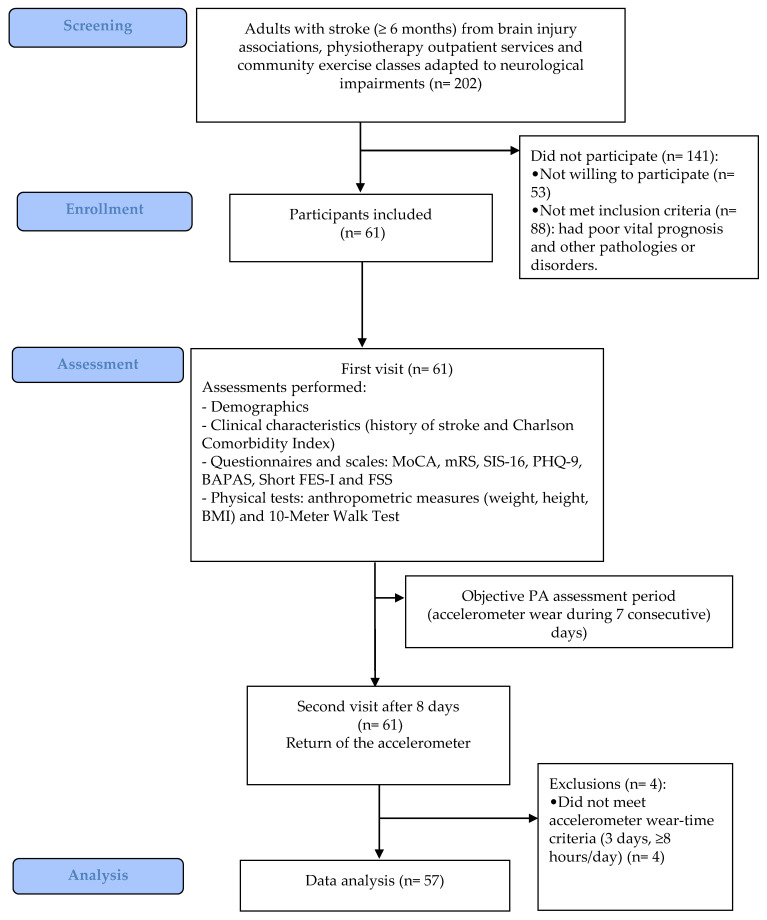
Understanding the fostering factors of physical activity (PA) and sedentary behavior (SB) in post-stroke chronic survivors is critical to address preventive and health interventions. This cross-sectional study aimed to analyze the association of barriers to PA, fear of falling and severity of fatigue encountered by stroke chronic survivors with device-measured PA and SB. Ambulatory community-dwelling post-stroke subjects (≥six months from stroke onset) were evaluated and answered the Barriers to Physical Activity after Stroke Scale (BAPAS), Short Falls Efficacy Scale-International (Short FES-I) and Fatigue Severity Scale (FSS). SB and PA were measured with an Actigraph GT3X+ accelerometer for ≥seven consecutive days. Stepwise multiple linear regression analysis was employed to identify factors associated with PA and SB. Fifty-seven participants (58.2 ± 11.1 years, 37 men) met the accelerometer wear-time criteria (three days, ≥eight h/day). The physical BAPAS score explained 28.7% of the variance of the prolonged sedentary time (β = 0.547; < 0.001). Additionally, the walking speed (β = 0.452) together with physical BAPAS (β = -0.319) explained 37.9% of the moderate-to-vigorous PA time ( < 0.001). In chronic post-stroke survivors, not only the walking speed but, also, the perceived physical barriers to PA are accounted for the SB and PA. Interventions to reverse SB and to involve subjects post-stroke in higher levels of PA should consider these factors.
了解中风后慢性幸存者身体活动(PA)和久坐行为(SB)的促进因素对于实施预防和健康干预至关重要。这项横断面研究旨在分析中风慢性幸存者遇到的PA障碍、跌倒恐惧和疲劳严重程度与设备测量的PA和SB之间的关联。对中风后居住在社区的门诊患者(中风发作后≥6个月)进行评估,并让他们回答中风后身体活动障碍量表(BAPAS)、国际简短跌倒效能量表(Short FES-I)和疲劳严重程度量表(FSS)。使用Actigraph GT3X+加速度计连续≥7天测量SB和PA。采用逐步多元线性回归分析来确定与PA和SB相关的因素。57名参与者(年龄58.2±11.1岁,37名男性)符合加速度计佩戴时间标准(3天,≥8小时/天)。身体BAPAS评分解释了久坐时间延长方差的28.7%(β = 0.547;P < 0.001)。此外,步行速度(β = 0.452)与身体BAPAS(β = -0.319)共同解释了中等到剧烈PA时间的37.9%(P < 0.001)。在中风后慢性幸存者中,不仅步行速度,而且PA的感知身体障碍都与SB和PA有关。旨在扭转SB并使中风后患者参与更高水平PA的干预措施应考虑这些因素。