Hinz Lennart, Metzner Sebastian, Müller Philipp, Schulte Robert, Besserer Hans-Bernward, Wackenrohr Steffen, Sauer Christopher, Kästner Markus, Hausotte Tino, Hübner Sven, Nürnberger Florian, Schleich Benjamin, Behrens Bernd-Arno, Wartzack Sandro, Merklein Marion, Reithmeier Eduard
Institute of Measurement and Automatic Control, Leibniz Universität Hannover (LUH), 30823 Garbsen, Germany.
Institute of Manufacturing Metrology, Friedrich-Alexander-Universität Erlangen-Nürnberg (FAU), 91052 Erlangen, Germany.
Sensors (Basel). 2021 Mar 30;21(7):2389. doi: 10.3390/s21072389.
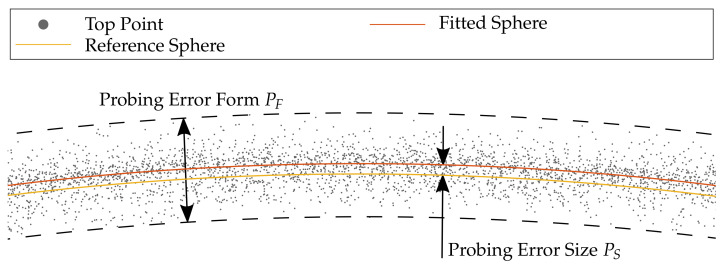
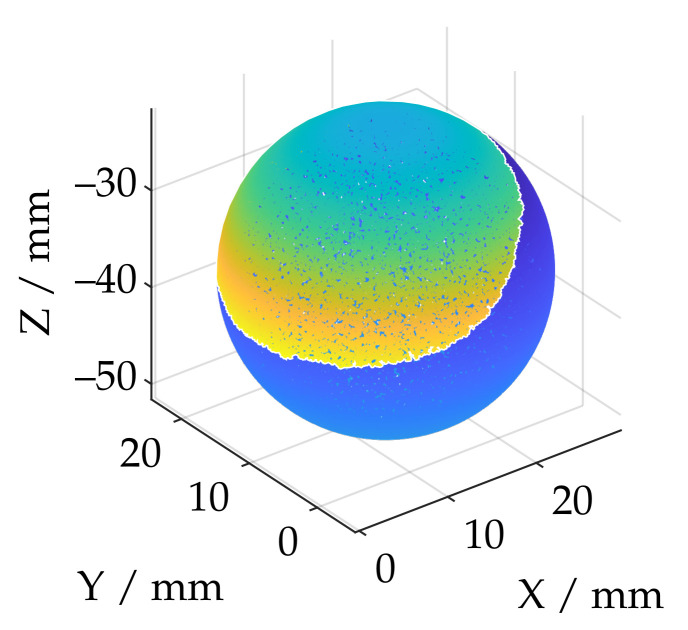
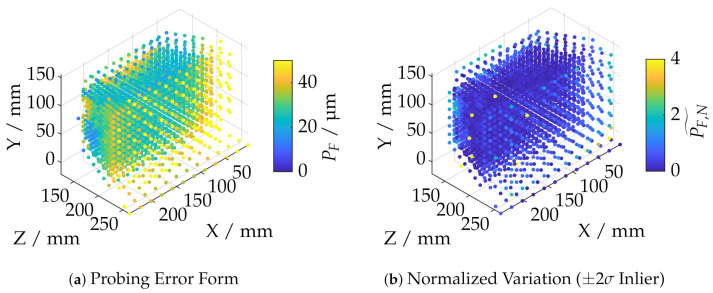
Fringe projection profilometry in combination with other optical measuring technologies has established itself over the last decades as an essential complement to conventional, tactile measuring devices. The non-contact, holistic reconstruction of complex geometries within fractions of a second in conjunction with the lightweight and transportable sensor design open up many fields of application in production metrology. Furthermore, triangulation-based measuring principles feature good scalability, which has led to 3D scanners for various scale ranges. Innovative and modern production processes, such as sheet-bulk metal forming, thus, utilize fringe projection profilometry in many respects to monitor the process, quantify possible wear and improve production technology. Therefore, it is essential to identify the appropriate 3D scanner for each application and to properly evaluate the acquired data. Through precise knowledge of the measurement volume and the relative uncertainty with respect to the specimen and scanner position, adapted measurement strategies and integrated production concepts can be realized. Although there are extensive industrial standards and guidelines for the quantification of sensor performance, evaluation and tolerancing is mainly global and can, therefore, neither provide assistance in the correct, application-specific positioning and alignment of the sensor nor reflect the local characteristics within the measuring volume. Therefore, this article compares fringe projection systems across various scale ranges by positioning and scanning a calibrated sphere in a high resolution grid.
在过去几十年中,条纹投影轮廓测量法与其他光学测量技术相结合,已成为传统触觉测量设备的重要补充。非接触式、能在几分之一秒内对复杂几何形状进行整体重建,再加上轻巧便携的传感器设计,在生产计量领域开辟了许多应用领域。此外,基于三角测量的原理具有良好的可扩展性,这催生了适用于各种规模范围的三维扫描仪。因此,诸如板料-体积金属成型等创新和现代的生产工艺在许多方面都利用条纹投影轮廓测量法来监控工艺、量化可能的磨损并改进生产技术。因此,为每个应用确定合适的三维扫描仪并正确评估采集到的数据至关重要。通过精确了解测量体积以及相对于样本和扫描仪位置的相对不确定度,可以实现适应性测量策略和集成生产概念。尽管有广泛的工业标准和指南用于量化传感器性能,但评估和公差设定主要是全局性的,因此既无法为传感器的正确、特定应用的定位和对准提供帮助,也无法反映测量体积内的局部特征。因此,本文通过在高分辨率网格中定位和扫描校准球体,对各种规模范围的条纹投影系统进行了比较。