Moorfields Eye Hospital NHS Foundation Trust, London EC1V 2PD, UK.
Institute of Ophthalmology, University College London, London EC1V 9EL, UK.
Genes (Basel). 2021 Mar 30;12(4):508. doi: 10.3390/genes12040508.
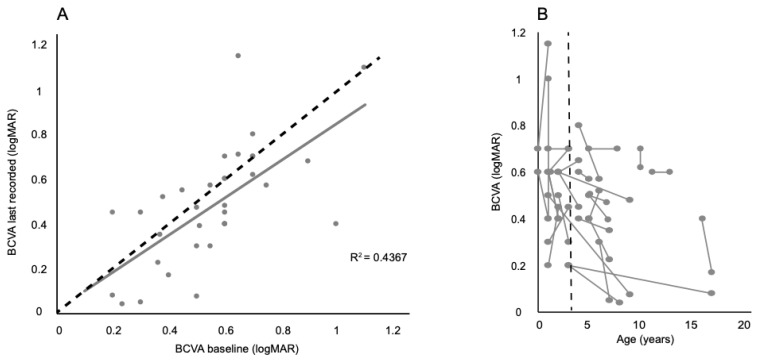
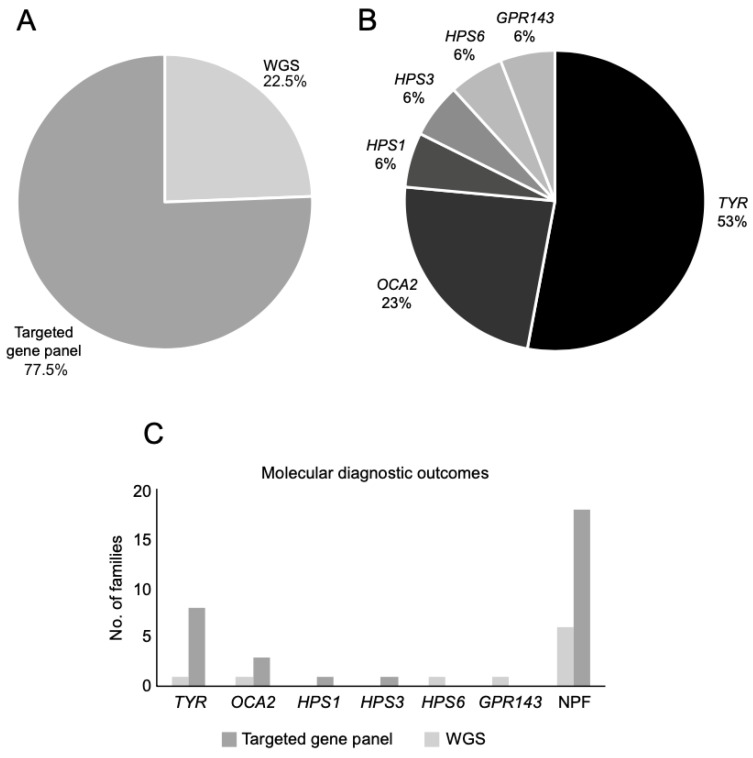
Albinism encompasses a group of hereditary disorders characterized by reduced or absent ocular pigment and variable skin and/or hair involvement, with syndromic forms such as Hermansky-Pudlak syndrome and Chédiak-Higashi syndrome. Autosomal recessive oculocutaneous albinism (OCA) is phenotypically and genetically heterogenous (associated with seven genes). X-linked ocular albinism (OA) is associated with only one gene, . We report the clinical and genetic outcomes of 44 patients, from 40 unrelated families of diverse ethnicities, with query albinism presenting to the ocular genetics service at Moorfields Eye Hospital NHS Foundation Trust between November 2017 and October 2019. Thirty-six were children (≤ 16 years) with a median age of 31 months (range 2-186), and eight adults with a median age of 33 years (range 17-39); 52.3% ( = 23) were male. Genetic testing using whole genome sequencing (WGS, = 9) or a targeted gene panel ( = 31) gave an overall diagnostic rate of 42.5% (44.4% (4/9) with WGS and 41.9% (13/31) with panel testing). Seventeen families had confirmed mutations in ( = 9), , ( = 4), ( = 1), ( = 1), ( = 1), and ( = 1). Molecular diagnosis of albinism remains challenging due to factors such as missing heritability. Differential diagnoses must include -associated foveal hypoplasia and syndromic forms of albinism.
白化病包括一组遗传性疾病,其特征是眼部色素减少或缺失,以及皮肤和/或头发的可变受累,包括 Hermansky-Pudlak 综合征和 Chédiak-Higashi 综合征等综合征形式。常染色体隐性眼皮肤白化病 (OCA) 在表型和遗传上具有异质性(与七个基因相关)。X 连锁眼白化病 (OA) 仅与一个基因相关, 。我们报告了 44 名患者的临床和遗传结果,这些患者来自 40 个不同种族的无亲缘关系的家庭,他们因疑似白化病于 2017 年 11 月至 2019 年 10 月期间在 Moorfields Eye Hospital NHS Foundation Trust 的眼遗传学服务处就诊。36 名是儿童(≤ 16 岁),中位年龄为 31 个月(范围 2-186),8 名是成年人,中位年龄为 33 岁(范围 17-39);52.3%(= 23)是男性。使用全基因组测序 (WGS,= 9) 或靶向基因panel ( = 31) 的基因检测总体诊断率为 42.5%(44.4%(9 例中有 4 例)使用 WGS 和 41.9%(31 例中有 13 例)使用 panel 检测)。17 个家庭在 (= 9)、 (= 4)、 (= 1)、 (= 1)、 (= 1)和 (= 1)中发现了确认的突变。白化病的分子诊断仍然具有挑战性,原因包括遗传缺失等因素。鉴别诊断必须包括与相关的黄斑发育不良和综合征形式的白化病。