Sainz Juan, García-Verdejo Francisco José, Martínez-Bueno Manuel, Kumar Abhishek, Sánchez-Maldonado José Manuel, Díez-Villanueva Anna, Vodičková Ludmila, Vymetálková Veronika, Martin Sánchez Vicente, Da Silva Filho Miguel Inacio, Sampaio-Marques Belém, Brezina Stefanie, Butterbach Katja, Ter Horst Rob, Hoffmeister Michael, Ludovico Paula, Jurado Manuel, Li Yang, Sánchez-Rovira Pedro, Netea Mihai G, Gsur Andrea, Vodička Pavel, Moreno Víctor, Hemminki Kari, Brenner Hermann, Chang-Claude Jenny, Försti Asta
Genomic Oncology Area, GENYO, Centre for Genomics and Oncological Research Pfizer/University of Granada/Andalusian Regional Government, 18016 Granada, Spain.
Hematology Department, Virgen de las Nieves University Hospital, 18012 Granada, Spain.
Cancers (Basel). 2021 Mar 12;13(6):1258. doi: 10.3390/cancers13061258.
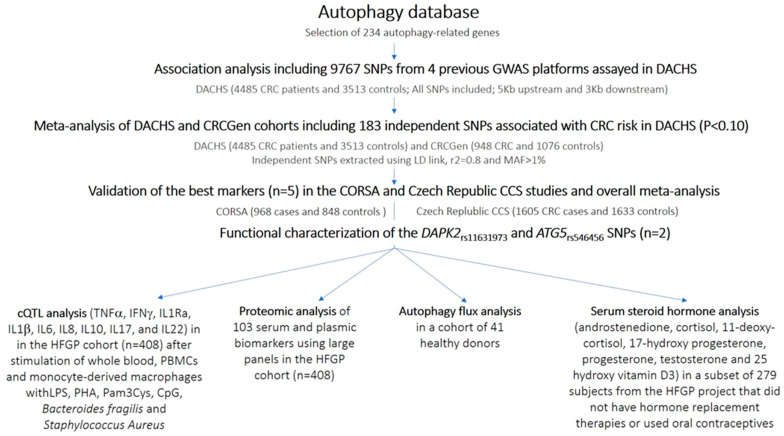
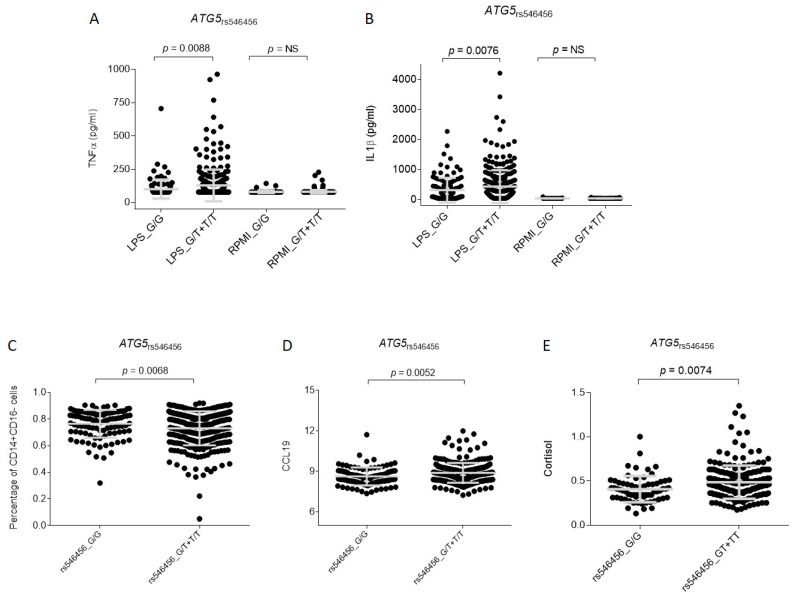
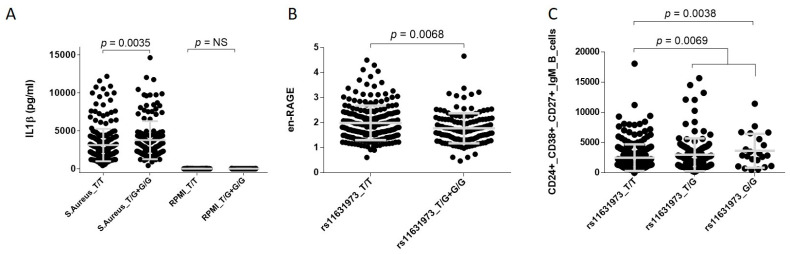
The role of genetic variation in autophagy-related genes in modulating autophagy and cancer is poorly understood. Here, we comprehensively investigated the association of autophagy-related variants with colorectal cancer (CRC) risk and provide new insights about the molecular mechanisms underlying the associations. After meta-analysis of the genome-wide association study (GWAS) data from four independent European cohorts (8006 CRC cases and 7070 controls), two loci, ( = 2.19 × 10) and ( = 6.28 × 10) were associated with the risk of CRC. Mechanistically, the allele was associated with IL1 β levels after the stimulation of peripheral blood mononuclear cells (PBMCs) with ( = 0.002), CD24 + CD38 + CD27 + IgM + B cell levels in blood ( = 0.0038) and serum levels of en-RAGE ( = 0.0068). allele was associated with TNF α and IL1 β levels after the stimulation of PBMCs with LPS ( = 0.0088 and = 0.0076, respectively), CD14+CD16- cell levels in blood ( = 0.0068) and serum levels of CCL19 and cortisol ( = 0.0052 and = 0.0074, respectively). Interestingly, no association with autophagy flux was observed. These results suggested an effect of the and loci in the pathogenesis of CRC, likely through the modulation of host immune responses.
自噬相关基因的遗传变异在调节自噬和癌症中的作用尚不清楚。在这里,我们全面研究了自噬相关变异与结直肠癌(CRC)风险之间的关联,并为这些关联背后的分子机制提供了新的见解。在对来自四个独立欧洲队列(8006例CRC病例和7070例对照)的全基因组关联研究(GWAS)数据进行荟萃分析后,发现两个位点( = 2.19 × 10)和( = 6.28 × 10)与CRC风险相关。从机制上讲, 等位基因与用 刺激外周血单个核细胞(PBMCs)后的IL1β水平相关( = 0.002)、血液中CD24 + CD38 + CD27 + IgM + B细胞水平( = 0.0038)以及血清中en-RAGE水平( = 0.0068)。 等位基因与用脂多糖刺激PBMCs后的TNFα和IL1β水平相关(分别为 = 0.0088和 = 0.0076)、血液中CD14+CD16-细胞水平( = 0.0068)以及血清中CCL19和皮质醇水平(分别为 = 0.0052和 = 0.0074)。有趣的是,未观察到与自噬通量的关联。这些结果表明 位点和 位点在CRC发病机制中起作用,可能是通过调节宿主免疫反应。