Da Broi Michele, Borrelli Paola, Meling Torstein R
Faculty of Medicine, University of Oslo, 0372 Oslo, Norway.
Department of Neurosurgery, Oslo University Hospital, 0372 Oslo, Norway.
Cancers (Basel). 2021 Mar 22;13(6):1451. doi: 10.3390/cancers13061451.
Although gross total resection (GTR) is the goal in meningioma surgery, this can sometimes be difficult to achieve in skull base meningiomas. We analyzed clinical outcomes and predictors of survival for subtotally resected benign meningiomas.
A total of 212 consecutive patients who underwent subtotal resection (STR) for benign skull base meningioma between 1990-2010 were investigated.
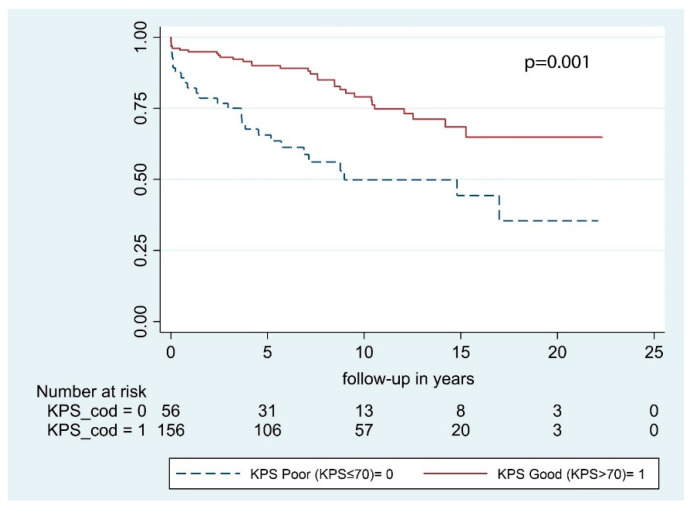
Median age was 57.7 [IQR 18.8] years, median preoperative Karnofsky performance status (KPS) was 80.0 [IQR 20.0], 75 patients (35.4%) had posterior fossa meningioma. After a median follow-up of 6.2 [IQR 7.9] years, retreatment (either radiotherapy or repeated surgery) rate was 16% at 1-year, 27% at 3-years, 34% at 5-years, and 38% at 10-years. Ten patients (4.7%) died perioperatively, 9 (3.5%) had postoperative hematomas, and 2 (0.8%) had postoperative infections. Neurological outcome at final visit was improved/stable in 122 patients (70%). Multivariable analysis identified advanced age and preoperative KPS < 70 as negative predictors for overall survival (OS). Patients who underwent retreatment had no significant reduction of OS.
Advanced age and preoperative KPS were independent predictors of OS. Retreatments did not prolong nor shorten the OS. Clinical outcomes in STR skull base meningiomas were generally worse compared to cohorts with high rates of GTR.
尽管全切除是脑膜瘤手术的目标,但对于颅底脑膜瘤,有时难以实现这一目标。我们分析了次全切除的良性脑膜瘤的临床结局和生存预测因素。
对1990年至2010年间连续212例接受次全切除(STR)的良性颅底脑膜瘤患者进行了研究。
中位年龄为57.7岁[四分位间距(IQR)为18.8岁],术前中位卡诺夫斯基功能状态(KPS)为80.0[IQR为20.0],75例患者(35.4%)患有后颅窝脑膜瘤。中位随访6.2年[IQR为7.9年]后,1年时再次治疗(放疗或再次手术)率为16%,3年时为27%,5年时为34%,10年时为38%。10例患者(4.7%)围手术期死亡,9例(3.5%)发生术后血肿,2例(0.8%)发生术后感染。末次随访时神经功能结局改善/稳定的患者有122例(70%)。多变量分析确定高龄和术前KPS<70是总生存(OS)的负性预测因素。接受再次治疗的患者OS无显著降低。
高龄和术前KPS是OS的独立预测因素。再次治疗既未延长也未缩短OS。与全切除率高的队列相比,STR颅底脑膜瘤的临床结局总体较差。