Adrados Murillo, Wang Kaicheng, Deng Yanhong, Bozzo Janis, Messina Tara, Stevens Amie, Moore Anne, Morris Jensa, O'Connor Mary I
Department of Orthopaedics and Rehabilitation, Yale School of Medicine, New Haven, CT, USA.
Yale Center for Analytical Sciences, Yale School of Public Health, New Haven, CT, USA.
Geriatr Orthop Surg Rehabil. 2021 Mar 24;12:2151459321998615. doi: 10.1177/2151459321998615. eCollection 2021.
Shorter length of stays (LOS) at a Skilled Nursing Facility (SNF) after hip fracture surgery would be expected to lead to costs savings for the healthcare system. Evidence also suggests that shorter SNF stays also leads to improved 30-day outcomes, thus compounding this value proposition. Our Integrated Fragility Hip Fracture Program created a simple algorithm at discharge to provide each post-operative hip fracture patient with an expected SNF LOS. We studied whether this intervention produced a shorter SNF LOS and other observable short-term outcomes.
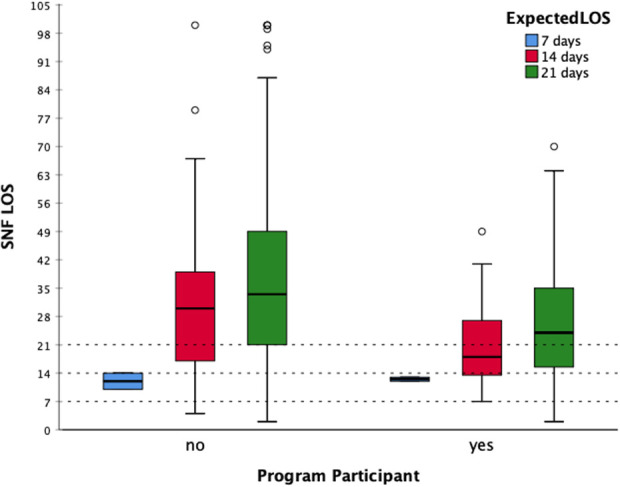
We retrospectively reviewed all original Medicare hip fracture patients treated with operative fixation who were admitted to our hospital in 2015, 2017 and 2018. We selected patients who were discharged to a single SNF following hospitalization, and excluded patients with incomplete records. The algorithm for the expected LOS recommendation was based on the degree of assistance the patient needed for ambulation: 7 days ("0-person assist"), 14 days ("1-person assist"), or 21 days ("2-person assist"). We compare the SNF LOS of our hip fracture patient population between those discharged to a program participant, those SNF that agreed to this algorithm, and those discharged to a non-program participant SNF.
We identified 246 patients meeting our selection criteria. 69 were discharged to a program participant SNF. Patients discharged to a participant SNF had similar baseline demographics and ASA distributions to those discharged to a non-participant provider. There was a statistically significant difference in length of stay between the groups, with program participant patients spending an average of 23 days at the SNF while the control group spent an average of 31 days. (p < 0.001). Program participant discharges were also associated with additional cost savings. There was no significant difference in ED visits within 90 days of discharge.
SNF LOS for geriatric hip fractures can be decreased with implementation of a simple physical therapy driven algorithm based on the patient's ambulatory independence at hospital discharge. : This is a simple, yet completely unique program that seems to have increased the value of healthcare provided.
髋部骨折手术后在熟练护理机构(SNF)的住院时间缩短有望为医疗系统节省成本。有证据还表明,SNF住院时间缩短还能改善30天的治疗效果,从而强化了这一价值主张。我们的综合脆性髋部骨折项目在出院时创建了一个简单算法,为每位术后髋部骨折患者提供预期的SNF住院时间。我们研究了这种干预措施是否能缩短SNF住院时间以及带来其他可观察到的短期结果。
我们回顾性分析了2015年、2017年和2018年在我院接受手术固定治疗的所有原发性医疗保险髋部骨折患者。我们选择了住院后出院至单一SNF的患者,并排除了记录不完整的患者。预期住院时间建议算法基于患者行走所需的协助程度:7天(“无需他人协助”)、14天(“一人协助”)或21天(“两人协助”)。我们比较了出院至项目参与机构的髋部骨折患者群体、同意该算法的SNF机构的患者群体以及出院至非项目参与机构SNF的患者群体的SNF住院时间。
我们确定了246名符合我们选择标准的患者。其中69名出院至项目参与机构的SNF。出院至参与机构SNF的患者与出院至非参与机构的患者在基线人口统计学和美国麻醉医师协会(ASA)分布方面相似。两组之间的住院时间存在统计学显著差异,项目参与机构的患者在SNF平均住院23天,而对照组平均住院31天。(p < 0.001)。项目参与机构的出院还带来了额外的成本节省。出院后90天内的急诊就诊次数没有显著差异。
基于患者出院时的行走独立性,通过实施一种简单的物理治疗驱动算法,可以减少老年髋部骨折患者的SNF住院时间。这是一个简单但完全独特的项目,似乎提高了所提供医疗服务的价值。