Van Houcke Jolien, Mariën Valerie, Zandecki Caroline, Seuntjens Eve, Ayana Rajagopal, Arckens Lutgarde
Laboratory of Neuroplasticity and Neuroproteomics, Department of Biology, KU Leuven, Leuven, Belgium.
Laboratory of Developmental Neurobiology, Department of Biology, KU Leuven, Leuven, Belgium.
Front Cell Dev Biol. 2021 Mar 18;9:619197. doi: 10.3389/fcell.2021.619197. eCollection 2021.
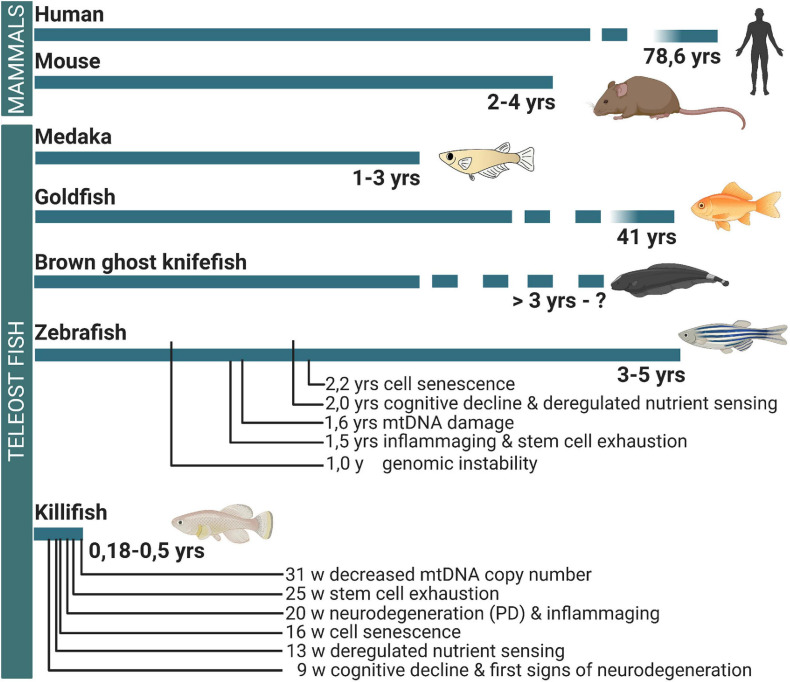
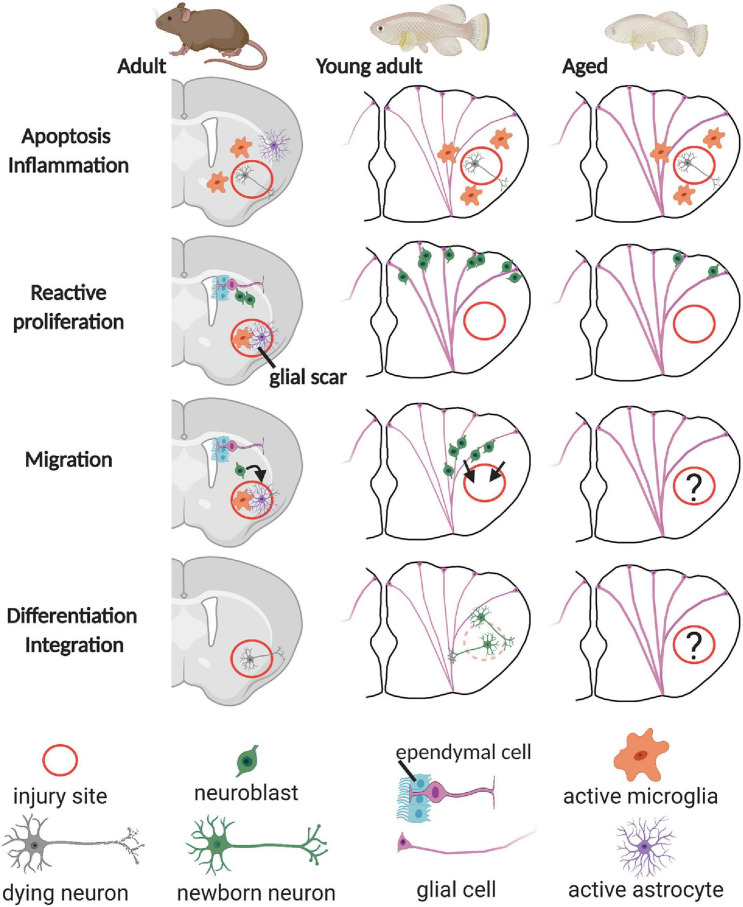
Aging increases the risk for neurodegenerative disease and brain trauma, both leading to irreversible and multifaceted deficits that impose a clear societal and economic burden onto the growing world population. Despite tremendous research efforts, there are still no treatments available that can fully restore brain function, which would imply neuroregeneration. In the adult mammalian brain, neuroregeneration is naturally limited, even more so in an aging context. In view of the significant influence of aging on (late-onset) neurological disease, it is a critical factor in future research. This review discusses the use of a non-standard gerontology model, the teleost brain, for studying the impact of aging on neurorepair. Teleost fish share a vertebrate physiology with mammals, including mammalian-like aging, but in contrast to mammals have a high capacity for regeneration. Moreover, access to large mutagenesis screens empowers these teleost species to fill the gap between established invertebrate and rodent models. As such, we here highlight opportunities to decode the factor age in relation to neurorepair, and we propose the use of teleost fish, and in particular killifish, to fuel new research in the neuro-gerontology field.
衰老会增加神经退行性疾病和脑损伤的风险,这两者都会导致不可逆转的多方面缺陷,给不断增长的世界人口带来明显的社会和经济负担。尽管进行了大量的研究工作,但仍然没有能够完全恢复脑功能(即神经再生)的治疗方法。在成年哺乳动物大脑中,神经再生自然受到限制,在衰老的情况下更是如此。鉴于衰老对(迟发性)神经疾病有重大影响,它是未来研究中的一个关键因素。本综述讨论了使用一种非标准的老年学模型——硬骨鱼脑,来研究衰老对神经修复的影响。硬骨鱼与哺乳动物具有相同的脊椎动物生理学,包括类似哺乳动物的衰老过程,但与哺乳动物不同的是,它们具有很高的再生能力。此外,利用大型诱变筛选技术使这些硬骨鱼物种能够填补已有的无脊椎动物模型和啮齿动物模型之间的空白。因此,我们在此强调了解码与神经修复相关的衰老因素的机会,并建议使用硬骨鱼,特别是鳉鱼,来推动神经老年学领域的新研究。