Reyes-Menendez Ana, Saura Jose Ramon, Filipe Ferrão
Department of Business Economics, Rey Juan Carlos University, Madrid, Spain.
Vice-Rector Universidade Portucalense, Universidade Portucalense Infante D. Henrique, Porto, Portugal.
PeerJ Comput Sci. 2019 Sep 23;5:e219. doi: 10.7717/peerj-cs.219. eCollection 2019.
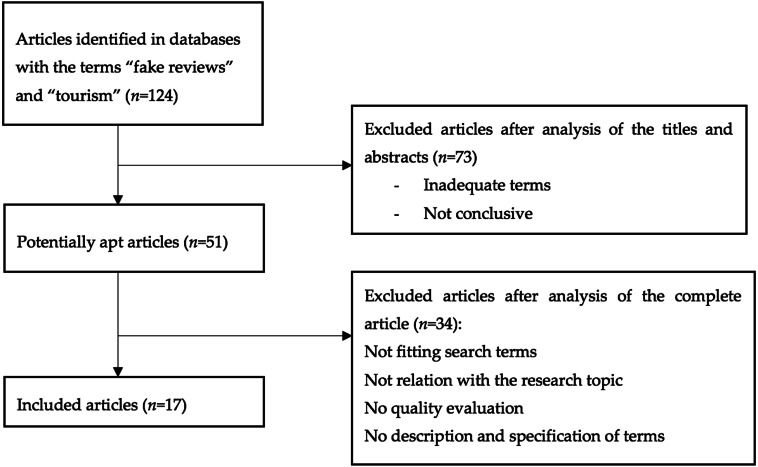
In the last several decades, electronic word of mouth (eWOM) has been widely used by consumers on different digital platforms to gather feedback about products and services from previous customer behavior. However, this useful information is getting blurred by fake reviews-i.e., reviews that were created artificially and are thus not representative of real customer opinions. The present study aims to thoroughly investigate the phenomenon of fake online reviews in the tourism sector on social networking and online reviews sites. To this end, we conducted a systematic review of the literature on fake reviews for tourism businesses. Our focus was on previous studies that addressed the following two main topics: (i) tourism (ii) fake reviews. Scientific databases were used to collect relevant literature. The search terms "tourism" and "fake reviews" were applied. The database of Web of Science produced a total of 124 articles and, after the application of different filters following the PRISMA 2009 Flow diagram, the process resulted in the selection of 17 studies. Our results demonstrate that (i) the analysis of fake reviews is interdisciplinary, ranging from Computer Science to Business and Management, (ii) the methods are based on algorithms and sentiment analysis, while other methodologies are rarely used; and (iii) the current and future state of fraudulent detection is based on emotional approaches, semantic analysis and new technologies such as Blockchain. This study also provides helpful strategies to counteract the ubiquity of fake reviews for tourism businesses.
在过去几十年里,电子口碑(eWOM)已被消费者广泛用于不同的数字平台,以根据以往的客户行为收集有关产品和服务的反馈。然而,这些有用的信息正被虚假评论所模糊,即那些人为制造的评论,因此并不代表真实的客户意见。本研究旨在全面调查社交网络和在线评论网站上旅游业虚假在线评论的现象。为此,我们对有关旅游企业虚假评论的文献进行了系统综述。我们关注的是以往涉及以下两个主要主题的研究:(i)旅游业(ii)虚假评论。利用科学数据库收集相关文献。应用了搜索词“旅游业”和“虚假评论”。科学引文索引数据库共产生了124篇文章,按照2009年系统评价与Meta分析的首选报告项目(PRISMA)流程图应用不同的筛选条件后,最终选定了17项研究。我们的结果表明:(i)对虚假评论的分析具有跨学科性,涵盖从计算机科学到商业与管理等领域;(ii)方法基于算法和情感分析,而其他方法很少使用;(iii)欺诈检测的现状和未来基于情感方法、语义分析以及区块链等新技术。本研究还提供了有助于应对旅游企业虚假评论泛滥问题的策略。