Department of Internal Medicine, Chonnam National University Medical School, Gwangju, Korea.
Endocrinol Metab (Seoul). 2021 Apr;36(2):413-423. doi: 10.3803/EnM.2020.906. Epub 2021 Apr 6.
Thyroid immune-related adverse events (IRAEs) have been reported in patients treated with programmed cell death protein-1 (PD-1) and programmed cell death protein-ligand 1 (PD-L1) inhibitors. We investigated the incidence and clinical course of PD-1/PD-L1 inhibitor-induced thyroid IRAEs, and identified predictable clinical risk factors of thyroid IRAEs, in particular, overt hypothyroidism (OH).
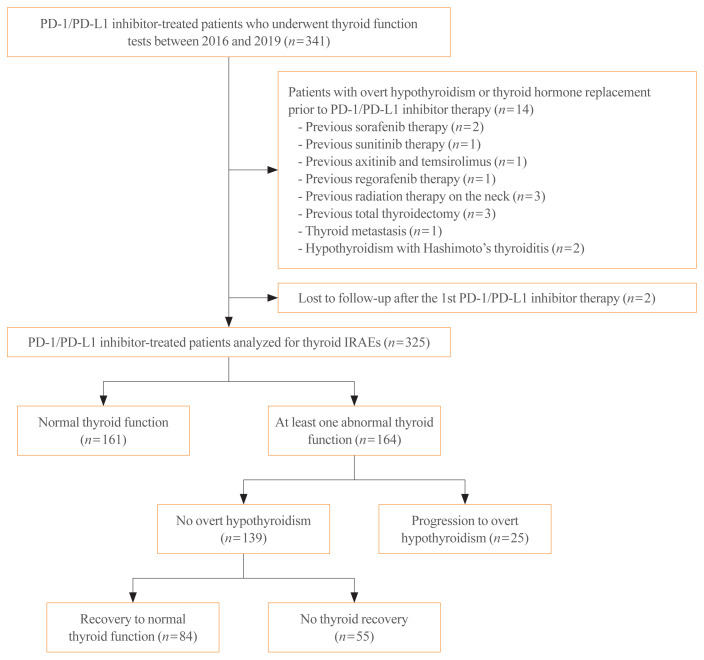
We retrospectively reviewed the medical records of 325 cancer patients receiving PD-1/PD-L1 inhibitor in a tertiary referral center.
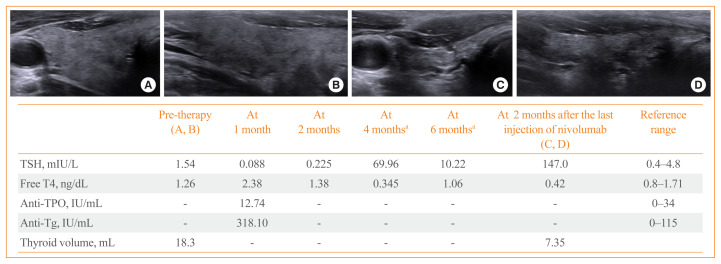
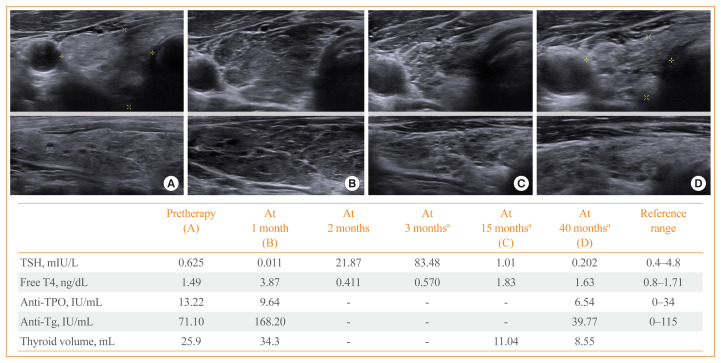
A total of 50.5% (164/325) of patients experienced at least one abnormal thyroid function following PD-1/PD-L1 inhibitor. Eighty-four patients (51.2%) of them recovered to normal thyroid function during follow-up. In overall population, 25 patients (7.7%) required thyroid hormone replacement therapy due to PD-1/PD-L1 inhibitor-induced OH. Patients who progressed to OH showed significantly higher baseline thyroid stimulating hormone level and longer duration of PD-1/PD-L1 inhibitor therapy than those without thyroid dysfunction or OH (both P<0.001). Median time interval to the development of OH was 3 months after the therapy. OH was significantly associated with positive anti-thyroid peroxidase antibody at baseline and anti-thyroglobulin antibody during the therapy than those without thyroid dysfunction or OH (P=0.015 and P=0.005, respectively). We observed no patients with OH who were able to stop levothyroxine replacement after the cessation of PD-1/PD-L1 inhibitor therapy.
PD-1/PD-L1 inhibitor-induced thyroid dysfunctions are considerably reversible; however, OH is irreversible requiring levothyroxine replacement even after stopping the therapy. Positive thyroid autoantibodies may predict the progression to OH.
程序性细胞死亡蛋白-1(PD-1)和程序性死亡配体 1(PD-L1)抑制剂治疗的患者发生了甲状腺免疫相关不良事件(IRAEs)。我们研究了 PD-1/PD-L1 抑制剂诱导的甲状腺 IRAEs 的发生率和临床过程,并确定了甲状腺 IRAEs 的可预测临床危险因素,特别是明显甲状腺功能减退(OH)。
我们回顾性分析了一家三级转诊中心的 325 名接受 PD-1/PD-L1 抑制剂治疗的癌症患者的病历。
共有 325 名患者中有 50.5%(164/325)在接受 PD-1/PD-L1 抑制剂治疗后出现至少一次甲状腺功能异常。在随访期间,有 84 名患者(51.2%)的甲状腺功能恢复正常。在总体人群中,由于 PD-1/PD-L1 抑制剂引起的 OH,有 25 名患者(7.7%)需要甲状腺激素替代治疗。与甲状腺功能正常或无 OH 的患者相比,进展为 OH 的患者在基线时甲状腺刺激素水平显著升高,且 PD-1/PD-L1 抑制剂治疗时间更长(均 P<0.001)。从治疗开始到 OH 发生的中位时间间隔为 3 个月。OH 与基线时甲状腺过氧化物酶抗体阳性和治疗期间甲状腺球蛋白抗体阳性显著相关,与甲状腺功能正常或无 OH 的患者相比(P=0.015 和 P=0.005)。我们没有观察到停止 PD-1/PD-L1 抑制剂治疗后能够停止使用左甲状腺素替代治疗的 OH 患者。
PD-1/PD-L1 抑制剂诱导的甲状腺功能紊乱相当可逆;然而,OH 是不可逆的,即使在停止治疗后也需要使用左甲状腺素替代治疗。阳性甲状腺自身抗体可能预示着向 OH 的进展。