Dhir Arun, Kular Hasandeep, Elzagallaai Abdelbaset A, Carleton Bruce, Rieder Michael J, Mak Raymond, Wong Tiffany
Department of Medicine, University of British Columbia, Vancouver, BC, Canada.
Division of Allergy and Immunology, Department of Medicine, University of British Columbia, Vancouver, BC, Canada.
Allergy Asthma Clin Immunol. 2021 Apr 5;17(1):37. doi: 10.1186/s13223-021-00535-4.
Drug reaction with eosinophilia and systemic symptoms (DRESS) is a rare but serious delayed hypersensitivity reaction that can be caused by antibiotic exposure. The reaction typically develops in 2 to 6 weeks. The pathophysiology is thought to involve toxic drug metabolites acting as a hapten, triggering a systemic response. The diagnosis is made clinically but can be confirmed using assays such as the lymphocyte toxicity assay (LTA), which correlates cell death upon exposure to drug metabolites with susceptibility to hypersensitivity reactions.
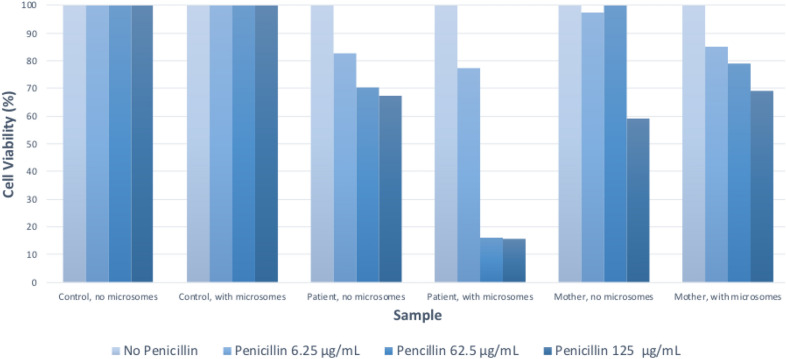
Case 1 involves a previously healthy 11-month-old male with first exposure to amoxicillin-clavulanate, prescribed for seven days to treat a respiratory infection. The patient developed DRESS fourteen days after starting the drug and was successfully treated with corticosteroids. LTA testing confirmed patient susceptibility to hypersensitivity reactions with amoxicillin-clavulanate. Parental samples were also tested, showing both maternal and paternal susceptibility. Neither parent reported prior hypersensitivity reactions. Lifelong penicillin avoidance for the patient was advised along with the notation in medical records of penicillin allergy. The parents were advised to avoid penicillin class antibiotics and be monitored closely for DRESS if they are exposed. Case 2 involves an 11-year-old female with atopic dermatitis with first exposure to amoxicillin-clavulanate, prescribed for ten days to treat a secondary bacterial skin infection. She developed DRESS eleven days after starting antibiotics and was successfully treated with corticosteroids. LTA testing confirmed patient susceptibility to hypersensitivity reactions with amoxicillin-clavulanate. Maternal samples were also tested and showed sensitivity. The mother reported no prior hypersensitivity reactions. Lifelong penicillin avoidance for the patient was advised along with the notation in medical records of penicillin allergy.
Amoxicillin-clavulanate is a commonly used antibiotic and the cases we have described suggest that it should be recognized as a potential cause of DRESS in pediatric patients. Furthermore, these cases contribute to current literature supporting that there may be a shorter latent period in DRESS induced by antibiotics. We have also shown that the LTA can be a helpful tool to confirm DRESS reactions, and that testing may have potential implications for family members.
药物超敏反应伴嗜酸性粒细胞增多和全身症状(DRESS)是一种罕见但严重的迟发型超敏反应,可由接触抗生素引起。该反应通常在2至6周内出现。其病理生理学被认为涉及作为半抗原的有毒药物代谢产物,引发全身反应。诊断通过临床做出,但可使用淋巴细胞毒性试验(LTA)等检测方法进行确认,该试验将接触药物代谢产物后的细胞死亡与超敏反应易感性相关联。
病例1涉及一名此前健康的11个月大男性,首次接触阿莫西林-克拉维酸,为治疗呼吸道感染而开了7天的药。患者在开始用药14天后出现DRESS,并成功接受了皮质类固醇治疗。LTA检测证实患者对阿莫西林-克拉维酸超敏反应敏感。还对父母的样本进行了检测,显示母亲和父亲均敏感。父母双方均未报告有过超敏反应。建议患者终身避免使用青霉素,并在病历中注明青霉素过敏。建议父母避免使用青霉素类抗生素,若接触应密切监测是否出现DRESS。病例2涉及一名11岁患有特应性皮炎的女性,首次接触阿莫西林-克拉维酸,为治疗继发性细菌性皮肤感染而开了10天的药。她在开始使用抗生素11天后出现DRESS,并成功接受了皮质类固醇治疗。LTA检测证实患者对阿莫西林-克拉维酸超敏反应敏感。对母亲的样本也进行了检测,显示敏感。母亲报告没有过超敏反应。建议患者终身避免使用青霉素,并在病历中注明青霉素过敏。
阿莫西林-克拉维酸是一种常用抗生素,我们所描述的病例表明,它应被视为儿科患者发生DRESS的潜在原因。此外,这些病例为当前文献提供了支持,即抗生素诱发的DRESS可能有较短的潜伏期。我们还表明,LTA可作为确认DRESS反应的有用工具,且该检测可能对家庭成员有潜在影响。