Department of Cardiovascular Surgery Mount Sinai Hospital New York NY.
Interventional Cardiology Unit University Hospital Alvaro Cunqueiro Vigo Spain.
J Am Heart Assoc. 2021 Apr 20;10(8):e019882. doi: 10.1161/JAHA.120.019882. Epub 2021 Apr 6.
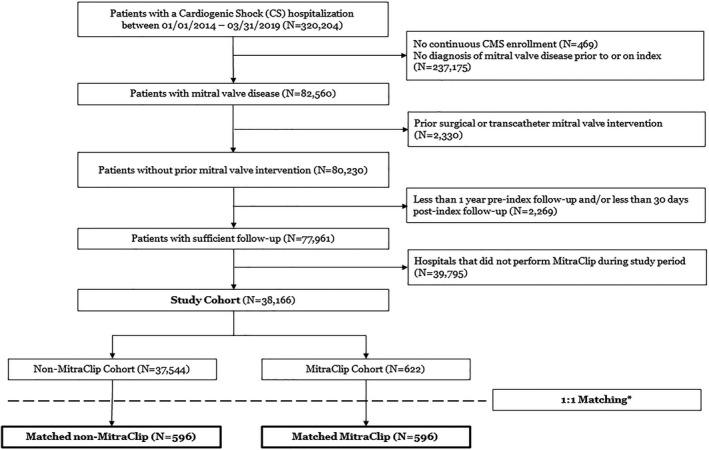
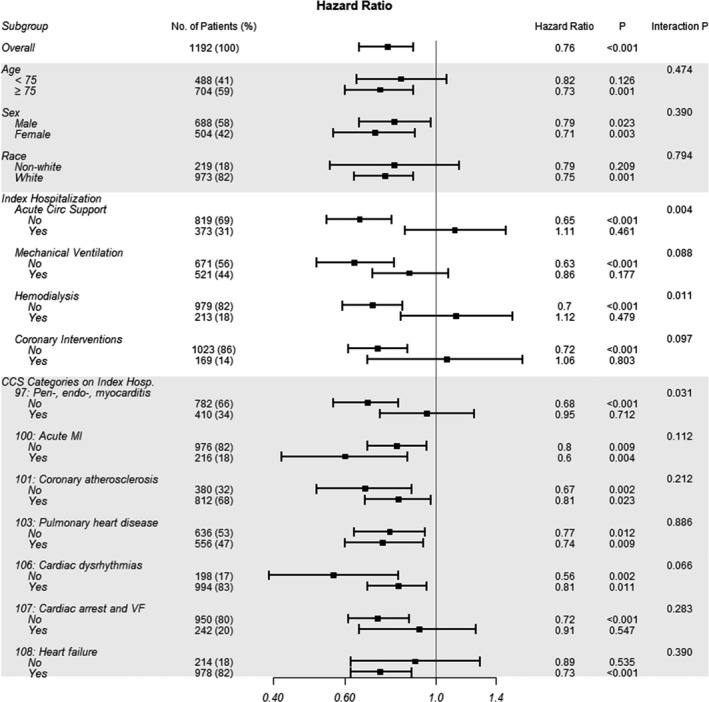
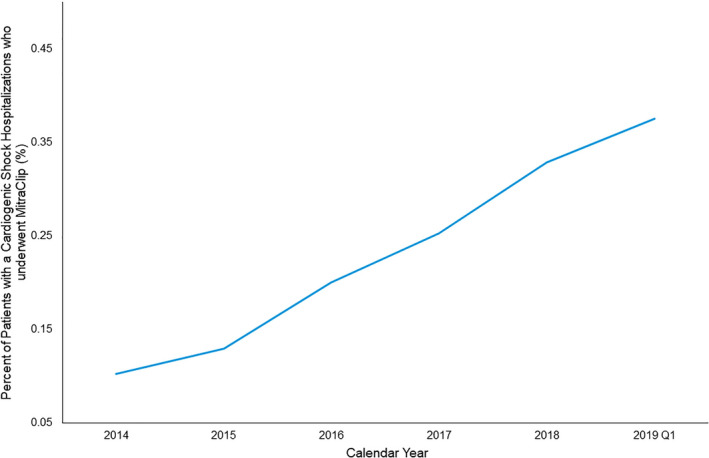
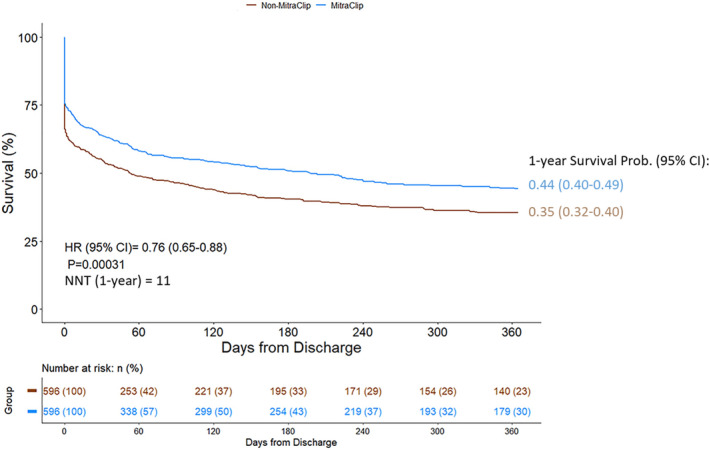
Background Edge-to-edge transcatheter mitral valve repair as salvage therapy in high surgical risk patients with severe mitral regurgitation presenting with cardiogenic shock (CS) has been described in small case series, but large clinical results have not been reported. This study aimed to evaluate outcomes of transcatheter mitral valve repair with MitraClip in patients with mitral regurgitation and CS using a large national database. Methods and Results From January 2014 to March 2019, we identified hospitalizations for CS in patients with mitral valve disease using data from Centers for Medicare and Medicaid Services. Those with a prior surgical or percutaneous mitral valve intervention were excluded. We compared survival between patients who underwent MitraClip during the index hospitalization and those who did not using propensity-matched analysis. The analysis included 38 166 patients (mean age, 71±11 years, 41.6% women) of whom 622 (1.6%) underwent MitraClip. MitraClip was increasingly used during CS hospitalizations over the study period (<0.001). After matching, patients receiving MitraClip had significantly lower in-hospital mortality (odds ratio, 0.6; 95% CI, 0.47-0.77; <0.001) and 1-year mortality (hazard ratio, 0.76; 95% CI, 0.65-0.88; <0.001) compared with those without MitraClip. The survival benefit associated with MitraClip was consistent across subgroups of interest, with the exception of patients requiring acute mechanical circulatory support or hemodialysis at index. Conclusions In patients with mitral regurgitation presenting with CS, use of MitraClip is increasing and associated with greater in-hospital and 1-year survival. Further studies are warranted to optimize patient selection and procedure timing for those receiving MitraClip as a treatment option in CS.
边缘对边缘经导管二尖瓣修复作为高手术风险的严重二尖瓣反流合并心源性休克(CS)患者的挽救性治疗,已经在小病例系列中得到描述,但尚未报道大规模的临床结果。本研究旨在使用大型国家数据库评估经导管二尖瓣修复术在二尖瓣反流合并 CS 患者中的应用结果。
从 2014 年 1 月至 2019 年 3 月,我们使用医疗保险和医疗补助服务中心的数据,确定了因 CS 住院的二尖瓣疾病患者。排除那些有既往外科或经皮二尖瓣介入治疗的患者。我们使用倾向匹配分析比较了在指数住院期间接受 MitraClip 治疗的患者和未接受 MitraClip 治疗的患者的生存情况。分析共纳入 38166 例患者(平均年龄 71±11 岁,41.6%为女性),其中 622 例(1.6%)接受了 MitraClip。在研究期间,CS 住院期间 MitraClip 的使用呈逐渐增加趋势(<0.001)。匹配后,接受 MitraClip 的患者院内死亡率显著降低(比值比,0.6;95%置信区间,0.47-0.77;<0.001),1 年死亡率也显著降低(风险比,0.76;95%置信区间,0.65-0.88;<0.001)。与未接受 MitraClip 的患者相比,MitraClip 与生存获益相关,除了在指数期需要急性机械循环支持或血液透析的患者外。MitraClip 的生存获益在各亚组中一致,除了在指数期需要急性机械循环支持或血液透析的患者外。
在二尖瓣反流合并 CS 的患者中,MitraClip 的使用正在增加,并与更高的院内和 1 年生存率相关。需要进一步的研究来优化患者选择和手术时机,以便将 MitraClip 作为 CS 的治疗选择。