Alexion Pharmaceuticals, Inc., Boston, Massachusetts, USA.
Orthopedic Department, University of Würzburg, Würzburg, Bavaria, Germany.
J Clin Pharmacol. 2021 Oct;61(10):1334-1343. doi: 10.1002/jcph.1870. Epub 2021 Jun 19.
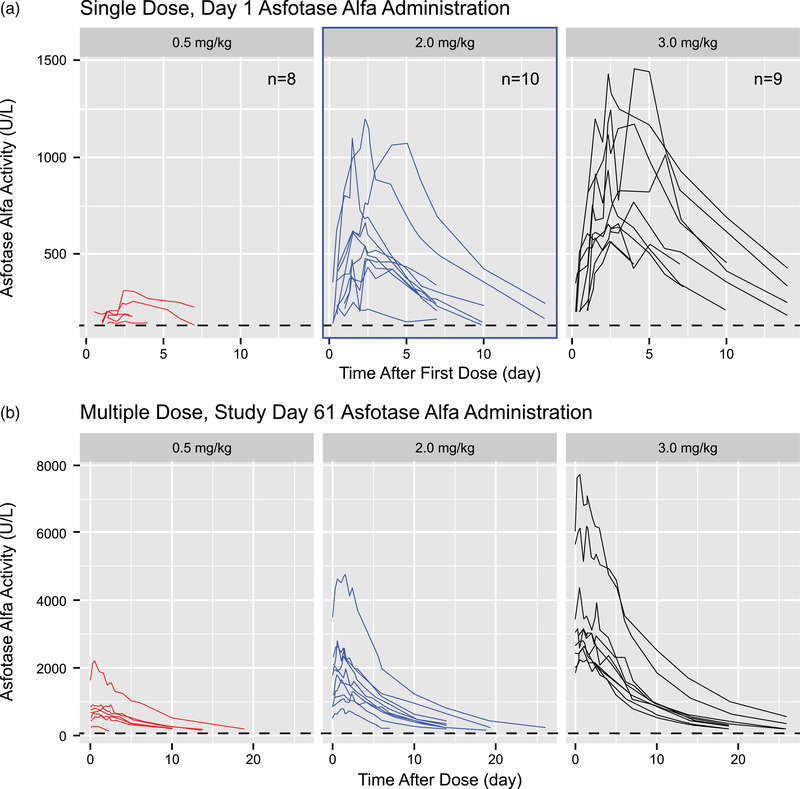
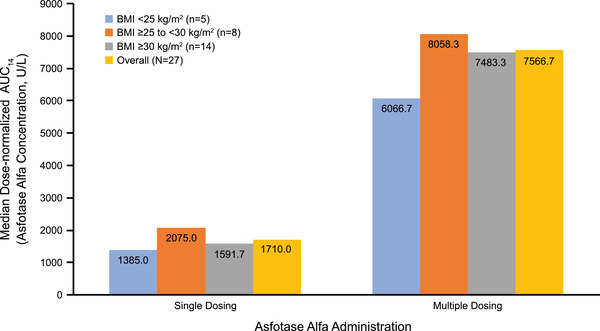
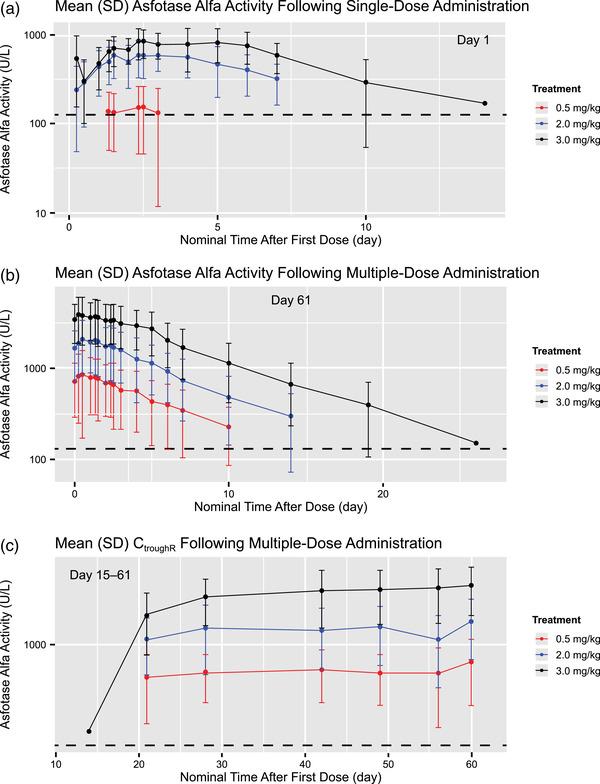
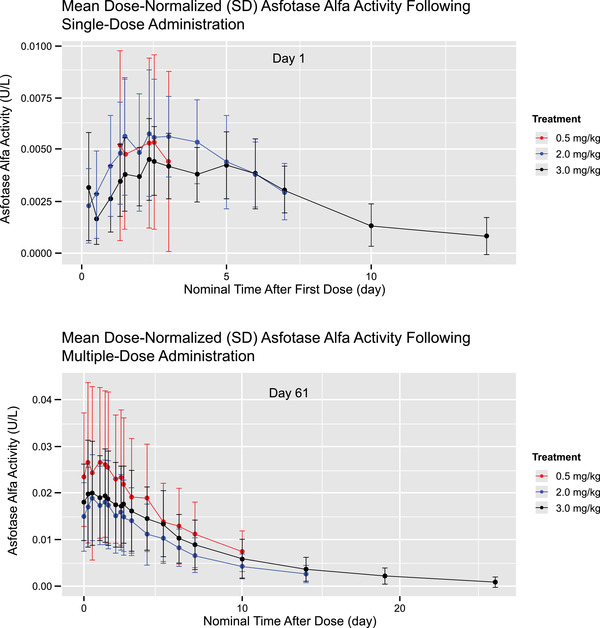
Hypophosphatasia is a rare metabolic disease resulting from variant(s) in the gene-encoding tissue-nonspecific isozyme of alkaline phosphatase. In this 13-week, phase 2a, multicenter, randomized, open-label, dose-response study (ClinicalTrials.gov: NCT02797821), the pharmacokinetics of asfotase alfa, an enzyme replacement therapy approved for the treatment of hypophosphatasia, was assessed in adult patients with pediatric-onset hypophosphatasia. In total, 27 adults were randomly assigned 1:1:1 to a single subcutaneous dose of asfotase alfa (0.5, 2.0, or 3.0 mg/kg) during week 1. From week 3 to week 9, patients received 0.5, 2.0, or 3.0 mg/kg subcutaneously 3 times per week (equivalent to 1.5, 6.0, or 9.0 mg/kg/wk, respectively). Noncompartmental analysis revealed exposure (maximum concentration in the dosing interval and area under the concentration-time curve from time 0 to infinity) to asfotase alfa increased between single- and multiple-dose administration and with increasing doses; however, extensive interindividual variability was observed in the concentration-time profiles within each dose cohort. Median terminal elimination half-life was ≈5 days following multiple-dose administration, with steady state achieved by approximately day 29. Dose-normalized exposure data indicated that asfotase alfa activity was approximately dose-proportional within the studied dose range. Additionally, dose-normalized exposure was comparable across body mass index categories of <25, ≥25 to <30, and ≥30 kg/m , indicating that asfotase alfa dosing bioavailability was consistent in these patients, including those who were obese. These data, together with previously published pharmacodynamic results in this study population, support the use of asfotase alfa at the recommended dose of 6 mg/kg/wk in adults with pediatric-onset hypophosphatasia.
低磷酸酯酶症是一种罕见的代谢疾病,由碱性磷酸酶组织非特异性同工酶基因变异引起。在这项为期 13 周、多中心、随机、开放标签、剂量反应的 2a 期研究(ClinicalTrials.gov:NCT02797821)中,评估了酶替代疗法阿法特酶在儿科起病的低磷酸酯酶症成年患者中的药代动力学。共有 27 名成年患者按 1:1:1 的比例随机分配,在第 1 周接受单次皮下注射阿法特酶(0.5、2.0 或 3.0mg/kg)。从第 3 周到第 9 周,患者每周接受 3 次皮下注射 0.5、2.0 或 3.0mg/kg(分别相当于 1.5、6.0 或 9.0mg/kg/周)。非房室分析显示,单次和多次给药后,阿法特酶的暴露量(给药间隔内的最大浓度和从 0 到无穷大的浓度-时间曲线下面积)随剂量增加而增加;然而,在每个剂量组内,浓度-时间曲线下的个体间变异性很大。多次给药后,中位终末消除半衰期约为 5 天,大约在第 29 天达到稳态。剂量标准化后的暴露数据表明,在研究剂量范围内,阿法特酶的活性与剂量呈近似比例关系。此外,在<25、≥25 至<30 和≥30kg/m 等体重指数类别中,剂量标准化后的暴露量相当,这表明阿法特酶的给药生物利用度在这些患者中是一致的,包括肥胖患者。这些数据与该研究人群中先前发表的药效学结果一起,支持在儿科起病的低磷酸酯酶症成年患者中使用推荐剂量的 6mg/kg/周的阿法特酶。