Kumi-Kyereme Akwasi
Department of Population and Health, Faculty of Social Sciences, University of Cape Coast, Cape Coast, Ghana.
Afr J Disabil. 2021 Mar 1;10:671. doi: 10.4102/ajod.v10i0.671. eCollection 2021.
Sexual and reproductive health (SRH) of young people including those with disabilities is a major public health concern globally. However, available evidence on their use of sexual and reproductive health services (SRHS) is inconsistent.
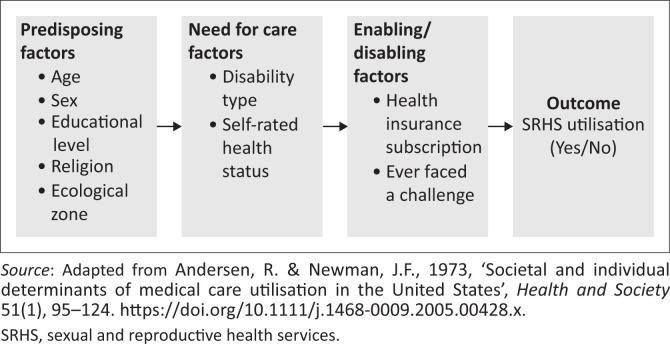
This study investigated utilisation of SRHS amongst the in-school young people with disabilities (YPWDs) in Ghana using the healthcare utilisation model.
Guided by the cross-sectional study design, a questionnaire was used to obtain data from 2114 blind and deaf pupils or students in the age group 10-24 years, sampled from 15 purposively selected special schools for the deaf and the blind in Ghana.
About seven out of every 10 respondents had ever utilised SRHS. The proportion was higher amongst the males (67.8%) compared with the females (62.8%). Young persons with disabilities in the coastal (OR = 0.03, 95% CI = 0.01-0.22) and middle (OR = 0.06, 95% CI = 0.01-0.44) zones were less likely to have ever utilised SRHS compared with those in the northern ecological zone. The blind pupils or students were more likely to have ever utilised SRHS than the deaf (OR = 1.45, 95% CI = 1.26-3.11).
Generally, SRHS utilisation amongst the in-school YPWDs in Ghana is high but significantly associated with some predisposing, need and enabling or disabling factors. This underscores the need for policymakers to consider in-school YPWDs as a heterogeneous group in the design and implementation of SRHS programmes. The Ghana Education Service in collaboration with the Ghana Health Service should adopt appropriate pragmatic measures and targeted interventions in the special schools to address the SRH needs of the pupils or students.
包括残疾青年在内的年轻人的性与生殖健康是全球主要的公共卫生问题。然而,关于他们使用性与生殖健康服务的现有证据并不一致。
本研究使用医疗保健利用模型调查了加纳在校残疾青年对性与生殖健康服务的利用情况。
在横断面研究设计的指导下,使用问卷调查从加纳15所特意挑选的聋校和盲校中抽取的2114名10至24岁的盲人和聋人学生中获取数据。
每10名受访者中约有7人曾使用过性与生殖健康服务。男性(67.8%)的这一比例高于女性(62.8%)。与北部生态区的残疾青年相比,沿海(OR = 0.03,95% CI = 0.01 - 0.22)和中部(OR = 0.06,95% CI = 0.01 - 0.44)地区的残疾青年使用性与生殖健康服务的可能性较小。盲生比聋生更有可能曾使用过性与生殖健康服务(OR = 1.45,95% CI = 1.26 - 3.11)。
总体而言,加纳在校残疾青年对性与生殖健康服务的利用率较高,但与一些易患因素、需求因素以及促成或阻碍因素显著相关。这突出表明政策制定者在设计和实施性与生殖健康服务项目时,需要将在校残疾青年视为一个异质性群体。加纳教育服务部门应与加纳卫生服务部门合作,在特殊学校采取适当的务实措施和有针对性的干预措施,以满足学生的性与生殖健康需求。