Department of Trauma Surgery, Klinikum Rechts Der Isar, Technical University of Munich, Ismaninger Strasse 22, 81675, Munich, Germany.
Arch Orthop Trauma Surg. 2022 Jul;142(7):1557-1561. doi: 10.1007/s00402-021-03871-7. Epub 2021 Apr 6.
The incidence of patella fracture is statistically low (0.5-1.5%) compared to other fractures of the extremities [Patella fractures 76(10):987-997, 2005]. In the latter research, patella fractures if treated surgically present an overall inferior functional outcome. Little is known about the influence of the postoperative patella height on the clinical outcome. Therefore, the aim of our study was to analyse the influence of the patella height on the patients' functional outcome after surgery.
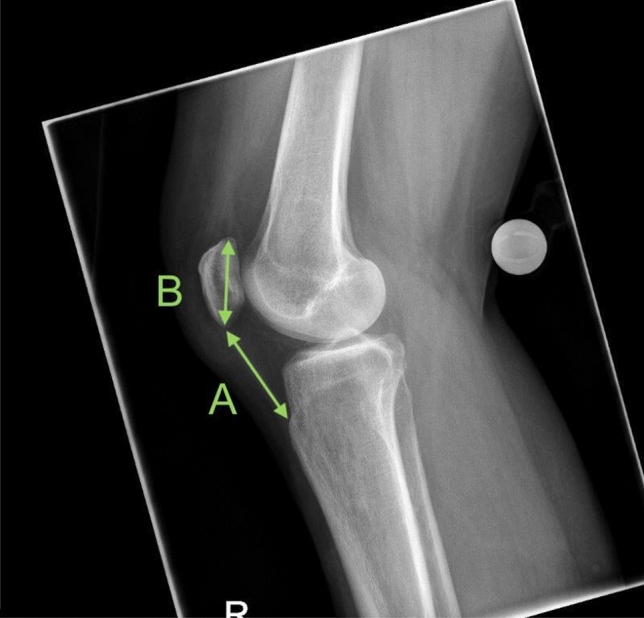
In this retrospective study the in-house trauma register of our level I University trauma center was screened for patients suffering patella fractures treated surgically. Patella height of the same patients was evaluated on lateral X-rays using the Insall-Salvati Ratio (ISR). The patients' X-rays were analyzed at two time points for the ISR, whereas group A presents ISR data right after surgery and group B data at the latest follow up (minimum 6 weeks). The change of mean ISR at both time points was tested for significance. The functional outcome was measured by the "Munich Knee Questionaire" (MKQ). These MKQ results of different patella heights and fracture types were compared.
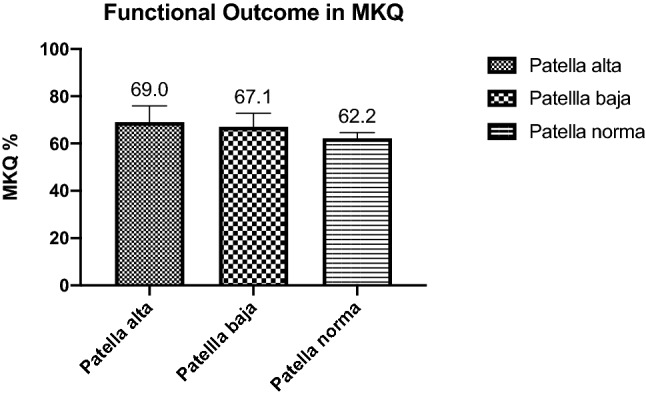
The screening of our in-house trauma register revealed 375 patients between the years 2003 and 2016. Out of these 54 patients (34f, 20 m) were enrolled. In detail the follow-up time for ISR between group A and B accounted for a mean of 503.8 ± 655.7 days. The MKQ was assessed at a mean of 1367.0 ± 1042.8 days after surgery. According to the AO-classification 10% AO.34 type B and 90% AO.34 type C fractures were found. Group A showed in 9.1% a patella baja and in 27.3% a patella alta compared to group B presenting 20.0% patella baja and 14.5% patella alta. There was no significant difference in functional outcome referring to the MKQ in patella alta (MKQ 69.0% ± 18.2) or baja (MKQ 67.1% ± 17.9) (p = 0.9). No significant functional difference between AO34.type B (MKQ 74.5% ± 11.0) and AO34.type C fractures (MKQ 64.0% ± 15.0) resulted (p = 0.1).
Our results demonstrate that different postoperative patella heights apparently do not influence the functional outcome in the short follow-up.
与四肢其他部位的骨折(髌骨骨折 76(10):987-997,2005)相比,髌骨骨折的发病率相对较低(0.5-1.5%)。在后一项研究中,手术治疗的髌骨骨折总体功能预后较差。术后髌骨高度对临床结果的影响知之甚少。因此,我们的研究目的是分析髌骨高度对术后患者功能结果的影响。
在这项回顾性研究中,我们对一级大学创伤中心的内部创伤登记处进行了筛选,以寻找接受手术治疗的髌骨骨折患者。使用 Insall-Salvati 比率(ISR)在侧位 X 光片上评估同一患者的髌骨高度。在两个时间点分析患者的 X 光片以获取 ISR,其中 A 组为术后即刻的 ISR 数据,B 组为随访时(至少 6 周)的 ISR 数据。测试两个时间点的平均 ISR 变化是否有统计学意义。使用“慕尼黑膝关节问卷”(MKQ)测量功能结果。将不同髌骨高度和骨折类型的这些 MKQ 结果进行比较。
筛选我们的内部创伤登记处显示 2003 年至 2016 年间有 375 名患者。其中 54 名患者(34 名女性,20 名男性)被纳入研究。A 组和 B 组的 ISR 随访时间平均为 503.8±655.7 天。术后平均 1367.0±1042.8 天进行了 MKQ 评估。根据 AO 分类,10%的 AO.34 型 B 骨折和 90%的 AO.34 型 C 骨折。A 组中髌骨低位的发生率为 9.1%,髌骨高位的发生率为 27.3%,而 B 组中髌骨低位的发生率为 20.0%,髌骨高位的发生率为 14.5%。髌骨高位(MKQ 69.0%±18.2)或低位(MKQ 67.1%±17.9)时功能结果无明显差异(p=0.9)。AO34.type B(MKQ 74.5%±11.0)和 AO34.type C 骨折(MKQ 64.0%±15.0)之间的功能差异无统计学意义(p=0.1)。
我们的研究结果表明,术后不同的髌骨高度在短期随访中显然不会影响功能结果。