Department of Pediatrics, Golisano Children's Hospital, University of Rochester Medical Center, 601 Elmwood Avenue, Box 590, Rochester, NY, USA.
Department of Pediatrics, The Children's Hospital of Philadelphia, Roberts Center for Pediatric Research, 2716 South Street, Philadelphia, PA, USA.
J Bone Miner Metab. 2021 Jul;39(4):693-699. doi: 10.1007/s00774-021-01214-5. Epub 2021 Apr 7.
Zoledronic acid (ZA) is an intravenous bisphosphonate used to treat pediatric osteoporosis. Adverse events including hypocalcemia and acute phase reaction (APR) are common following first-infusion. The purpose of this report is to describe implementation of a ZA clinical practice guideline and the subsequent process changes to improve adherence to aspects of the protocol related to safety and efficacy.
Quality assurance was evaluated by chart review over a 5-year period to compare the prevalence of hypocalcemia and APR to published data. A quality improvement (QI) initiative consisting of process changes including the addition of an endocrine RN to coordinate infusions and a shift to patient/family self-scheduling of infusions was conducted. The effect of the interventions on safety (completion of pre- and post-infusion bloodwork) and efficacy (receipt of all prescribed infusions) outcomes was evaluated.
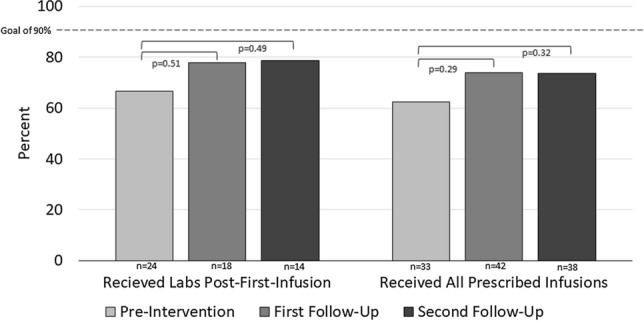
Seventy-two patients received 244 infusions over the period. The frequency of hypocalcemia (22%) and APR (31%) was consistent with prior reports. 99% of patients received pre-infusion bloodwork, 78% received post-first-infusion bloodwork, and 47% received all prescribed infusions. QI initiatives increased the percentage of patients receiving post-first-infusion bloodwork from 67 to 79% and those receiving all infusions from 62 to 74%, but fell short of the goal of 90%.
The implementation of a standardized protocol for ZA use in children was successful in confirming patient eligibility with pre-infusion bloodwork but failed to ensure that patients obtained post-first-infusion bloodwork and received all prescribed infusions. Further efforts to systematize the management of children on ZA are needed.
唑来膦酸(ZA)是一种用于治疗儿童骨质疏松症的静脉用双膦酸盐。首次输注后,常见低钙血症和急性期反应(APR)等不良事件。本报告的目的是描述 ZA 临床实践指南的实施情况,以及随后为提高协议中与安全性和疗效相关方面的依从性而进行的流程更改。
通过 5 年的图表审查评估质量保证,以将低钙血症和 APR 的发生率与已发表的数据进行比较。实施了一项质量改进(QI)计划,包括流程更改,包括增加一名内分泌 RN 来协调输液以及将输液改为患者/家属自行安排。评估干预措施对安全性(输注前后完成血液检查)和疗效(接受所有规定的输注)结果的影响。
72 名患者在该期间接受了 244 次输注。低钙血症(22%)和 APR(31%)的频率与先前的报告一致。99%的患者接受了输注前的血液检查,78%的患者接受了首次输注后的血液检查,47%的患者接受了所有规定的输注。QI 计划使接受首次输注后血液检查的患者比例从 67%增加到 79%,接受所有输注的患者比例从 62%增加到 74%,但未达到 90%的目标。
在儿童中使用 ZA 的标准化方案的实施成功地通过输注前血液检查确认了患者的资格,但未能确保患者获得首次输注后的血液检查并接受所有规定的输注。需要进一步努力系统地管理接受 ZA 治疗的儿童。