Institute of Psychology, Clinical Psychology and Psychotherapy, University of Zurich, Binzmuehlestrasse 14/Box 26, 8050, Zurich, Switzerland.
Department of Education and Psychology, Division of Clinical Psychological Intervention, Freie Universität Berlin, Berlin, Germany.
J Neural Transm (Vienna). 2021 Sep;128(9):1279-1286. doi: 10.1007/s00702-021-02330-2. Epub 2021 Apr 7.
Less than half of all individuals with post-traumatic stress disorder (PTSD) remit spontaneously and a large proportion of those seeking treatment do not respond sufficiently. This suggests that there may be subgroups of individuals who are in need of augmentative or alternative treatments. One of the most frequent pathophysiological findings in PTSD is alterations in the hypothalamic-pituitary-adrenal (HPA) axis, including enhanced negative feedback sensitivity and attenuated peripheral cortisol. Given the role of the HPA axis in cognition, this pattern may contribute to PTSD symptoms and interfere with key processes of standard first-line treatments, such as trauma-focused cognitive behavioural therapy (TF-CBT).
This review provides a comprehensive summary of the current state of research regarding the role of HPA axis functioning in PTSD symptoms and treatment.
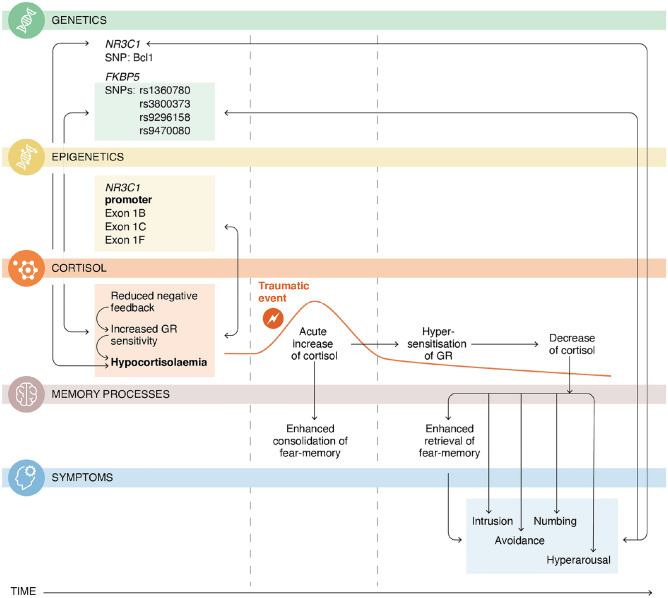
Overall, there is preliminary evidence that hypocortisolaemia contributes to symptom manifestation in PTSD; that it predicts non-responses to TF-CBT; and that it is subject to change in parallel with positive treatment trajectories. Moreover, there is evidence that genetic and epigenetic alterations within the genes NR3C1 and FKBP5 are associated with this hypocortisolaemic pattern and that some of these alterations change as symptoms improve over the course of treatment.
Future research priorities include investigations into the role of the HPA axis in day-to-day symptom variation, the time scale in which biological changes in response to treatment occur, and the effects of sex. Furthermore, before conceiving augmentative or alternative treatments that target the described mechanisms, multilevel studies are warranted.
不足一半的创伤后应激障碍(PTSD)患者会自发缓解,而寻求治疗的患者中很大一部分对治疗反应不足。这表明可能存在需要增强或替代治疗的亚组人群。PTSD 最常见的病理生理学发现之一是下丘脑-垂体-肾上腺(HPA)轴的改变,包括增强的负反馈敏感性和外周皮质醇的减弱。鉴于 HPA 轴在认知中的作用,这种模式可能导致 PTSD 症状,并干扰标准一线治疗(如创伤聚焦认知行为疗法(TF-CBT))的关键过程。
本综述全面总结了目前关于 HPA 轴功能在 PTSD 症状和治疗中的作用的研究现状。
总体而言,有初步证据表明低皮质醇血症与 PTSD 症状的表现有关;它预测了对 TF-CBT 的无反应;并且它与积极的治疗轨迹平行变化。此外,有证据表明,NR3C1 和 FKBP5 基因内的遗传和表观遗传改变与这种低皮质醇血症模式有关,并且这些改变中的一些随着治疗过程中症状的改善而改变。
未来的研究重点包括研究 HPA 轴在日常症状变化中的作用、治疗过程中生物变化发生的时间尺度以及性别的影响。此外,在构想针对描述的机制的增强或替代治疗之前,需要进行多层次的研究。