Wasli Nur Syafinaz, Ridzwan Irna Elina, Azzubaidi Marwan Saad, Kasmuri Abdul Razak, Ahmed Qamar Uddin, Ming Long Chiau, Mohamed Nornisah, Syd Mohmad Faudzi Syed Mohd Syahmi
Department of Basic Medical Sciences, Kulliyyah of Pharmacy, International Islamic University Malaysia, Kuantan, Pahang, Malaysia.
Department of Pharmaceutical Chemistry, Kulliyyah of Pharmacy, International Islamic University Malaysia, Kuantan, Pahang, Malaysia.
J Pharm Bioallied Sci. 2020 Nov;12(Suppl 2):S826-S830. doi: 10.4103/jpbs.JPBS_379_19. Epub 2020 Nov 5.
κ-opioid receptor (KOPr) system has been linked to relapse to many substances, especially opioids. Positive responses were recently reported in morphine and methamphetamine (polydrug)-dependent mice treated with buprenorphine and naltrexone, a functional κ antagonist.
This study aimed to determine the specific brain region that is responsive to KOPr treatment following polydrug dependence.
The polydrug-dependent mice model was developed using conditioned place preference (CPP) method. Following successful withdrawal phase, the mice were treated with 0.3 mg/kg buprenorphine and 1.0 mg/kg naltrexone. Four brain regions (hippocampus, prefrontal cortex, amygdala, and striatum) were investigated using immunohistochemistry technique. This is to quantify the changes in KOPr expression in each major brain region that was primarily involved in addiction neurocircuits of many substances. Unpaired Student's test was used to analyze all results, where < 0.05 is considered significant.
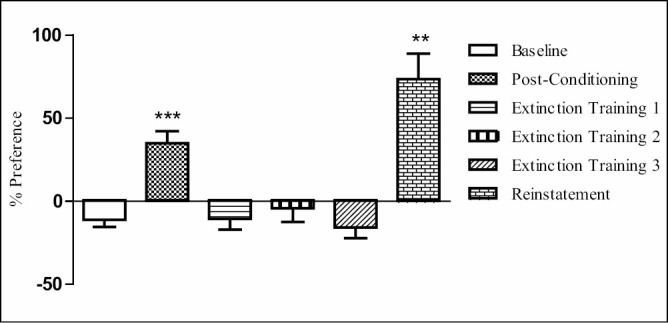
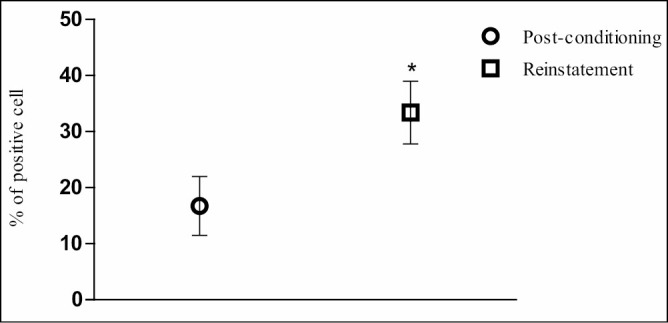
The results showed that treatment with buprenorphine and naltrexone successfully attenuated relapse in 60% of mice ( = 14). A significant upregulation of KOPr was detected in striatum at the end of post-withdrawal phase ( < 0.01, = 12). This treatment successfully suppressed KOPr in striatum ( < 0.001, = 12), which supports the positive results seen in the CPP setting. No significant changes were observed in other brain regions studied.
The hyperactivity of striatum suggests that the affected brain region following KOPr antagonist treatment is the region that primarily controls the drug rewarding activity, in which nucleus accumbens is located. This indicates that manipulation of KOPr system is one of the potential targets to treat morphine- or methamphetamine-dependence problem.
κ-阿片受体(KOPr)系统与多种物质的复吸有关,尤其是阿片类物质。最近有报道称,在接受丁丙诺啡和纳曲酮(一种功能性κ拮抗剂)治疗的吗啡和甲基苯丙胺(多药)依赖小鼠中出现了阳性反应。
本研究旨在确定多药依赖后对KOPr治疗有反应的特定脑区。
采用条件性位置偏爱(CPP)方法建立多药依赖小鼠模型。在成功度过戒断期后,给小鼠注射0.3mg/kg丁丙诺啡和1.0mg/kg纳曲酮。使用免疫组织化学技术研究四个脑区(海马体、前额叶皮质、杏仁核和纹状体)。这是为了量化每个主要脑区中KOPr表达的变化,这些脑区主要参与多种物质成瘾神经回路。使用非配对学生t检验分析所有结果,其中P<0.05被认为具有显著性。
结果显示,丁丙诺啡和纳曲酮治疗成功使60%的小鼠(n = 14)的复吸得到缓解。在戒断后期结束时,纹状体中检测到KOPr显著上调(P<0.01,n = 12)。这种治疗成功地抑制了纹状体中的KOPr(P<0.001,n = 12),这支持了在CPP实验中看到的阳性结果。在所研究的其他脑区未观察到显著变化。
纹状体的过度活跃表明,KOPr拮抗剂治疗后受影响的脑区是主要控制药物奖赏活动的区域,伏隔核就位于该区域。这表明操纵KOPr系统是治疗吗啡或甲基苯丙胺依赖问题的潜在靶点之一。