Su Yongdong, Bayarjargal Maitsetseg, Hale Tracy K, Filichev Vyacheslav V
School of Fundamental Sciences, Massey University, Private Bag 11-222, 4442 Palmerston North, New Zealand.
Maurice Wilkins Centre for Molecular Biodiscovery, Auckland 1142, New Zealand.
Beilstein J Org Chem. 2021 Mar 29;17:749-761. doi: 10.3762/bjoc.17.65. eCollection 2021.
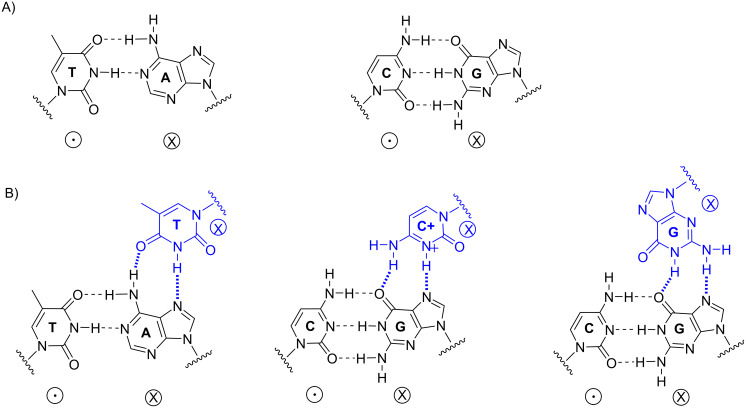
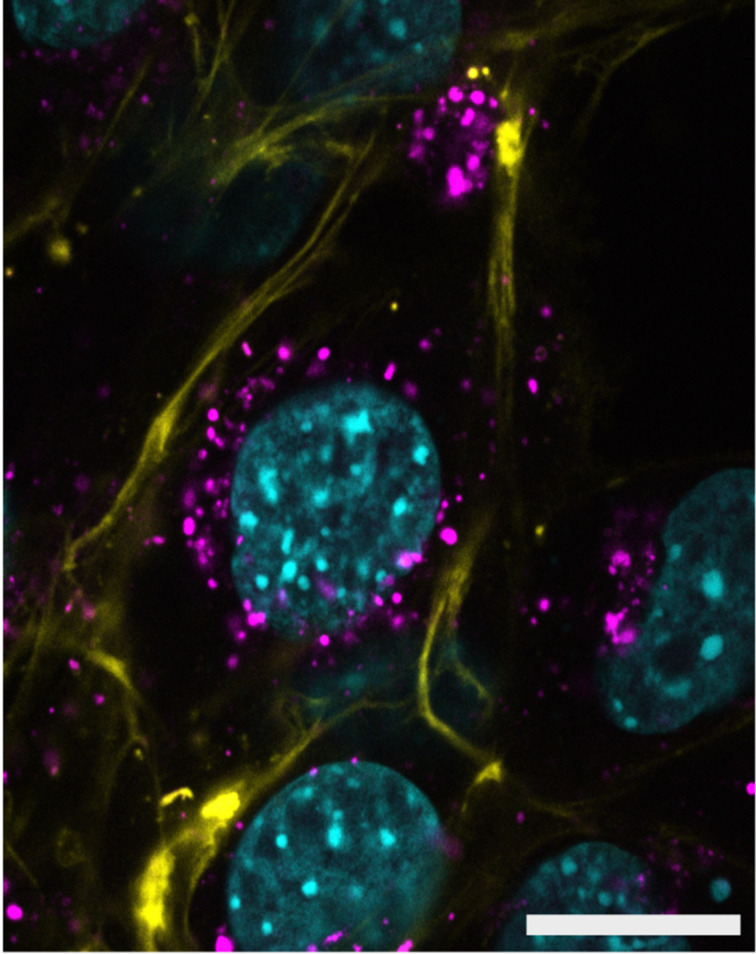
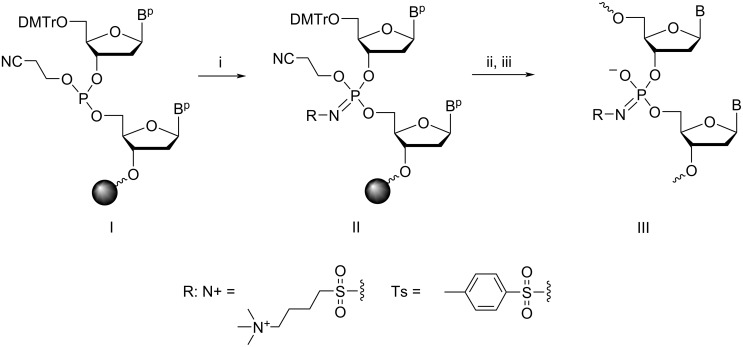
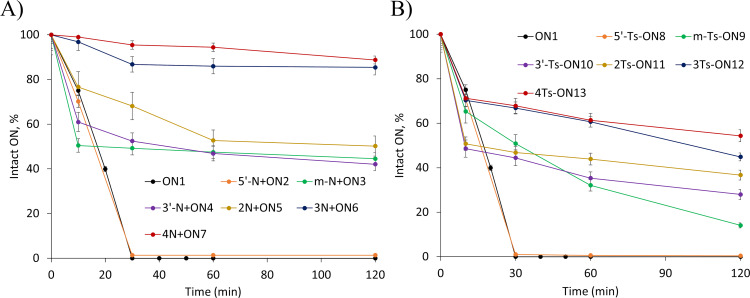
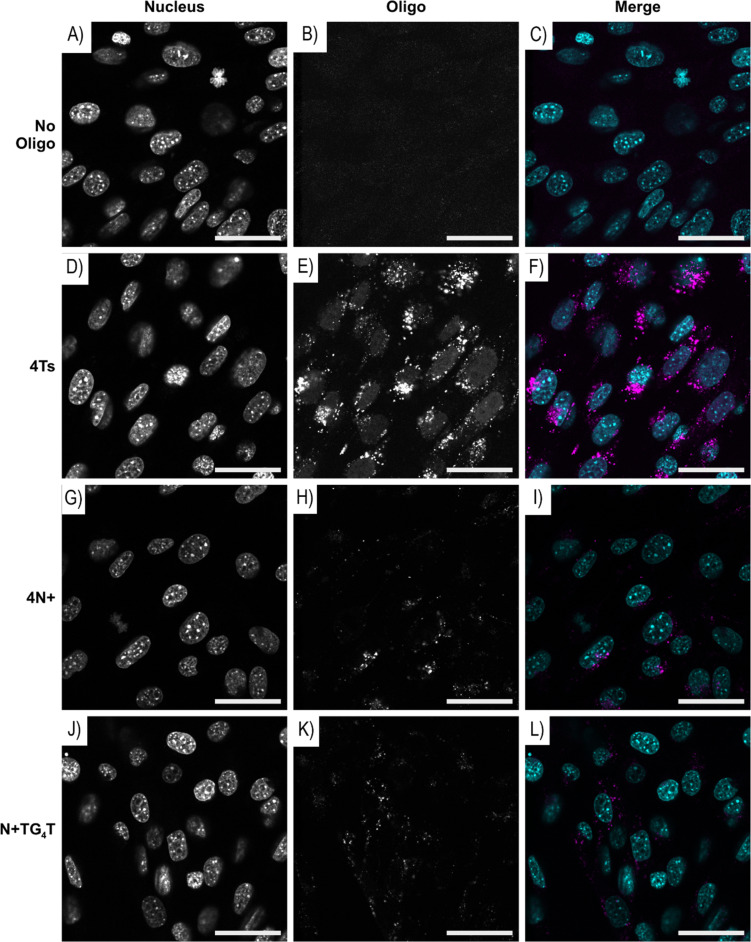
Two phosphate modifications were introduced into the DNA backbone using the Staudinger reaction between the 3',5'-dinucleoside β-cyanoethyl phosphite triester formed during DNA synthesis and sulfonyl azides, 4-(azidosulfonyl)--trimethylbutan-1-aminium iodide (N+ azide) or -toluenesulfonyl (tosyl or Ts) azide, to provide either a zwitterionic phosphoramidate with N+ modification or a negatively charged phosphoramidate for Ts modification in the DNA sequence. The incorporation of these N+ and Ts modifications led to the formation of thermally stable parallel DNA triplexes, regardless of the number of modifications incorporated into the oligodeoxynucleotides (ONs). For both N+ and Ts-modified ONs, the antiparallel duplexes formed with complementary RNA were more stable than those formed with complementary DNA (except for ONs with modification in the middle of the sequence). Additionally, the incorporation of N+ modifications led to the formation of duplexes with a thermal stability that was less dependent on the ionic strength than native DNA duplexes. The thermodynamic analysis of the melting curves revealed that it is the reduction in unfavourable entropy, despite the decrease in favourable enthalpy, which is responsible for the stabilisation of duplexes with N+ modification. N+ONs also demonstrated greater resistance to nuclease digestion by snake venom phosphodiesterase I than the corresponding Ts-ONs. Cell uptake studies showed that Ts-ONs can enter the nucleus of mouse fibroblast NIH3T3 cells without any transfection reagent, whereas, N+ONs remain concentrated in vesicles within the cytoplasm. These results indicate that both N+ and Ts-modified ONs are promising for various in vivo applications.
利用DNA合成过程中形成的3',5'-二核苷亚磷酸酯三酯与磺酰叠氮化物、4-(叠氮磺酰基)-三甲基丁烷-1-碘化铵(N⁺叠氮化物)或对甲苯磺酰基(甲苯磺酰基或Ts)叠氮化物之间的施陶丁格反应,将两种磷酸修饰引入DNA主链,以在DNA序列中提供具有N⁺修饰的两性离子氨基磷酸酯或用于Ts修饰的带负电荷的氨基磷酸酯。这些N⁺和Ts修饰的掺入导致形成热稳定的平行DNA三链体,而与掺入寡脱氧核苷酸(ONs)中的修饰数量无关。对于N⁺和Ts修饰的ONs,与互补RNA形成的反平行双链体比与互补DNA形成的反平行双链体更稳定(序列中间有修饰的ONs除外)。此外,N⁺修饰的掺入导致形成双链体,其热稳定性比天然DNA双链体对离子强度的依赖性更小。熔解曲线的热力学分析表明,尽管有利焓减少,但不利熵的降低是导致N⁺修饰双链体稳定的原因。N⁺ ONs对蛇毒磷酸二酯酶I的核酸酶消化也比相应的Ts-ONs表现出更大的抗性。细胞摄取研究表明,Ts-ONs无需任何转染试剂即可进入小鼠成纤维细胞NIH3T3细胞核,而N⁺ ONs仍集中在细胞质内的囊泡中。这些结果表明,N⁺和Ts修饰的ONs在各种体内应用中都很有前景。