• 文献检索
  • 文档翻译
  • 深度研究
  • 学术资讯
  • Suppr Zotero 插件Zotero 插件
  • 邀请有礼
  • 套餐&价格
  • 历史记录
应用&插件
Suppr Zotero 插件Zotero 插件浏览器插件Mac 客户端Windows 客户端微信小程序
定价
高级版会员购买积分包购买API积分包
服务
文献检索文档翻译深度研究API 文档MCP 服务
关于我们
关于 Suppr公司介绍联系我们用户协议隐私条款
关注我们

Suppr 超能文献

核心技术专利:CN118964589B侵权必究
粤ICP备2023148730 号-1Suppr @ 2026

文献检索

告别复杂PubMed语法,用中文像聊天一样搜索,搜遍4000万医学文献。AI智能推荐,让科研检索更轻松。

立即免费搜索

文件翻译

保留排版,准确专业,支持PDF/Word/PPT等文件格式,支持 12+语言互译。

免费翻译文档

深度研究

AI帮你快速写综述,25分钟生成高质量综述,智能提取关键信息,辅助科研写作。

立即免费体验

用于退伍军人酒精滥用自我管理的移动应用程序(Step Away)的可用性和可接受性:试点队列研究。

Usability and Acceptability of a Mobile App for the Self-Management of Alcohol Misuse Among Veterans (Step Away): Pilot Cohort Study.

机构信息

Center of Excellence in Substance Addiction Treatment and Education (CESATE), Veterans Affairs Puget Sound Health Care System, Seattle, WA, United States.

Health Services Research & Development Seattle Center of Innovation for Veteran-Centered and Value-Driven Care, Veterans Affairs Puget Sound Health Care System, Seattle, WA, United States.

出版信息

JMIR Mhealth Uhealth. 2021 Apr 8;9(4):e25927. doi: 10.2196/25927.

DOI:10.2196/25927
PMID:33830064
原文链接:https://pmc.ncbi.nlm.nih.gov/articles/PMC8063094/
Abstract

BACKGROUND

Alcohol misuse is common among Operation Enduring Freedom and Operation Iraqi Freedom veterans, yet barriers limit treatment participation. Mobile apps hold promise as means to deliver alcohol interventions to veterans who prefer to remain anonymous, have little time for conventional treatments, or live too far away to attend treatment in person.

OBJECTIVE

This pilot study evaluated the usability and acceptability of Step Away, a mobile app designed to reduce alcohol-related risks, and explored pre-post changes on alcohol use, psychological distress, and quality of life.

METHODS

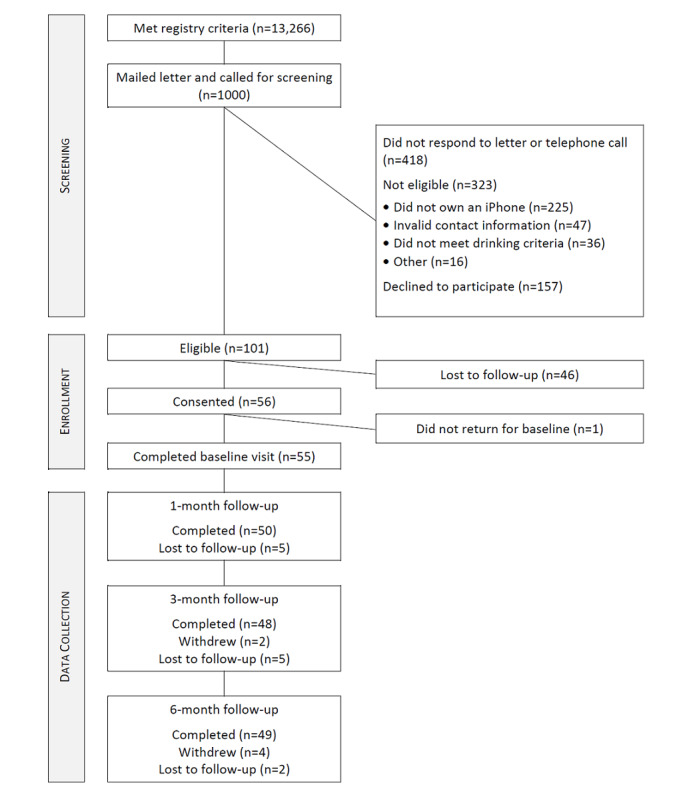
This single-arm pilot study recruited Operation Enduring Freedom and Operation Iraqi Freedom veterans aged 18 to 55 years who exceeded National Institute on Alcohol Abuse and Alcoholism drinking guidelines and owned an iPhone. Enrolled veterans (N=55) completed baseline and 1-, 3-, and 6-month assessments. The System Usability Scale (scaled 1-100, ≥70 indicating acceptable usability) assessed the effectiveness, efficiency, and satisfaction dimensions of usability, while a single item (scaled 1-9) measured the attractiveness of 10 screenshots. Learnability was assessed by app use during week 1. App engagement (proportion of participants using Step Away, episodes of use, and minutes per episode per week) over 6 months measured acceptability. Secondary outcomes included pre-post change on heavy drinking days (men: ≥5 drinks per day; women: ≥4 drinks per day) and Short Inventory of Problems-Revised, Kessler-10, and brief World Health Organization Quality of Life Questionnaire scores.

RESULTS

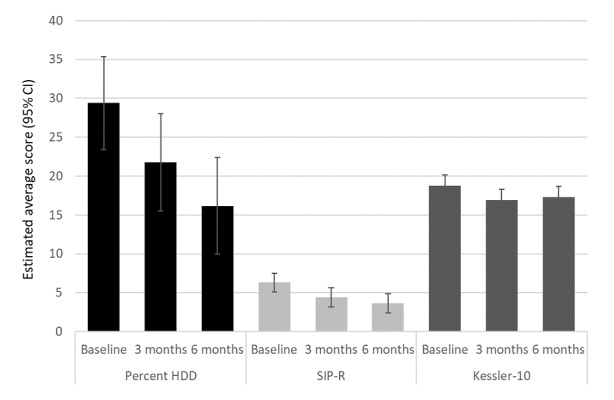
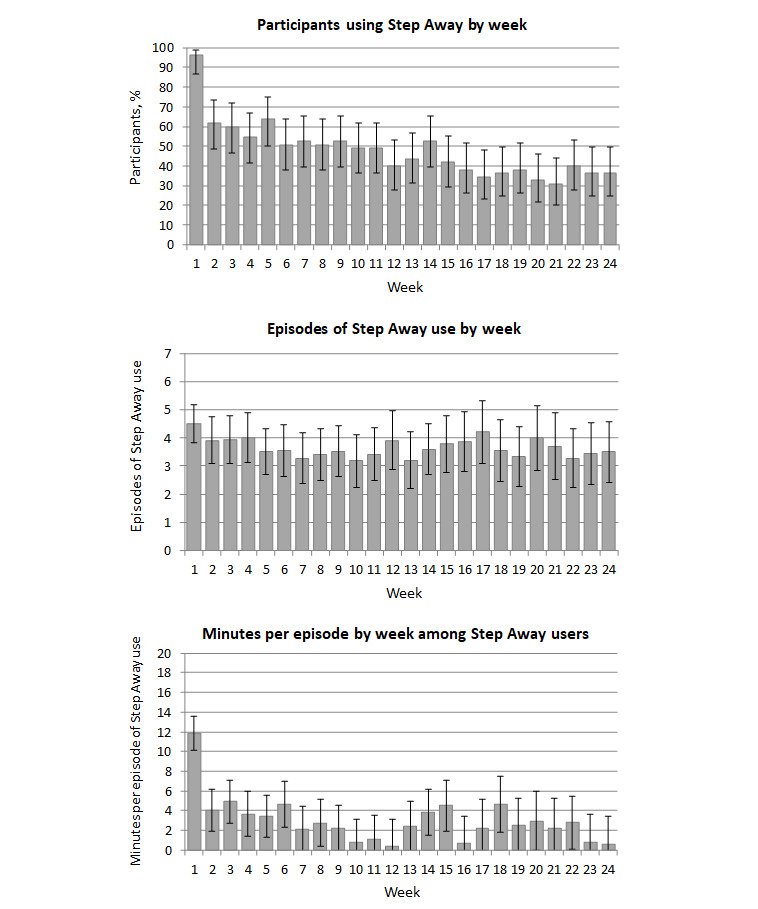
Among the 55 veterans enrolled in the study, the mean age was 37.4 (SD 7.6), 16% (9/55) were women, 82% (45/55) were White, and 82% (45/55) had an alcohol use disorder. Step Away was used by 96% (53/55) of participants in week 1, 55% (30/55) in week 4, and 36% (20/55) in week 24. Step Away use averaged 55.1 minutes (SD 57.6) in week 1 and <15 minutes per week in weeks 2 through 24. Mean System Usability Scale scores were 69.3 (SD 19.7) and 71.9 (SD 15.8) at 1 and 3 months, respectively. Median attractiveness scores ranged from 5 to 8, with lower ratings for text-laden screens. Heavy drinking days decreased from 29.4% (95% CI 23.4%-35.4%) at baseline to 16.2% (95% CI 9.9%-22.4%) at 6 months (P<.001). Likewise, over 6 months, Short Inventory of Problems-Revised scores decreased from 6.3 (95% CI 5.1-7.5) to 3.6 (95% CI 2.4-4.9) (P<.001) and Kessler-10 scores decreased from 18.8 (95% CI 17.4-20.1) to 17.3 (95% CI 15.8-18.7) (P=.046). Changes were not detected on quality of life scores.

CONCLUSIONS

Operation Enduring Freedom and Operation Iraqi Freedom veterans found the usability of Step Away to be acceptable and engaged in the app over the 6-month study. Reductions were seen in heavy drinking days, alcohol-related problems, and Kessler-10 scores. A larger randomized trial is warranted to confirm our findings.

摘要

背景

酒精滥用在阿富汗和伊拉克自由行动的退伍军人中很常见,但由于存在障碍,他们参与治疗的比例有限。移动应用程序有望成为向那些更喜欢匿名、没有太多时间接受传统治疗或居住距离治疗地点太远而无法亲自接受治疗的退伍军人提供酒精干预的手段。

目的

本试点研究评估了 Step Away 的可用性和可接受性,Step Away 是一款旨在降低与酒精相关风险的移动应用程序,并探讨了酒精使用、心理困扰和生活质量的前后变化。

方法

这项单臂试点研究招募了年龄在 18 至 55 岁之间、超过国家酒精滥用和酒精中毒研究所饮酒指南且拥有 iPhone 的阿富汗和伊拉克自由行动的退伍军人。入组的退伍军人(N=55)完成了基线和 1、3 和 6 个月的评估。系统可用性量表(1-100 分,≥70 分表示可接受的可用性)评估了有效性、效率和满意度维度的可用性,而一个单独的项目(1-9 分)衡量了 10 个屏幕截图的吸引力。在第 1 周评估应用程序学习能力。在 6 个月内,通过参与者使用 Step Away 的比例、使用次数和每周每 episode 的分钟数来衡量接受度。次要结局包括 Heavy Drinking Days(男性:≥5 杯/天;女性:≥4 杯/天)和简短的问题清单修订版、Kessler-10 和世界卫生组织生活质量问卷得分的前后变化。

结果

在研究中入组的 55 名退伍军人中,平均年龄为 37.4(SD 7.6),16%(9/55)为女性,82%(45/55)为白人,82%(45/55)患有酒精使用障碍。在第 1 周,有 96%(53/55)的参与者使用了 Step Away,第 4 周为 55%(30/55),第 24 周为 36%(20/55)。第 1 周的平均使用时间为 55.1 分钟(SD 57.6),而在第 2 周到第 24 周,每周的使用时间不到 15 分钟。平均系统可用性量表得分分别为 1 个月时的 69.3(SD 19.7)和 3 个月时的 71.9(SD 15.8)。吸引力评分中位数范围为 5 至 8,文字较多的屏幕评分较低。与基线相比,重度饮酒天数从 29.4%(95%CI 23.4%-35.4%)降至 6 个月时的 16.2%(95%CI 9.9%-22.4%)(P<.001)。同样,在 6 个月期间,简短问题清单修订版评分从 6.3(95%CI 5.1-7.5)降至 3.6(95%CI 2.4-4.9)(P<.001),Kessler-10 评分从 18.8(95%CI 17.4-20.1)降至 17.3(95%CI 15.8-18.7)(P=.046)。生活质量评分没有变化。

结论

阿富汗和伊拉克自由行动的退伍军人发现 Step Away 的可用性可以接受,并在 6 个月的研究中使用了该应用程序。重度饮酒天数、酒精相关问题和 Kessler-10 评分均有所下降。需要进行更大规模的随机试验来证实我们的发现。
https://cdn.ncbi.nlm.nih.gov/pmc/blobs/e29d/8063094/d01dd8d401ec/mhealth_v9i4e25927_fig3.jpg
https://cdn.ncbi.nlm.nih.gov/pmc/blobs/e29d/8063094/a21f4f01d190/mhealth_v9i4e25927_fig1.jpg
https://cdn.ncbi.nlm.nih.gov/pmc/blobs/e29d/8063094/032d46d520b9/mhealth_v9i4e25927_fig2.jpg
https://cdn.ncbi.nlm.nih.gov/pmc/blobs/e29d/8063094/d01dd8d401ec/mhealth_v9i4e25927_fig3.jpg
https://cdn.ncbi.nlm.nih.gov/pmc/blobs/e29d/8063094/a21f4f01d190/mhealth_v9i4e25927_fig1.jpg
https://cdn.ncbi.nlm.nih.gov/pmc/blobs/e29d/8063094/032d46d520b9/mhealth_v9i4e25927_fig2.jpg
https://cdn.ncbi.nlm.nih.gov/pmc/blobs/e29d/8063094/d01dd8d401ec/mhealth_v9i4e25927_fig3.jpg

相似文献

1
Usability and Acceptability of a Mobile App for the Self-Management of Alcohol Misuse Among Veterans (Step Away): Pilot Cohort Study.用于退伍军人酒精滥用自我管理的移动应用程序(Step Away)的可用性和可接受性:试点队列研究。
JMIR Mhealth Uhealth. 2021 Apr 8;9(4):e25927. doi: 10.2196/25927.
2
U.S. veterans' experiences and factors associated with use of a smartphone application to self-manage unhealthy alcohol use.美国退伍军人使用智能手机应用程序自我管理不健康饮酒的经历和相关因素。
Psychol Serv. 2023 Nov;20(4):908-917. doi: 10.1037/ser0000716. Epub 2022 Oct 13.
3
From "Step Away" to "Stand Down": Tailoring a Smartphone App for Self-Management of Hazardous Drinking for Veterans.从“回避”到“放弃”:为退伍军人量身定制一款用于危险饮酒自我管理的智能手机应用程序。
JMIR Mhealth Uhealth. 2020 Feb 13;8(2):e16062. doi: 10.2196/16062.
4
A Personalized Approach Bias Modification Smartphone App ("SWiPE") to Reduce Alcohol Use: Open-Label Feasibility, Acceptability, and Preliminary Effectiveness Study.一款个性化的基于智能手机的饮酒行为修正应用("SWiPE"):开放性可行性、可接受性及初步有效性研究。
JMIR Mhealth Uhealth. 2021 Dec 10;9(12):e31353. doi: 10.2196/31353.
5
Contrasting a Mobile App With a Conversational Chatbot for Reducing Alcohol Consumption: Randomized Controlled Pilot Trial.对比移动应用程序与对话式聊天机器人对减少酒精消费的作用:随机对照试验性研究
JMIR Form Res. 2022 May 16;6(5):e33037. doi: 10.2196/33037.
6
Evaluating the Efficacy of the Drinks:Ration Mobile App to Reduce Alcohol Consumption in a Help-Seeking Military Veteran Population: Randomized Controlled Trial.评估 Drinks:Ration 移动应用程序在寻求帮助的退伍军人人群中减少饮酒量的效果:随机对照试验。
JMIR Mhealth Uhealth. 2022 Jun 20;10(6):e38991. doi: 10.2196/38991.
7
Using peers to increase veterans' engagement in a smartphone application for unhealthy alcohol use: A pilot study of acceptability and utility.利用同伴提高退伍军人使用智能手机应用程序来减少不健康饮酒行为:一项接受度和实用性的初步研究。
Psychol Addict Behav. 2021 Nov;35(7):829-839. doi: 10.1037/adb0000598. Epub 2020 Jun 29.
8
Feasibility, Acceptability, and Preliminary Efficacy of a Smartphone App-Led Cognitive Behavioral Therapy for Depression Under Therapist Supervision: Open Trial.在治疗师监督下,智能手机应用引导的认知行为疗法治疗抑郁症的可行性、可接受性和初步疗效:开放试验。
JMIR Ment Health. 2024 Apr 9;11:e53998. doi: 10.2196/53998.
9
Self-management and Shared Decision-Making in Alcohol Dependence via a Mobile App: a Pilot Study.通过移动应用程序进行酒精依赖的自我管理和共同决策:一项试点研究。
Int J Behav Med. 2017 Oct;24(5):722-727. doi: 10.1007/s12529-017-9643-6.
10
Evaluating the Efficacy of a Mobile App (Drinks:Ration) and Personalized Text and Push Messaging to Reduce Alcohol Consumption in a Veteran Population: Protocol for a Randomized Controlled Trial.评估一款移动应用程序(Drinks:Ration)以及个性化短信和推送消息在减少退伍军人酒精消费方面的效果:一项随机对照试验方案。
JMIR Res Protoc. 2020 Oct 2;9(10):e19720. doi: 10.2196/19720.

引用本文的文献

1
Effectiveness of the WeChat-based mini-program ("Sober Time ACT") on individuals with hazardous drinking in China: a randomized controlled trial.基于微信的小程序(“清醒时刻ACT”)对中国危险饮酒者的有效性:一项随机对照试验。
BMC Med. 2025 Jul 1;23(1):385. doi: 10.1186/s12916-025-04217-5.
2
Prevention of Alcohol-Associated Liver Disease.酒精性肝病的预防
Am J Gastroenterol. 2025 Mar 26. doi: 10.14309/ajg.0000000000003427.
3
Brief report: Aging adult utilization of an mHealth intervention for problem drinking.简要报告:移动健康干预措施在中老年饮酒问题中的应用。

本文引用的文献

1
From "Step Away" to "Stand Down": Tailoring a Smartphone App for Self-Management of Hazardous Drinking for Veterans.从“回避”到“放弃”:为退伍军人量身定制一款用于危险饮酒自我管理的智能手机应用程序。
JMIR Mhealth Uhealth. 2020 Feb 13;8(2):e16062. doi: 10.2196/16062.
2
Mental Health Treatment Delay: A Comparison Among Civilians and Veterans of Different Service Eras.心理健康治疗延迟:不同服务时代的平民和退伍军人之间的比较。
Psychiatr Serv. 2019 May 1;70(5):358-366. doi: 10.1176/appi.ps.201800444. Epub 2019 Mar 7.
3
Mobile Health Interventions for Self-Control of Unhealthy Alcohol Use: Systematic Review.
Front Public Health. 2024 Oct 28;12:1462737. doi: 10.3389/fpubh.2024.1462737. eCollection 2024.
4
Acceptability of "DIDE", a mobile application designed at facilitating care adherence of patients with substance use disorder.接受度研究:“DIDE”,一款旨在促进物质使用障碍患者坚持治疗的移动应用程序。
Addict Sci Clin Pract. 2024 Oct 15;19(1):72. doi: 10.1186/s13722-024-00500-7.
5
User Engagement With mHealth Interventions to Promote Treatment Adherence and Self-Management in People With Chronic Health Conditions: Systematic Review.用户对移动医疗干预措施的参与度,以促进慢性病患者的治疗依从性和自我管理:系统评价。
J Med Internet Res. 2024 Sep 24;26:e50508. doi: 10.2196/50508.
6
Pilot Trial of a Smartphone-Based Intervention to Reduce Alcohol Consumption among Veterans with HIV.一项基于智能手机干预措施以减少感染艾滋病毒退伍军人酒精摄入量的试点试验。
Mil Behav Health. 2023;11(1-2):66-77. doi: 10.1080/21635781.2023.2221465. Epub 2023 Jun 14.
7
Engagement with mHealth Alcohol Interventions: User Perspectives on an App or Chatbot-Delivered Program to Reduce Drinking.参与移动健康酒精干预:用户对应用程序或聊天机器人提供的减少饮酒计划的看法。
Healthcare (Basel). 2024 Jan 2;12(1):101. doi: 10.3390/healthcare12010101.
8
The Cultural Adaption of a Sobriety Support App for Alaska Native and American Indian People: Qualitative Feasibility and Acceptability Study.一款针对阿拉斯加原住民和美国印第安人的戒酒支持应用程序的文化适应性:定性可行性和可接受性研究。
JMIR Form Res. 2023 Feb 7;7:e38894. doi: 10.2196/38894.
9
A Smartphone Physical Activity App for Patients in Alcohol Treatment: Single-Arm Feasibility Trial.一款用于酒精治疗患者的智能手机身体活动应用程序:单臂可行性试验。
JMIR Form Res. 2022 Oct 19;6(10):e35926. doi: 10.2196/35926.
10
U.S. veterans' experiences and factors associated with use of a smartphone application to self-manage unhealthy alcohol use.美国退伍军人使用智能手机应用程序自我管理不健康饮酒的经历和相关因素。
Psychol Serv. 2023 Nov;20(4):908-917. doi: 10.1037/ser0000716. Epub 2022 Oct 13.
移动健康干预措施对控制不健康饮酒的作用:系统评价。
JMIR Mhealth Uhealth. 2019 Jan 29;7(1):e10899. doi: 10.2196/10899.
4
Predictors of Engagement, Response to Follow Up, and Extent of Alcohol Reduction in Users of a Smartphone App (Drink Less): Secondary Analysis of a Factorial Randomized Controlled Trial.智能手机应用程序(少饮酒)使用者参与度、随访反应及酒精减少程度的预测因素:析因随机对照试验的二次分析
JMIR Mhealth Uhealth. 2018 Dec 14;6(12):e11175. doi: 10.2196/11175.
5
Customizing a clinical app to reduce hazardous drinking among veterans in primary care.定制临床应用程序以减少初级保健中的退伍军人危险饮酒。
Psychol Serv. 2019 May;16(2):250-254. doi: 10.1037/ser0000300. Epub 2018 Nov 8.
6
A Smartphone App and Personalized Text Messaging Framework (InDEx) to Monitor and Reduce Alcohol Use in Ex-Serving Personnel: Development and Feasibility Study.一款用于监测和减少退役军人酒精使用的智能手机应用程序和个性化短信框架(InDEx):开发与可行性研究。
JMIR Mhealth Uhealth. 2018 Sep 11;6(9):e10074. doi: 10.2196/10074.
7
Veterans' Attitudes Toward Smartphone App Use for Mental Health Care: Qualitative Study of Rurality and Age Differences.退伍军人对用于精神卫生保健的智能手机应用程序的态度:农村地区和年龄差异的定性研究
JMIR Mhealth Uhealth. 2018 Aug 22;6(8):e10748. doi: 10.2196/10748.
8
The Role of Technology-Based Interventions for Substance Use Disorders in Primary Care: A Review of the Literature.基于技术的干预措施在初级保健中治疗物质使用障碍的作用:文献综述。
Med Clin North Am. 2018 Jul;102(4):715-731. doi: 10.1016/j.mcna.2018.02.011.
9
There is an app for that - Or is there? A content analysis of publicly available smartphone apps for managing alcohol use.有一款应用程序可以做到这一点——真的有吗?对可公开获取的用于管理饮酒行为的智能手机应用程序的内容分析。
J Subst Abuse Treat. 2017 Nov;82:67-73. doi: 10.1016/j.jsat.2017.09.006. Epub 2017 Sep 12.
10
Efficacy and outcomes of a mobile app targeting alcohol use in young people.针对年轻人饮酒问题的移动应用程序的疗效和结果。
Addict Behav. 2018 Feb;77:89-95. doi: 10.1016/j.addbeh.2017.09.020. Epub 2017 Sep 29.