Department of Community Medicine, Faculty of Medicine and Allied Sciences, Rajarata University of Sri Lanka, Anuradhapura, Sri Lanka.
Department of Social and Behavioral Science, Yale School of Public Health, New Haven, USA.
Int Breastfeed J. 2021 Apr 8;16(1):32. doi: 10.1186/s13006-021-00378-0.
Sri Lanka was named as the first-ever 'Green' breastfeeding nation status by the World Breastfeeding Trends Initiative (WBTi) in January 2020. However, improvements are still needed. This study aims to identify barriers and facilitators for early initiation of breastfeeding and exclusive breastfeeding for 6 months in rural Sri Lanka.
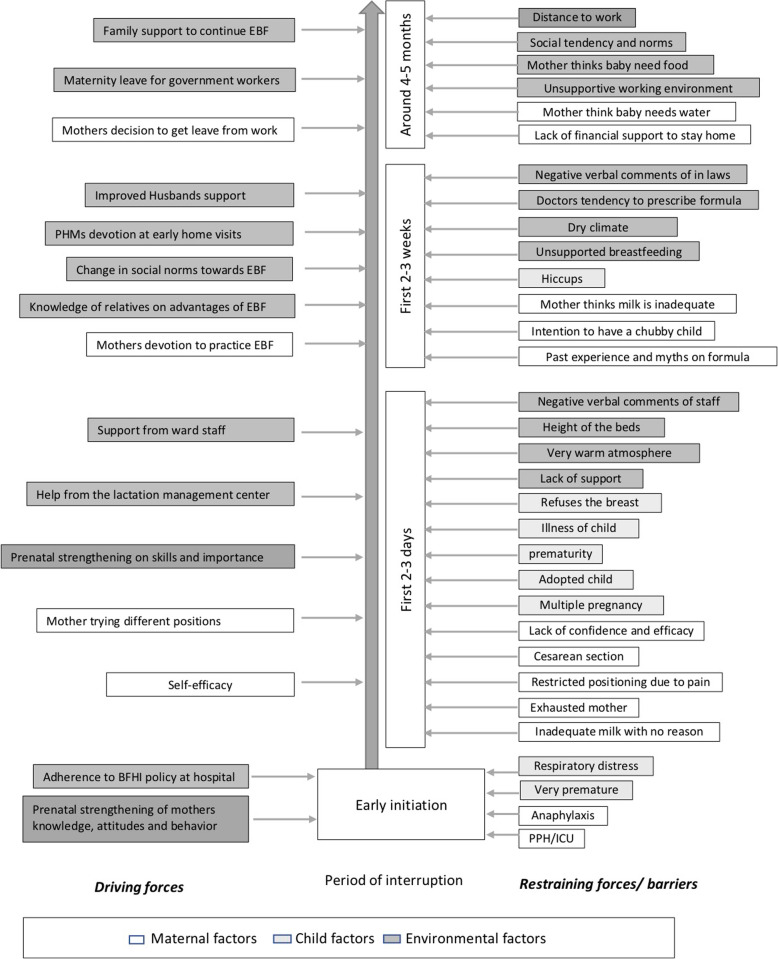
We conducted in-depth interviews with 16 mothers with infants, who had been unable to practice early initiation of breastfeeding and/or exclusive breastfeeding (EBF), in six child-welfare clinics in Anuradhapura, Sri Lanka. Three focus group discussions were held with public health midwives (PHMs). Initial thematic analysis that built upon force field and social learning theories was performed.
Main barriers for EBF were clustered at three time periods; during the first 2-3 days, 2-3 weeks, and 4-5 months postpartum. Early barriers included cesarean section pain, poor breast latch, maternal exhaustion, suboptimal maternity ward environment, and lack of support for breastfeeding. Around 2-3 weeks postpartum mothers introduced water or infant formula due to social norms and poor support. On-demand feeding was misunderstood. Around 4 and 5 months postpartum, EBF ended due to return to work. PHMs reported a heavy workload limiting their time to support breastfeeding.
EBF interruption was due to diverse individual- and environnmental- level barriers that varied across the first 6 months. To improve EBF, Sri Lanka should focus on strengthening policies for reducing the excessive rates of cesarean section, improving support in maternity ward facilities, fostering on-demand breastfeeding, enhancing support for working mothers and reducing the work load of PHMs.
2020 年 1 月,世界母乳喂养趋势倡议组织(WBTi)将斯里兰卡评为首个“绿色”母乳喂养国家。然而,仍需做出改进。本研究旨在确定斯里兰卡农村地区早期开始母乳喂养和纯母乳喂养 6 个月的障碍和促进因素。
我们在斯里兰卡阿努拉德普勒的六家儿童保健诊所对 16 名无法进行早期母乳喂养和/或纯母乳喂养(EBF)的母婴进行了深入访谈。与三名公共卫生助产士(PHM)进行了三次焦点小组讨论。采用基于力场和社会学习理论的初步主题分析。
EBF 的主要障碍集中在三个时期:产后 2-3 天、2-3 周和 4-5 个月。早期的障碍包括剖宫产疼痛、乳头衔接不良、产妇疲劳、分娩环境不佳以及缺乏母乳喂养支持。大约在产后 2-3 周,由于社会规范和支持不佳,母亲会给婴儿喂水或婴儿配方奶粉。按需喂养被误解。大约在产后 4-5 个月,由于重返工作岗位,EBF 结束。PHM 报告说,工作量大限制了他们支持母乳喂养的时间。
EBF 的中断是由于多样化的个体和环境层面的障碍,这些障碍在头 6 个月内有所不同。为了改善 EBF,斯里兰卡应专注于加强政策以降低剖宫产率、改善产房设施中的支持、促进按需母乳喂养、加强对工作母亲的支持和减轻 PHM 的工作量。