USF Health Byrd Alzheimer's Institute, University of South Florida, Tampa, FL, 33613, USA.
Department of Molecular Medicine, Morsani College of Medicine, University of South Florida, Tampa, FL, 33620, USA.
Acta Neuropathol Commun. 2021 Apr 8;9(1):65. doi: 10.1186/s40478-021-01159-w.
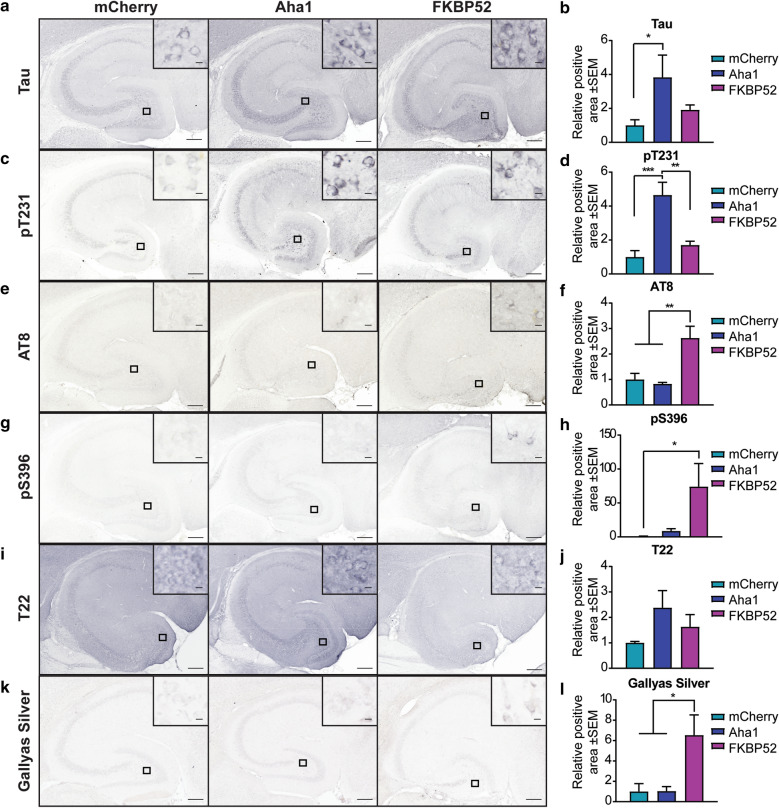
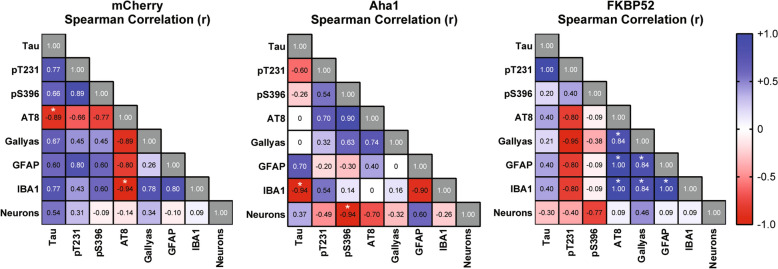
The microtubule associated protein tau is an intrinsically disordered phosphoprotein that accumulates under pathological conditions leading to formation of neurofibrillary tangles, a hallmark of Alzheimer's disease (AD). The mechanisms that initiate the accumulation of phospho-tau aggregates and filamentous deposits are largely unknown. In the past, our work and others' have shown that molecular chaperones play a crucial role in maintaining protein homeostasis and that imbalance in their levels or activity can drive tau pathogenesis. We have found two co-chaperones of the 90 kDa heat shock protein (Hsp90), FK506-binding protein 52 (FKBP52) and the activator of Hsp90 ATPase homolog 1 (Aha1), promote tau aggregation in vitro and in the brains of tau transgenic mice. Based on this, we hypothesized that increased levels of these chaperones could promote tau misfolding and accumulation in the brains of aged wild-type mice. We tested this hypothesis by overexpressing Aha1, FKBP52, or mCherry (control) proteins in the hippocampus of 9-month-old wild-type mice. After 7 months of expression, mice were evaluated for cognitive and pathological changes. Our results show that FKBP52 overexpression impaired spatial reversal learning, while Aha1 overexpression impaired associative learning in aged wild-type mice. FKBP52 and Aha1 overexpression promoted phosphorylation of distinct AD-relevant tau species. Furthermore, FKBP52 activated gliosis and promoted neuronal loss leading to a reduction in hippocampal volume. Glial activation and phospho-tau accumulation were also detected in areas adjacent to the hippocampus, including the entorhinal cortex, suggesting that after initiation these pathologies can propagate through other brain regions. Overall, our findings suggest a role for chaperone imbalance in the initiation of tau accumulation in the aging brain.
微管相关蛋白 tau 是一种固有无序的磷酸化蛋白,在导致神经原纤维缠结形成的病理条件下积累,这是阿尔茨海默病 (AD) 的一个标志。启动磷酸化 tau 聚集和丝状沉积物积累的机制在很大程度上尚不清楚。过去,我们的工作和其他人的工作表明,分子伴侣在维持蛋白质内稳态方面起着至关重要的作用,它们的水平或活性失衡可能导致 tau 发病机制。我们发现 90 kDa 热休克蛋白 (Hsp90) 的两个伴侣蛋白 FK506 结合蛋白 52 (FKBP52) 和 Hsp90 ATP 酶激活因子 1 (Aha1) 促进 tau 在体外和 tau 转基因小鼠的大脑中聚集。基于此,我们假设这些伴侣蛋白水平的增加可能会促进衰老野生型小鼠大脑中的 tau 错误折叠和积累。我们通过在 9 个月大的野生型小鼠的海马体中过表达 Aha1、FKBP52 或 mCherry(对照)蛋白来检验这一假设。表达 7 个月后,对小鼠进行认知和病理变化评估。我们的结果表明,FKBP52 过表达损害了空间反转学习,而 Aha1 过表达损害了老年野生型小鼠的联想学习。FKBP52 和 Aha1 的过表达促进了不同 AD 相关 tau 物种的磷酸化。此外,FKBP52 激活神经胶质细胞并促进神经元丢失,导致海马体体积减少。在海马体相邻区域(包括内嗅皮层)也检测到神经胶质激活和磷酸化 tau 积累,这表明这些病理学在启动后可以在其他脑区传播。总体而言,我们的研究结果表明,伴侣蛋白失衡在衰老大脑中 tau 积累的启动中起作用。