Konarev Petr V, Gruzinov Andrey Yu, Mertens Haydyn D T, Svergun Dmitri I
A. V. Shubnikov Institute of Crystallography, Federal Scientific Research Centre 'Crystallography and Photonics' of Russian Academy of Sciences, Leninsky prospekt 59, Moscow, 119333, Russian Federation.
Hamburg Outstation, European Molecular Biology Laboratory, Notkestrasse 85, Hamburg, 22607, Germany.
J Appl Crystallogr. 2021 Feb 1;54(Pt 1):169-179. doi: 10.1107/S1600576720015368.
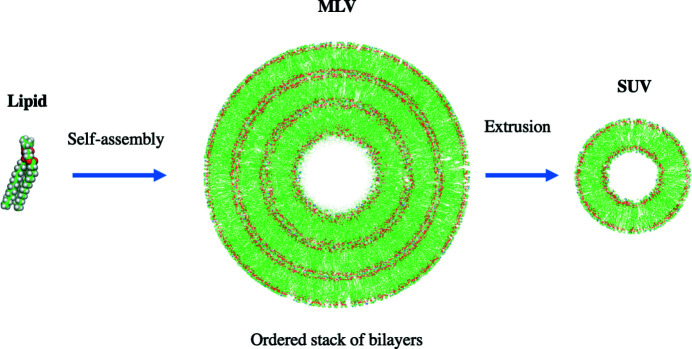
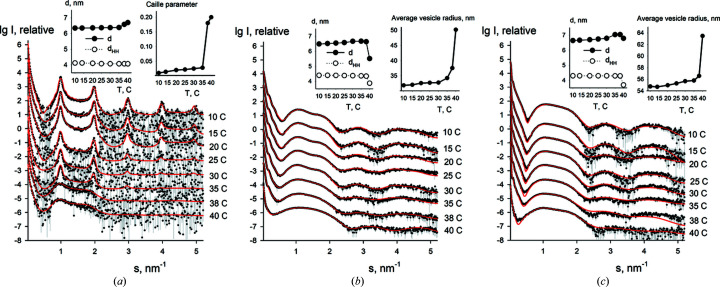
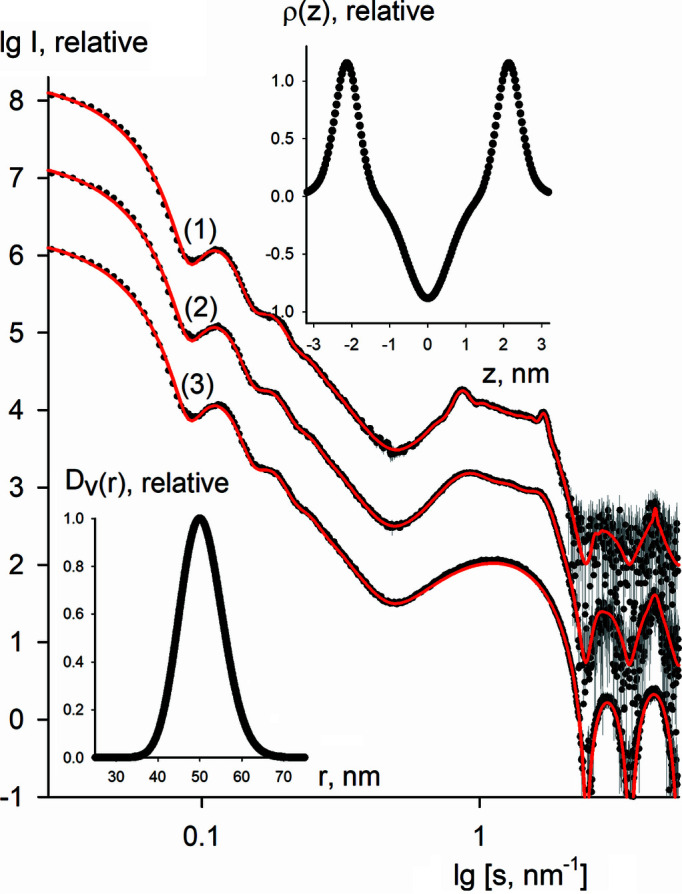
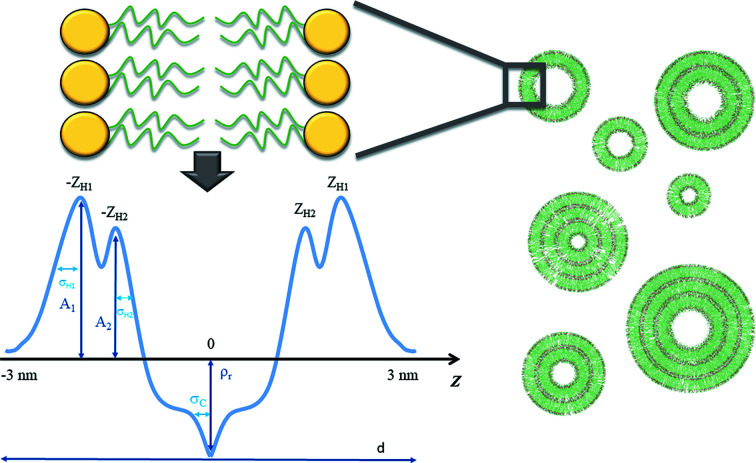
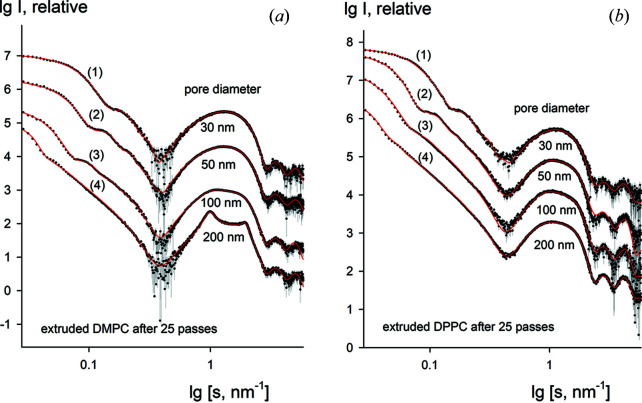
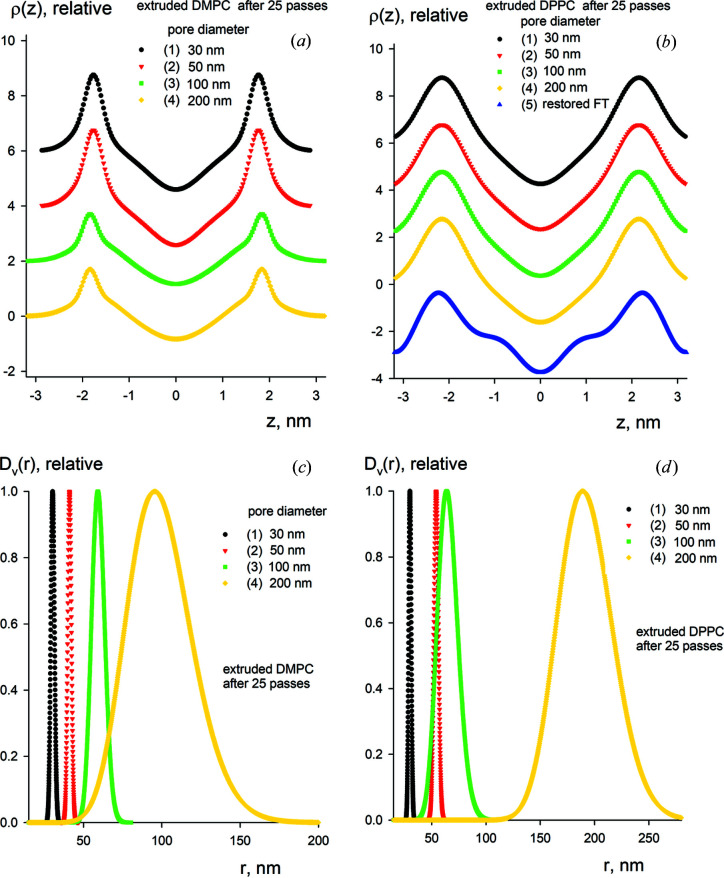
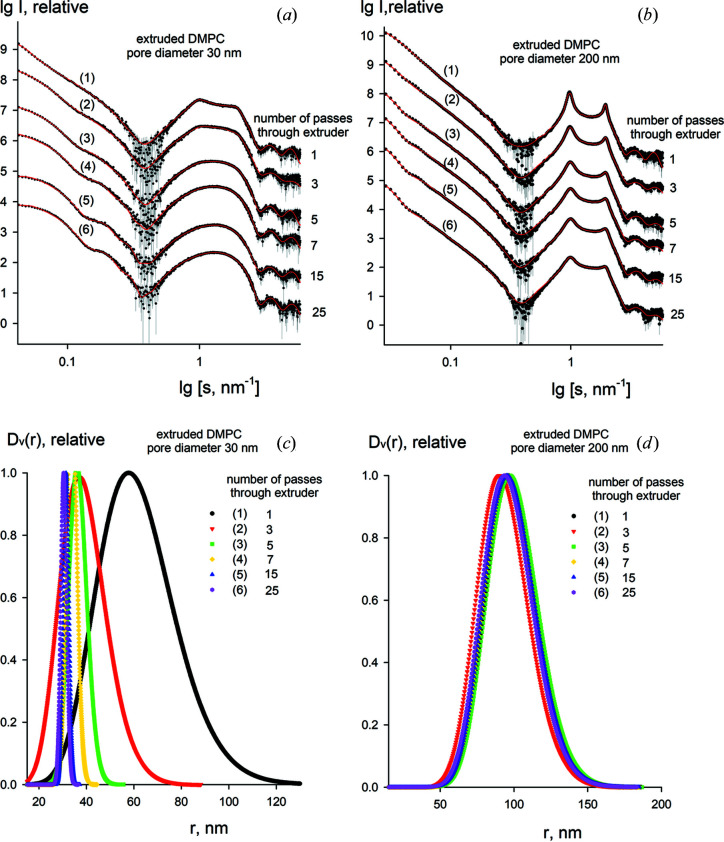
Small-angle X-ray scattering (SAXS) is widely utilized to study soluble macromolecules, including those embedded into lipid carriers and delivery systems such as surfactant micelles, phospho-lipid vesicles and bilayered nanodiscs. To adequately describe the scattering from such systems, one needs to account for both the form factor (overall structure) and long-range-order Bragg reflections emerging from the organization of bilayers, which is a non-trivial task. Presently existing methods separate the analysis of lipid mixtures into distinct procedures using form-factor fitting and the fitting of the Bragg peak regions. This article describes a general approach for the computation and analysis of SAXS data from lipid mixtures over the entire angular range of an experiment. The approach allows one to restore the electron density of a lipid bilayer and simultaneously recover the corresponding size distribution and multilamellar organization of the vesicles. The method is implemented in a computer program, , and its performance is demonstrated on an aqueous solution of layered lipid vesicles undergoing an extrusion process. The approach is expected to be useful for the analysis of various types of lipid-based systems, for the characterization of interactions between target drug molecules and potential carrier/delivery systems.
小角X射线散射(SAXS)被广泛用于研究可溶性大分子,包括嵌入脂质载体和递送系统中的大分子,如表面活性剂胶束、磷脂囊泡和双层纳米盘。为了充分描述此类系统的散射,需要考虑形状因子(整体结构)和由双层结构产生的长程有序布拉格反射,这并非易事。目前现有的方法使用形状因子拟合和布拉格峰区域拟合将脂质混合物的分析分为不同的步骤。本文描述了一种在实验的整个角度范围内计算和分析脂质混合物SAXS数据的通用方法。该方法可以恢复脂质双层的电子密度,同时获得相应的囊泡尺寸分布和多层结构。该方法在计算机程序中实现,并在经历挤压过程的层状脂质囊泡水溶液上展示了其性能。该方法有望用于分析各种类型的脂质基系统,用于表征靶标药物分子与潜在载体/递送系统之间的相互作用。