Yan Zhipeng, Yang Ming, Lai Ching-Lung
Department of Medicine, Queen Mary Hospital, The University of Hong Kong, Hong Kong, Hong Kong.
Department of Ophthalmology, The University of Hong Kong, Hong Kong, Hong Kong.
Clin Endocrinol (Oxf). 2021 Sep;95(3):478-488. doi: 10.1111/cen.14479. Epub 2021 May 5.
To evaluate the efficacy of lenvatinib in the treatment of radioiodine-refractory thyroid carcinoma.
Thyroid carcinoma is one of the top ten carcinomas worldwide. Clinically, thyroid cancers are managed with resections and adjuvant therapy with radioiodine. However, radioiodine is not effective for radioiodine-refractory (RR) thyroid carcinoma in some patients. Lenvatinib is a multi-kinase inhibitor for the treatment of RR thyroid carcinoma. Several clinical trials showed its efficacy in prolonging progression-free survival (PFS) and overall survival (OS).
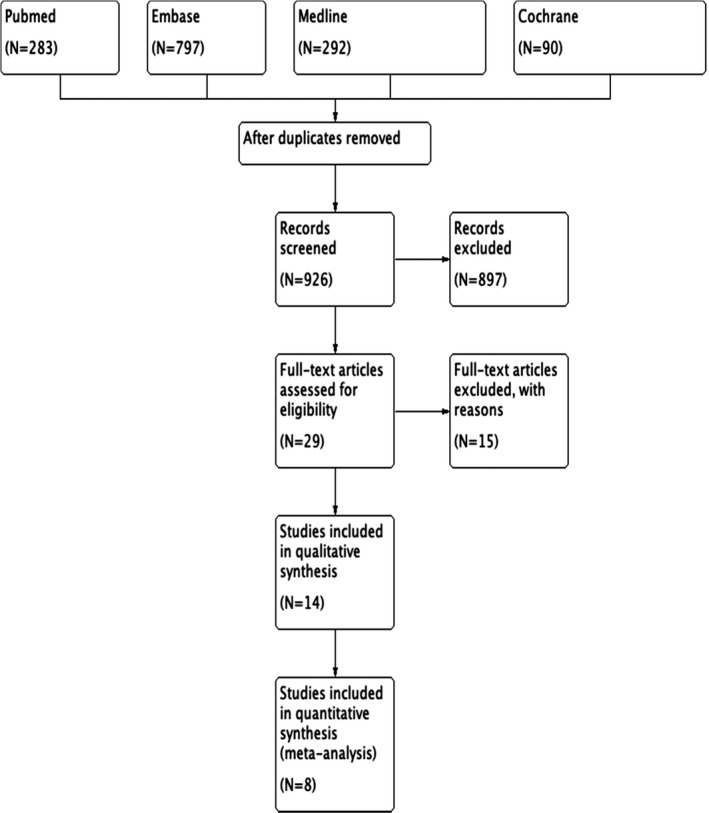
DESIGN, PATIENTS AND MEASUREMENTS: A systematic search was done on databases (PubMed, Embase, MEDLINE, Cochrane) on 8 June 2020. Search keywords were lenvatinib, thyroid carcinoma and randomized controlled trials. Clinical trials fulfilling the SELECT protocol were selected to evaluate the efficacy of lenvatinib in terms of prolongation of PFS, OS and objective response rate (ORR). The risk ratio and distribution of grade 3 or above adverse events were documented.
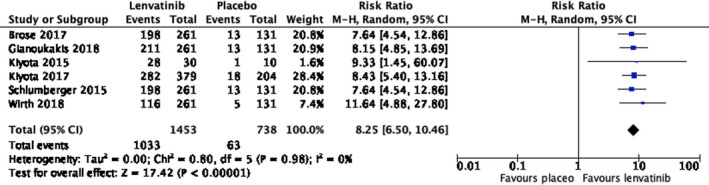
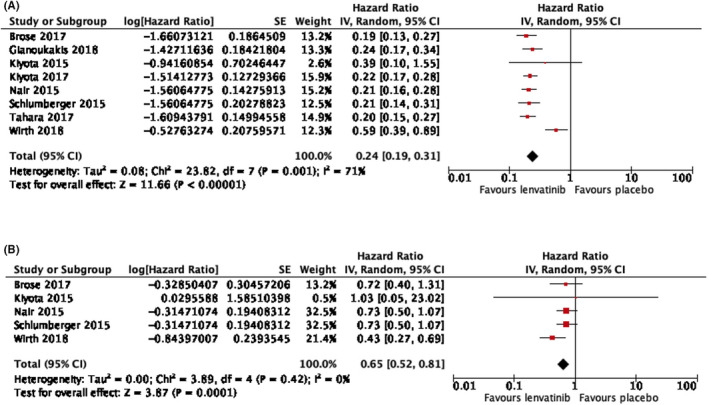
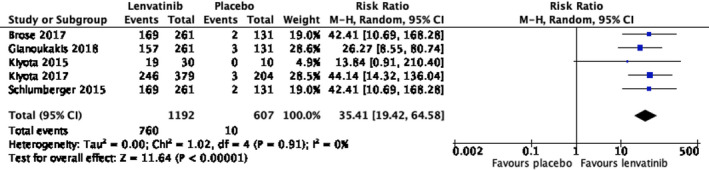
Of the 3997 patients of mean age 62.5 years in fifteen selected studies, lenvatinib is associated with prolonged PFS (hazard ratio 0.24, 95% CI, 0.19-0.31, p < .001) and OS (hazard ratio 0.65, 95% CI, 0.52-0.81, p < .001). Compared with placebo, the risk ratio of ORR and incidence of grade 3 or above adverse events are 35.41 (95% CI, 19.42-64.58, p < .001) and 8.25 (95% CI, 6.50-10.46, p < .001), respectively. Subgroup analysis shows that lenvatinib is effective for all patients with RR thyroid carcinoma, regardless of age, histological subtypes, radiological subtypes and mutation status.
Lenvatinib is effective in the treatment of RR thyroid carcinoma. Close monitoring of serious adverse events is recommended.
评估乐伐替尼治疗放射性碘难治性甲状腺癌的疗效。
甲状腺癌是全球十大癌症之一。临床上,甲状腺癌通过手术切除和放射性碘辅助治疗。然而,放射性碘对某些患者的放射性碘难治性(RR)甲状腺癌无效。乐伐替尼是一种用于治疗RR甲状腺癌的多激酶抑制剂。多项临床试验显示其在延长无进展生存期(PFS)和总生存期(OS)方面的疗效。
设计、患者与测量:于2020年6月8日在数据库(PubMed、Embase、MEDLINE、Cochrane)上进行系统检索。检索关键词为乐伐替尼、甲状腺癌和随机对照试验。选择符合SELECT方案的临床试验,以评估乐伐替尼在延长PFS、OS和客观缓解率(ORR)方面的疗效。记录3级及以上不良事件的风险比和分布情况。
在15项入选研究中的3997例平均年龄为62.5岁的患者中,乐伐替尼与延长PFS(风险比0.24,95%CI,0.19 - 0.31,p <.001)和OS(风险比0.65,95%CI,0.52 - 0.81,p <.001)相关。与安慰剂相比,ORR的风险比和3级及以上不良事件的发生率分别为35.41(9�%CI,19.42 - 64.58,p <.001)和8.25(95%CI,6.50 - 10.46,p <.001)。亚组分析表明,乐伐替尼对所有RR甲状腺癌患者均有效,无论年龄、组织学亚型、放射学亚型和突变状态如何。
乐伐替尼治疗RR甲状腺癌有效。建议密切监测严重不良事件。