Lee Jeeun, Lee Jeongjae, Lee Minwoo, Lim Jae Sung, Kim Jin Hyouk, Yu Kyung Ho, Oh Mi Sun, Lee Byung Chul
Department of Neurology, Seoul National University Hospital, Seoul, Korea.
Department of Neurology, Hallym University Sacred Heart Hospital, Anyang, Korea.
J Clin Neurol. 2021 Apr;17(2):206-212. doi: 10.3988/jcn.2021.17.2.206.
Serum insulin-like growth factor-1 (IGF-1) is known to have a neuroprotective effect. This study aimed to determine the effects of serum IGF-1 on the severity and clinical outcome of acute ischemic stroke (AIS).
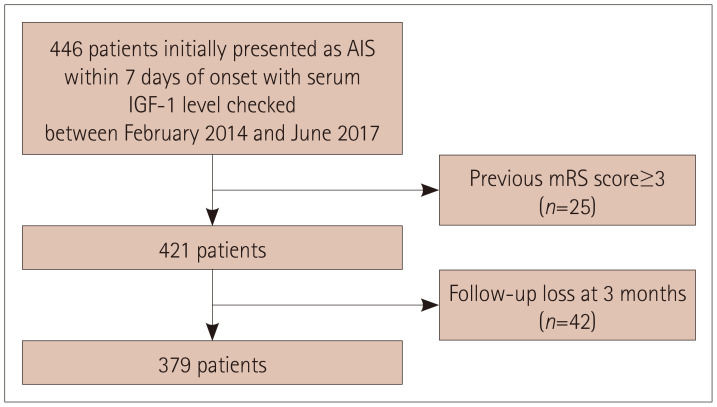
This study included 446 patients with AIS who were admitted to Hallym University Sacred Heart Hospital within 7 days of stroke onset from February 2014 to June 2017. Serum IGF-1 levels were measured within 24 hours of admission. Stroke severity was measured using the National Institutes of Health Stroke Scale (NIHSS) score at admission, and the functional outcome at 3 months after symptom onset was assessed using the modified Rankin Scale score. The effects of serum IGF-1 levels on stroke severity and 3-month functional outcomes were analyzed using multivariate logistic regression analysis.
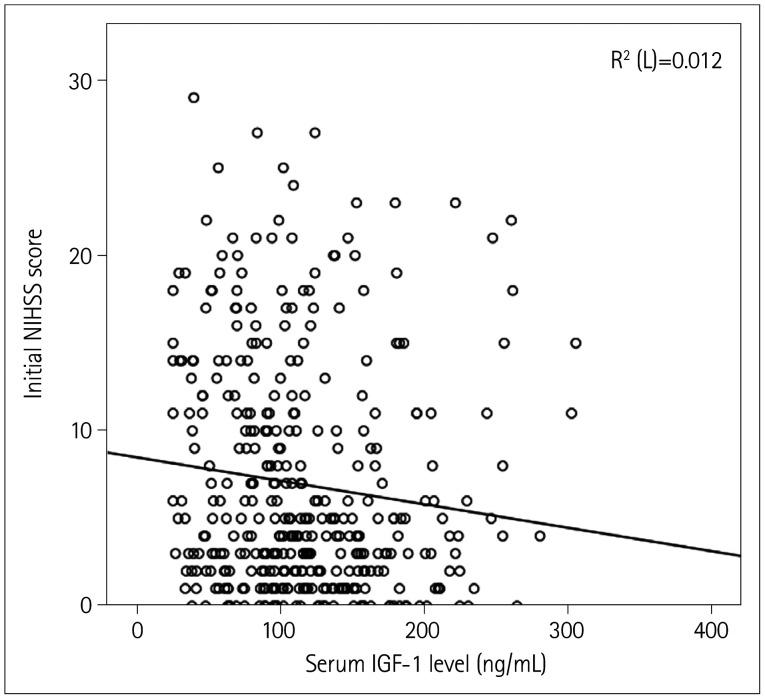
This study evaluated 379 patients with AIS (age 67.2±12.6 years, mean±standard deviation; 59.9% males) after excluding 67 patients who had a history of previous stroke (=25) or were lost to follow-up at 3 months (=42). After adjusting for clinically relevant covariates, a higher serum IGF-1 level was associated with a lower NIHSS score at admission (adjusted odds ratio=0.44, 95% confidence interval=0.24-0.80, =0.01), while there was no significant association at 3 months.
This study showed that a higher serum IGF-1 level is associated with a lower NIHSS score at admission but not at 3 months. Further studies are required to clarify the usefulness of the serum IGF-1 level as a prognostic marker for ischemic stroke.
已知血清胰岛素样生长因子-1(IGF-1)具有神经保护作用。本研究旨在确定血清IGF-1对急性缺血性卒中(AIS)严重程度及临床结局的影响。
本研究纳入了2014年2月至2017年6月期间在翰林大学圣心医院卒中发作7天内入院的446例AIS患者。入院后24小时内测定血清IGF-1水平。入院时使用美国国立卫生研究院卒中量表(NIHSS)评分评估卒中严重程度,症状发作3个月后使用改良Rankin量表评分评估功能结局。采用多因素逻辑回归分析血清IGF-1水平对卒中严重程度及3个月功能结局的影响。
排除67例既往有卒中病史(=25)或3个月失访(=42)的患者后,本研究评估了379例AIS患者(年龄67.2±12.6岁,均值±标准差;男性占59.9%)。在对临床相关协变量进行校正后,较高的血清IGF-1水平与入院时较低的NIHSS评分相关(校正比值比=0.44,95%置信区间=0.24 - 0.80,=0.01),而在3个月时无显著相关性。
本研究表明,较高的血清IGF-1水平与入院时较低的NIHSS评分相关,但与3个月时的评分无关。需要进一步研究以阐明血清IGF-1水平作为缺血性卒中预后标志物的有用性。