Anthony Nolan Research Institute, Royal Free Hospital, London, UK.
UCL Cancer Institute, University College London, London, UK.
J Clin Oncol. 2021 Jul 20;39(21):2397-2409. doi: 10.1200/JCO.20.03643. Epub 2021 Apr 9.
Ultrahigh resolution (UHR) HLA matching is reported to result in better outcomes following unrelated donor hematopoietic cell transplantation, improving survival and reducing post-transplant complications. However, most studies included relatively small numbers of patients. Here we report the findings from a large, multicenter validation study.
UHR HLA typing was available on 5,140 conventionally 10 out of 10 HLA-matched patients with malignant disease transplanted between 2008 and 2017.
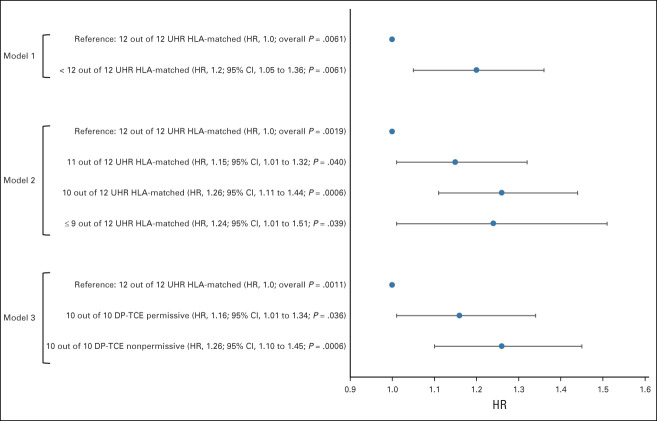
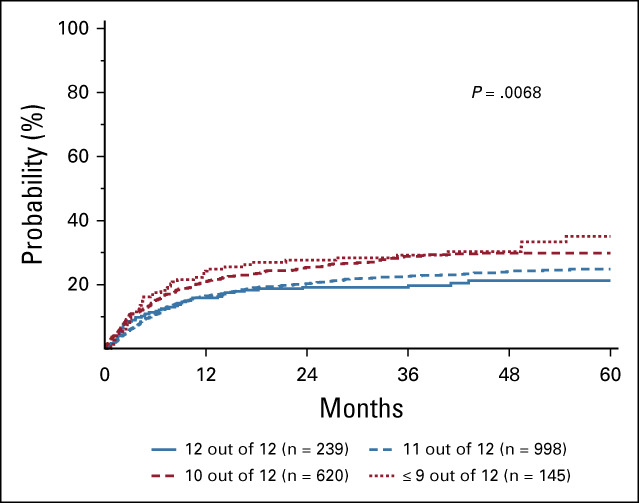
After UHR HLA typing, 82% of pairs remained 10 out of 10 UHR-matched; 12.3% of patients were 12 out of 12 UHR HLA-matched. Compared with 12 out of 12 UHR-matched patients, probabilities of grade 2-4 acute graft-versus-host disease (aGVHD) were significantly increased with UHR mismatches (overall = .0019) and in those patients who were HLA-DPB1 T-cell epitope permissively mismatched or nonpermissively mismatched (overall = .0011). In the T-cell-depleted subset, the degree of UHR HLA mismatch was only associated with increased transplant-related mortality (TRM) (overall = .0068). In the T-cell-replete subset, UHR HLA matching was associated with a lower probability of aGVHD (overall = .0020); 12 out of 12 UHR matching was associated with reduced TRM risk when compared with HLA-DPB1 T-cell epitope permissively mismatched patients, whereas nonpermissive mismatching resulted in a greater risk (overall = .0003).
This study did not confirm that UHR 12 out of 12 HLA matching increases the probability of overall survival but does demonstrate that aGVHD risk, and in certain settings TRM, is lowest in UHR HLA-matched pairs and thus warrants consideration when multiple 10 out of 10 HLA-matched donors of equivalent age are available.
超高分辨率(UHR)HLA 配型可改善无关供者造血细胞移植后的结局,提高生存率并降低移植后并发症。然而,大多数研究纳入的患者数量相对较少。本研究报道了一项大型多中心验证研究的结果。
2008 年至 2017 年间,5140 例接受常规 10/10 HLA 配型的恶性疾病患者接受了 UHR HLA 分型。
UHR HLA 分型后,82%的配对仍为 10/10 UHR 配型;12.3%的患者为 12/12 UHR HLA 配型。与 12/12 UHR 配型患者相比,UHR 错配患者的 2-4 级急性移植物抗宿主病(aGVHD)发生概率显著增加(总体=0.0019),且在 HLA-DPB1 T 细胞表位允许错配或不允许错配的患者中也是如此(总体=0.0011)。在 T 细胞耗竭亚组中,UHR HLA 错配程度仅与移植相关死亡率(TRM)增加相关(总体=0.0068)。在 T 细胞丰富亚组中,UHR HLA 配型与较低的 aGVHD 发生概率相关(总体=0.0020);与 HLA-DPB1 T 细胞表位允许错配的患者相比,12/12 UHR 配型与降低 TRM 风险相关,而不允许错配则导致更高的风险(总体=0.0003)。
本研究未证实 UHR 12/12 HLA 配型可提高总体生存率的概率,但确实表明,在 UHR HLA 配型的配对中,aGVHD 风险最低,在某些情况下 TRM 也最低,因此在有多个年龄相当的 10/10 HLA 配型供者可供选择时,值得考虑。