Wang Ling, Laird-Fick Heather S, Parker Carol J, Solomon David
Department of Medicine, Michigan State University, 909 Wilson Rd, 120 West Fee Hall, East Lansing, MI, 48824, USA.
Office of Medical Education Research and Development (OMERAD), Michigan State University, East Lansing, MI, USA.
BMC Med Educ. 2021 Apr 9;21(1):200. doi: 10.1186/s12909-021-02633-8.
Medical students must meet curricular expectations and pass national licensing examinations to become physicians. However, no previous studies explicitly modeled stages of medical students acquiring basic science knowledge. In this study, we employed an innovative statistical model to characterize students' growth using progress testing results over time and predict licensing examination performance.
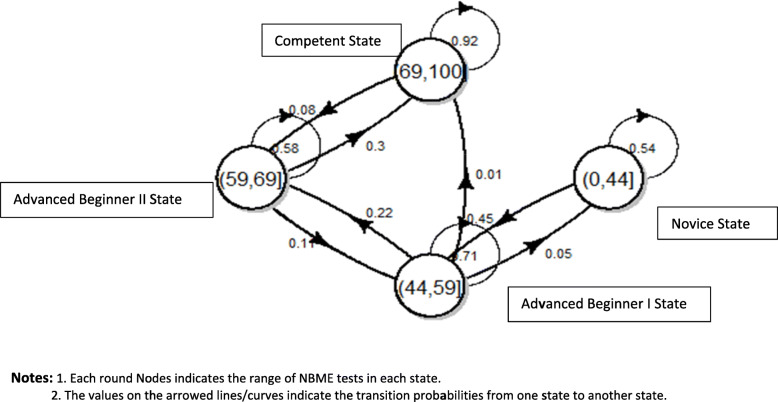
All students matriculated from 2016 to 2017 in our medical school with USMLE Step 1 test scores were included in this retrospective cohort study (N = 358). Markov chain method was employed to: 1) identify latent states of acquiring scientific knowledge based on progress tests and 2) estimate students' transition probabilities between states. The primary outcome of this study, United States Medical Licensing Examination (USMLE) Step 1 performance, were predicted based on students' estimated probabilities in each latent state identified by Markov chain model.
Four latent states were identified based on students' progress test results: Novice, Advanced Beginner I, Advanced Beginner II and Competent States. At the end of the first year, students predicted to remain in the Novice state had lower mean Step 1 scores compared to those in the Competent state (209, SD = 14.8 versus 255, SD = 10.8 respectively) and had more first attempt failures (11.5% versus 0%). On regression analysis, it is found that at the end of the first year, if there was 10% higher chance staying in Novice State, Step 1 scores will be predicted 2.0 points lower (95% CI: 0.85-2.81 with P < .01); while 10% higher chance in Competent State, Step 1scores will be predicted 4.3 points higher (95% CI: 2.92-5.19 with P < .01). Similar findings were also found at the end of second year medical school.
Using the Markov chain model to analyze longitudinal progress test performance offers a flexible and effective estimation method to identify students' transitions across latent stages for acquiring scientific knowledge. The results can help identify students who are at-risk for licensing examination failure and may benefit from targeted academic support.
医学生必须达到课程要求并通过国家执业资格考试才能成为医生。然而,以前没有研究明确构建医学生获取基础科学知识的阶段模型。在本研究中,我们采用了一种创新的统计模型,利用随时间推移的进步测试结果来描述学生的成长情况,并预测执业资格考试成绩。
本回顾性队列研究纳入了2016年至2017年进入我校医学院且有美国医师执照考试第一步(USMLE Step 1)成绩的所有学生(N = 358)。采用马尔可夫链方法来:1)根据进步测试确定获取科学知识的潜在状态;2)估计学生在各状态之间的转换概率。基于马尔可夫链模型确定的每个潜在状态下学生的估计概率,预测本研究的主要结果——美国医师执照考试第一步(USMLE Step 1)成绩。
根据学生的进步测试结果确定了四个潜在状态:新手、初级I、初级II和胜任状态。在第一学年末,预计仍处于新手状态的学生的第一步平均成绩低于胜任状态的学生(分别为209分,标准差 = 14.8;255分,标准差 = 10.8),首次考试不及格的比例也更高(11.5%对0%)。回归分析发现,在第一学年末,如果留在新手状态的概率增加10%,预计第一步成绩将低2.0分(95%置信区间:0.85 - 2.81,P <.01);而在胜任状态的概率增加10%,预计第一步成绩将高4.3分(95%置信区间:2.92 - 5.19,P <.01)。在医学院第二学年末也发现了类似结果。
使用马尔可夫链模型分析纵向进步测试成绩,为识别学生在获取科学知识的潜在阶段的转变提供了一种灵活有效的估计方法。结果有助于识别有执业资格考试不及格风险的学生,这些学生可能会从有针对性的学业支持中受益。