Faistauer Marina, Lang Silva Alice, Félix Têmis Maria, Todeschini de Souza Liliane, Bohn Renata, Selaimen da Costa Sady, Petersen Schmidt Rosito Letícia
Universidade Federal do Rio Grande do Sul, Faculdade de Medicina, Porto Alegre, RS, Brazil.
Hospital de Clínicas de Porto Alegre, Departamento de Otorrinolaringologia e Cirurgia de Cabeça e Pescoço, Porto Alegre, RS, Brazil; Universidade Federal do Rio Grande do Sul, Faculdade de Medicina, Departamento de Oftalmologia e Otorrinolaringologia, Porto Alegre, RS, Brazil.
Braz J Otorhinolaryngol. 2022 Nov-Dec;88 Suppl 1(Suppl 1):S33-S41. doi: 10.1016/j.bjorl.2021.02.012. Epub 2021 Mar 20.
Hearing loss etiology depends on the population studied as well as on the ethnicity and the socio-economic condition of the analyzed region. Etiological diagnosis contributes to the improvement of preventive measures and to the early identification of this deficiency.
To identify the etiological factors of hearing loss and its prevalence in a tertiary hospital in southern Brazil, to verify the frequency of mutations in GJB2 and GJB6 genes, and to correlate the degree of hearing loss with the etiological factors of deafness.
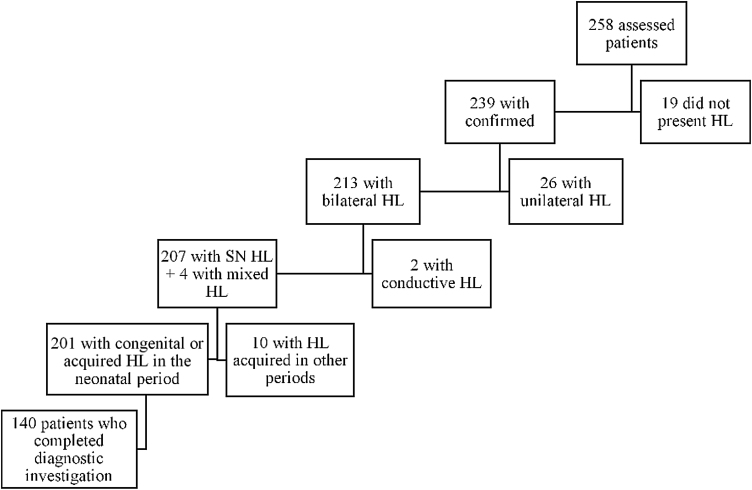
This prevalence study involved 140 children with bilateral sensorineural or mixed hearing loss. Medical history, physical examination, audiometry, and evoked auditory brainstem response were conducted. Imaging and genetic examinations were also performed.
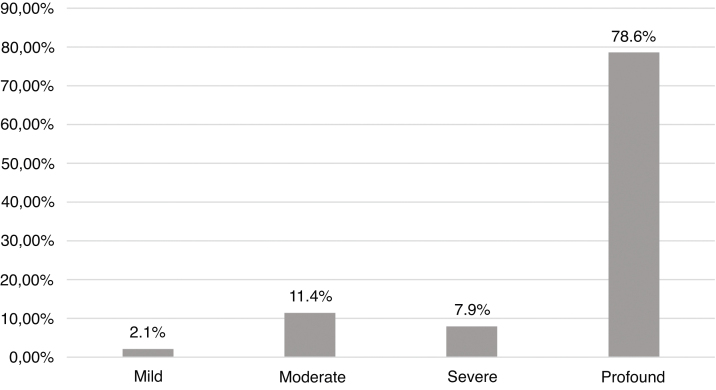
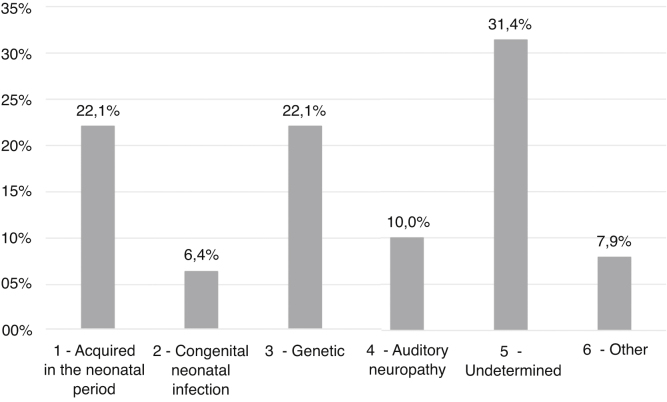
Etiologies and their prevalence were as follows: (a) indeterminate causes, 31.4%; (b) conditions related to neonatal period, 22.1%; (c) genetic, 22.1%; (d) auditory neuropathy, 10%; (e) other factors (cortical malformation, intracranial hemorrhage, and internal ear malformations), 7.9% and (f) congenital infections, 6.4%. Within the genetic cases, ten homozygous and seven heterozygotes of the 35delG mutation were identified, besides two cases of rare variants of GJB2: p.Try172* and p.Arg184Pro. One case with homozygosis of del(GJB6-D13S1830) was found. Regarding severity of hearing loss, in 78.6% of the cases the degree of hearing loss was profound and there were no significant differences when comparing between etiologies.
The number of indeterminate etiologies is still high and congenital CMV infection may be a possible cause of undiagnosed etiology for hearing loss. The predominance of etiologies related to neonatal conditions and infectious causes are characteristic of developing countries. The most prevalent mutation was 35delG, the main GJB2 gene, probably because of the European influence in the genotype of our population.
听力损失的病因取决于所研究的人群以及所分析地区的种族和社会经济状况。病因诊断有助于改进预防措施并早期识别这种缺陷。
确定巴西南部一家三级医院听力损失的病因及其患病率,验证GJB2和GJB6基因的突变频率,并将听力损失程度与耳聋病因相关联。
这项患病率研究纳入了140例双侧感音神经性或混合性听力损失儿童。进行了病史采集、体格检查、听力测定和听觉脑干诱发电位检查。还进行了影像学和基因检查。
病因及其患病率如下:(a) 不明原因,31.4%;(b) 与新生儿期相关的情况,22.1%;(c) 遗传因素,22.1%;(d) 听神经病,10%;(e) 其他因素(皮质畸形、颅内出血和内耳畸形),7.9%;(f) 先天性感染,6.4%。在遗传病例中,除了两例GJB2罕见变异:p.Try172*和p.Arg184Pro外,还鉴定出10例35delG突变的纯合子和7例杂合子。发现1例del(GJB6-D13S1830)纯合子病例。关于听力损失的严重程度,78.6%的病例听力损失程度为重度,不同病因之间比较无显著差异。
不明病因的数量仍然很高,先天性巨细胞病毒感染可能是听力损失未确诊病因的一个可能原因。与新生儿状况和感染性病因相关的病因占主导是发展中国家的特征。最常见的突变是主要GJB2基因的35delG,这可能是由于欧洲对我们人群基因型的影响。