Department of Neonatology, Charité - Universitätsmedizin Berlin, Berlin, Germany.
Department of Pediatrics, German Red Cross Hospital Westend, Berlin, Germany.
Eur J Pediatr. 2021 Sep;180(9):2951-2958. doi: 10.1007/s00431-021-04069-0. Epub 2021 Apr 10.
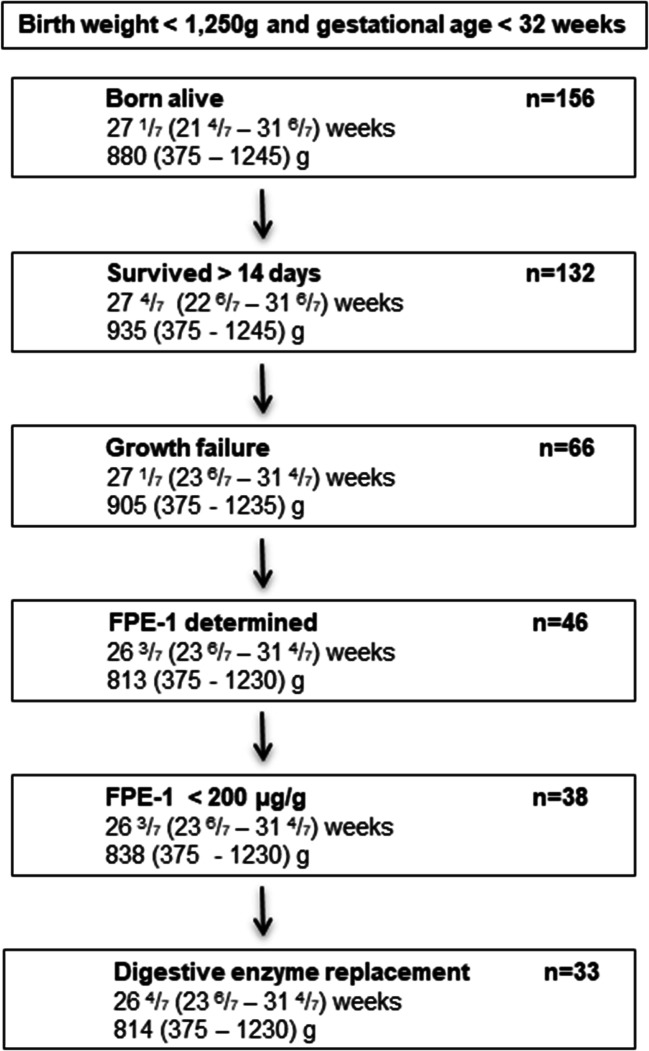
In orally fed preterm infants, poor weight gain may be linked to low fecal pancreatic elastase-1 (FPE-1) activity, indicative of exocrine pancreatic insufficiency. The objective of this study was the retrospective assessment of the effect of exogenous digestive enzyme replacement by gavage in preterm infants with growth failure and low FPE-1 (<200 μg/g). We analyzed weight gain relative to baseline and caloric intake during 14-day periods before and after institution of digestive enzyme replacement containing 6000 U lipase and 240 U protease kg d. Among 46 of 132 preterm infants < 1250g birth weight surviving to at least 14 days in whom FPE-1 was determined, 38 infants had low FPE-1 (< 200 μg/g), and 33 infants received exogenous digestive enzyme replacement. Average daily weight gain significantly increased from 14.4 [range 2.6-22.4] g kg d to 17.4 [8.4-29.0] g kg d (P = 0.001), as did weight gain per kcal, from 0.08 [0.02-0.13] g kcal d to 0.11 [0.05-0.18] g kcal d.Conclusion: In preterm infants with signs and symptoms of exocrine pancreatic insufficiency, exogenous digestive enzyme replacement is associated with improved growth. What is Known: • Very preterm infants on full enteral nutrition may display growth failure linked to transient poor exocrine pancreatic function. • Porcine pancreatic enzymes covered with an acid-resistant coating are too large to pass the internal diameter of most gavage tubes used in very preterm infants. What is New: • Administration of a liquid formulation of acid-resistant microbial digestive enzymes in preterm infants with growth failure and low fecal pancreatic elastase-1 values was associated with improved weight gain. • Response to exogenous digestive enzyme replacement was associated with the prior extent of growth failure.
经口喂养的早产儿,如果粪便胰腺弹性蛋白酶-1(FPE-1)活性低(表明存在胰腺外分泌功能不全),可能体重增长不良。本研究的目的是回顾性评估在生长不良且 FPE-1 较低(<200μg/g)的早产儿中,通过管饲给予外源性消化酶替代物的效果,这些消化酶包含 6000U 脂肪酶和 240U 蛋白酶/kg/d。在 132 名出生体重<1250g、至少存活 14 天的早产儿中,有 46 名 FPE-1 可检测,其中 38 名 FPE-1 较低(<200μg/g),33 名接受了外源性消化酶替代治疗。平均每日体重增加量从 14.4[2.6-22.4]g/kg/d 显著增加到 17.4[8.4-29.0]g/kg/d(P=0.001),每千卡体重增加量也从 0.08[0.02-0.13]g/kcal/d 增加到 0.11[0.05-0.18]g/kcal/d。
对于有胰腺外分泌功能不全表现和症状的早产儿,给予外源性消化酶替代治疗可改善生长。
· 全肠内营养的极早产儿可能出现生长不良,与短暂的胰腺外分泌功能不良有关。
· 用酸抗性涂层包裹的猪胰腺酶太大,无法通过极早产儿常用的大多数胃管的内径。
· 在生长不良且粪便胰腺弹性蛋白酶-1 值较低的早产儿中,给予抗酸性微生物消化酶的液体配方,可增加体重增长。
· 对外源消化酶替代治疗的反应与之前的生长不良程度有关。