Bansal Tania, Garg Kamakshi, Katyal Sunil, Sood Dinesh, Grewal Anju, Kumar Arvind
Department of Anaesthesiology, Dayanand Medical College and Hospital, Ludhiana, Punjab, India.
Department of Medicine, Dayanand Medical College and Hospital, Ludhiana, Punjab, India.
J Anaesthesiol Clin Pharmacol. 2020 Oct-Dec;36(4):541-545. doi: 10.4103/joacp.JOACP_307_19. Epub 2021 Jan 18.
Anesthesia in obese patients is difficult due to associated comorbidities and altered physiology. Desflurane and sevoflurane have a low fat-blood solubility coefficient and are better suited in these patients to achieve a rapid emergence. We studied BIS guided drug titration to compare the postoperative recovery characteristics and cognitive function of desflurane versus sevoflurane in obese patients undergoing laparoscopic abdominal surgeries.
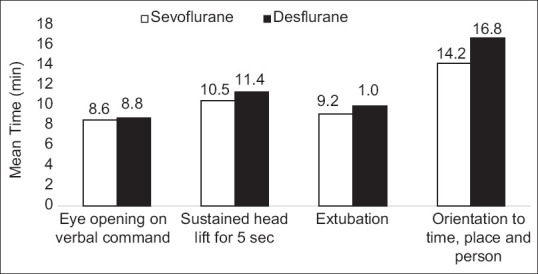
After institutional ethics committee approval and written informed consent, sixty obese patients (BMI ≥30 kg/m) were randomized to receive either BIS guided desflurane or sevoflurane. Recovery was assessed by time taken for eye opening on verbal command, sustained head lift for 5 s, and extubation and orientation to time, place, and person after discontinuation of volatile anesthetic agent. For cognitive function, time taken to complete Mini mental state examination (MMSE) score to baseline was compared in both study groups.
Difference of time taken for eye opening on verbal command, sustained head lift for 5 s, and extubation and orientation to time, place, and person was not significant between both anesthetic groups. Patients in sevoflurane group took significantly (-value = 0.001) less time (40.07 ± 13 min) to achieve preoperative MMSE score than desflurane group (51.2 ± 11.7 min).
Both desflurane and sevoflurane have similar recovery profile in obese patients when anesthetic concentration is carefully titrated. Reversal of cognitive function is significantly earlier in obese patients anesthetized with sevoflurane.
肥胖患者的麻醉因合并症和生理改变而具有挑战性。地氟烷和七氟烷具有较低的脂血溶解度系数,更适合用于这些患者以实现快速苏醒。我们研究了在双频谱指数(BIS)引导下的药物滴定,以比较地氟烷与七氟烷用于接受腹腔镜腹部手术的肥胖患者时的术后恢复特征和认知功能。
经机构伦理委员会批准并获得书面知情同意后,60例肥胖患者(BMI≥30kg/m²)被随机分为接受BIS引导的地氟烷或七氟烷麻醉组。通过对言语指令睁眼、持续抬头5秒、拔管以及停用挥发性麻醉剂后对时间、地点和人物的定向能力所需时间来评估恢复情况。对于认知功能,比较了两个研究组恢复至基线简易精神状态检查表(MMSE)评分所需的时间。
两组麻醉患者在言语指令睁眼、持续抬头5秒、拔管以及对时间、地点和人物的定向能力所需时间方面差异无统计学意义。七氟烷组患者恢复至术前MMSE评分所需时间(40.07±13分钟)显著少于地氟烷组(51.2±11.7分钟)(P值=0.001)。
当仔细滴定麻醉浓度时,地氟烷和七氟烷在肥胖患者中具有相似的恢复情况。七氟烷麻醉的肥胖患者认知功能恢复明显更早。