Secolin Rodrigo, Gonsales Marina C, Rocha Cristiane S, Naslavsky Michel, De Marco Luiz, Bicalho Maria A C, Vazquez Vinicius L, Zatz Mayana, Silva Wilson A, Lopes-Cendes Iscia
Department of Medical Genetics and Genomic Medicine, Brazilian Institute of Neuroscience and Neurotechnology (BRAINN), University of Campinas - UNICAMP, Campinas, Brazil.
Departament of Genetics and Evolutive Biology, Human Genome and Stem Cell Research Center, Institute of Bioscience, University of São Paulo (USP), São Paulo, Brazil.
Front Genet. 2021 Mar 25;12:636542. doi: 10.3389/fgene.2021.636542. eCollection 2021.
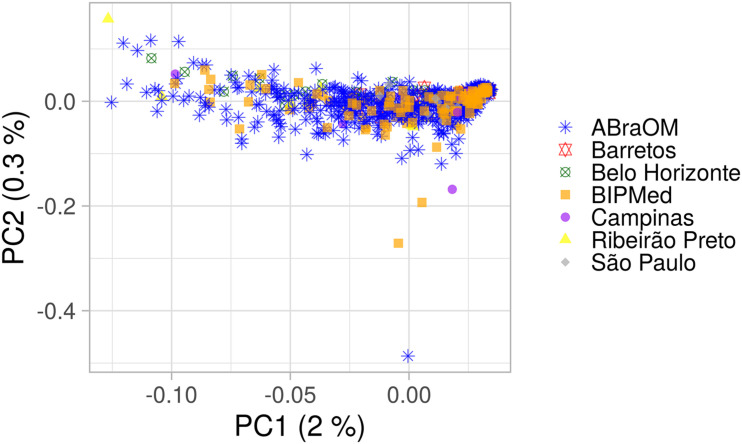
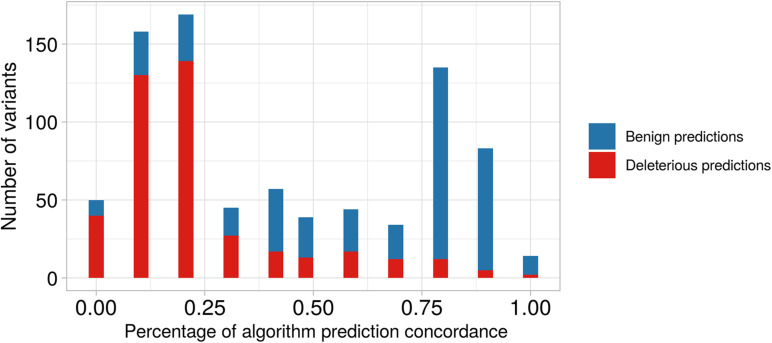
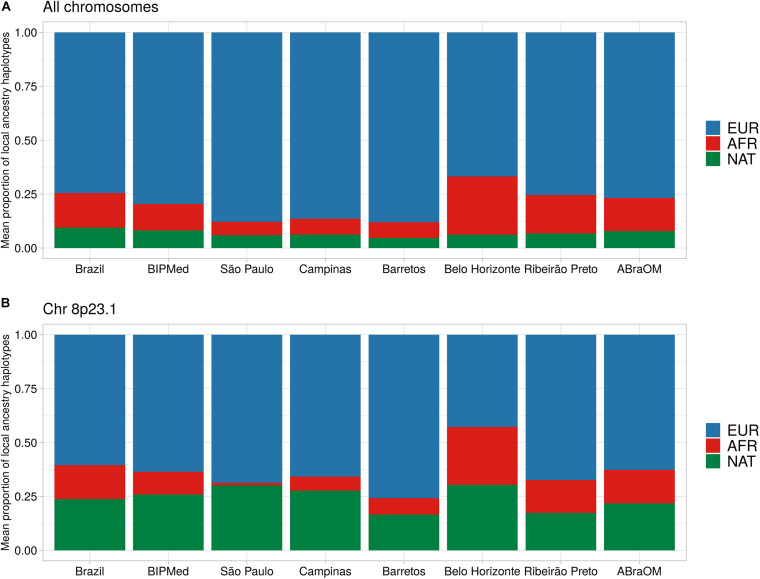
We recently reported a deviation of local ancestry on the chromosome (ch) 8p23.1, which led to positive selection signals in a Brazilian population sample. The deviation suggested that the genetic variability of candidate genes located on ch 8p23.1 may have been evolutionarily advantageous in the early stages of the admixture process. In the present work, we aim to extend the previous work by studying additional Brazilian admixed individuals and examining DNA sequencing data from the ch 8p23.1 candidate region. Thus, we inferred the local ancestry of 125 exomes from individuals born in five towns within the Southeast region of Brazil (São Paulo, Campinas, Barretos, and Ribeirão Preto located in the state of São Paulo and Belo Horizonte, the capital of the state of Minas Gerais), and compared to data from two public Brazilian reference genomic databases, BIPMed and ABraOM, and with information from the 1000 Genomes Project phase 3 and gnomAD databases. Our results revealed that ancestry is similar among individuals born in the five Brazilian towns assessed; however, an increased proportion of sub-Saharan African ancestry was observed in individuals from Belo Horizonte. In addition, individuals from the five towns considered, as well as those from the ABRAOM dataset, had the same overrepresentation of Native-American ancestry on the ch 8p23.1 locus that was previously reported for the BIPMed reference sample. Sequencing analysis of ch 8p23.1 revealed the presence of 442 non-synonymous variants, including frameshift, inframe deletion, start loss, stop gain, stop loss, and splicing site variants, which occurred in 24 genes. Among these genes, 13 were associated with obesity, type II diabetes, lipid levels, and waist circumference (, , , , , , , , , , , , and ). These results strengthen the hypothesis that a set of variants located on ch 8p23.1 that result from positive selection during early admixture events may influence obesity-related disease predisposition in admixed individuals of the Brazilian population. Furthermore, we present evidence that the exploration of local ancestry deviation in admixed individuals may provide information with the potential to be translated into health care improvement.
我们最近报告了8号染色体(ch)8p23.1上本地祖先的偏差,这在一个巴西人群样本中产生了正选择信号。这种偏差表明,位于ch 8p23.1上的候选基因的遗传变异性在混合过程的早期阶段可能在进化上具有优势。在本研究中,我们旨在通过研究更多巴西混合个体并检查ch 8p23.1候选区域的DNA测序数据来扩展先前的工作。因此,我们推断了来自巴西东南部地区五个城镇(圣保罗州的圣保罗、坎皮纳斯、巴雷托斯和里贝朗普雷图以及米纳斯吉拉斯州首府贝洛奥里藏特)出生的个体的125个外显子组的本地祖先,并与来自两个巴西公共参考基因组数据库BIPMed和ABraOM的数据以及来自千人基因组计划第3阶段和gnomAD数据库的信息进行了比较。我们的结果显示,在所评估的五个巴西城镇出生的个体之间祖先相似;然而,在贝洛奥里藏特的个体中观察到撒哈拉以南非洲祖先的比例增加。此外,来自所考虑的五个城镇的个体以及来自ABRAOM数据集的个体,在ch 8p23.1位点上具有与之前报道的BIPMed参考样本相同的美洲原住民祖先的过度代表性。对ch 8p23.1的测序分析揭示了442个非同义变体的存在,包括移码、框内缺失、起始丢失、终止获得、终止丢失和剪接位点变体,这些变体出现在24个基因中。在这些基因中,13个与肥胖、II型糖尿病、血脂水平和腰围相关(,,,,,,,,,,,,和)。这些结果强化了这样一种假设,即在早期混合事件中由正选择产生的一组位于ch 8p23.1上的变体可能影响巴西人群混合个体中与肥胖相关疾病的易感性。此外,我们提供的证据表明,对混合个体中本地祖先偏差的探索可能提供有可能转化为医疗保健改善的信息。