Nelson Samuel, Wilson Charles S, Becker James
Montana State University.
Int J Sports Phys Ther. 2021 Apr 2;16(2):371-380. doi: 10.26603/001c.21492.
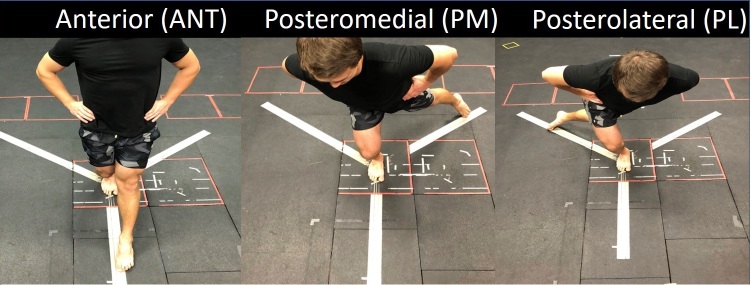
The Y-Balance Test (YBT) assesses dynamic stability and neuromuscular control of the lower extremity. Several authors have analyzed kinematic predictors of YBT performance with conflicting results, but the influence of kinetic factors is not well understood.
To examine kinematic predictors of YBT performance and determine the joint kinetics which predict YBT performance.
Cross-sectional study.
Thirty-one physically active individuals performed YBT trials on a force plate while whole body kinematics were recorded using a motion capture system. Sagittal, frontal, and transverse plane joint kinematics and joint moments were calculated at maximum reach in each YBT reach direction. Variables correlated with reach distances at the < 0.2 level were entered into a stepwise linear regression.
In the anterior direction, knee flexion and torso rotation ( =0.458, <0.001) and knee extensor and hip abductor moments ( =0.461, <0.001) were the best kinematic and kinetic predictors of reach distance. In the posterior medial direction, hip flexion, ankle dorsiflexion, and ankle rotation accounted for 45.8% of the variance in reach direction (<0.001) while hip and knee extensor, and hip abductor moments explained 72.6% of the variance in reach distance (<0.001). In the posterior lateral direction, hip flexion and pelvic rotation ( =0.696, <.001) and hip extensor moments ( =0.433, =0.001) were the best kinematic and kinetic predictors of reach distance.
The ability to generate large hip and knee joint moments in the sagittal and frontal plane are critical for YBT performance.
Y 平衡测试(YBT)用于评估下肢的动态稳定性和神经肌肉控制能力。几位作者分析了 YBT 表现的运动学预测因素,但结果相互矛盾,而动力学因素的影响尚未得到充分理解。
研究 YBT 表现的运动学预测因素,并确定预测 YBT 表现的关节动力学因素。
横断面研究。
31 名身体活跃的个体在测力板上进行 YBT 测试,同时使用运动捕捉系统记录全身运动学数据。在每个 YBT 伸展方向的最大伸展时,计算矢状面、额状面和横断面的关节运动学和关节力矩。将与伸展距离相关且 p<0.2 的变量纳入逐步线性回归。
在前向方向上,膝关节屈曲和躯干旋转(r = 0.458,p<0.001)以及膝关节伸展和髋关节外展力矩(r = 0.461,p<0.001)是伸展距离最佳的运动学和动力学预测因素。在后内侧方向上,髋关节屈曲、踝关节背屈和踝关节旋转占伸展方向变异的 45.8%(p<0.001),而髋关节和膝关节伸展以及髋关节外展力矩解释了伸展距离变异的 72.6%(p<0.001)。在后外侧方向上,髋关节屈曲和骨盆旋转(r = 0.696, p<.001)以及髋关节伸展力矩(r = 0.433, p = 0.001)是伸展距离最佳的运动学和动力学预测因素。
在矢状面和额状面产生较大髋关节和膝关节力矩的能力对 YBT 表现至关重要。
3 级。