Bulow Alison, Bellemare Alixandra, Anderson Judy E, Leiter Jeff R S, MacDonald Peter B, Peeler Jason D
University of Manitoba.
University of Manitoba; Pan Am Clinic.
Int J Sports Phys Ther. 2021 Apr 1;16(2):381-392. doi: 10.26603/001c.21529.
Adolescent females are at significant risk for sustaining an ACL injury. The Y-Balance Test (YBT) is frequently used to evaluate neuromuscular control and lower extremity function. However, few studies have quantified 2D lower extremity kinematics during performance of the YBT, and there is an absence of kinematic data specific to at-risk adolescent females.
To examine lower extremity joint kinematics during execution of the YBT by healthy and ACL-injured adolescent females.
Prospective cohort.
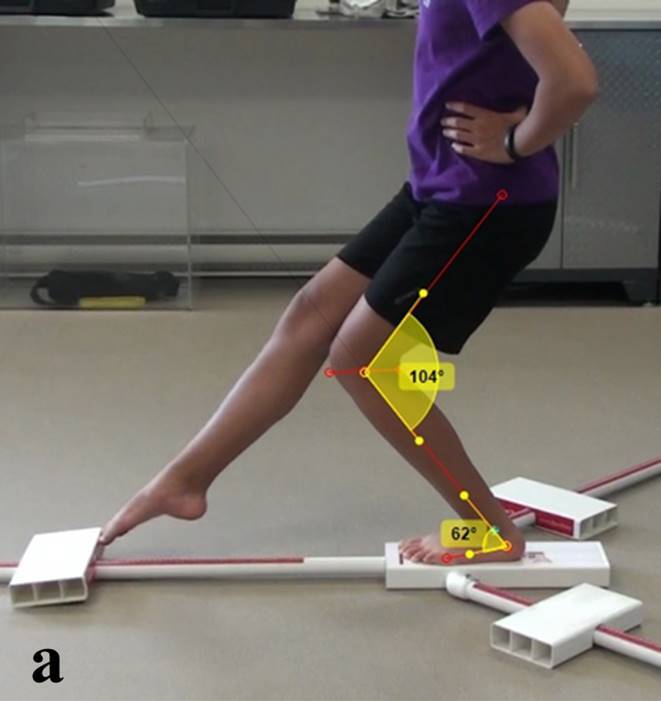
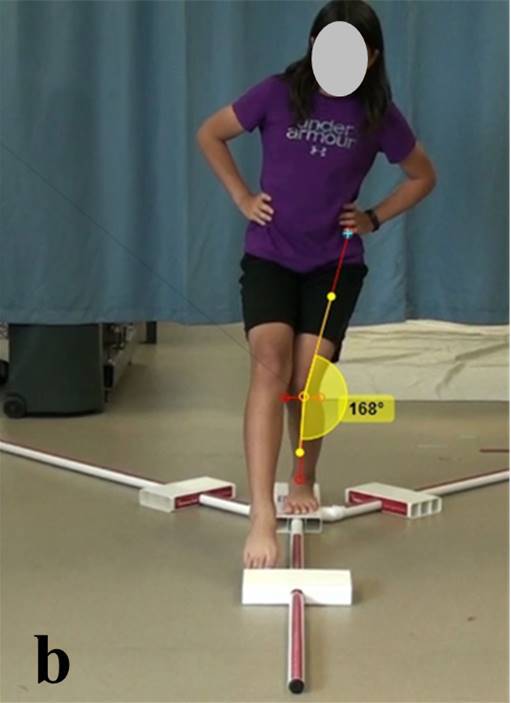
Twenty-five healthy and ten ACL-injured (mean time from injury 143 days) adolescent females were assessed using the YBT. Sagittal and frontal plane knee and ankle motion was video recorded during execution of the YBT anterior reach movement. Ankle dorsi-flexion, knee flexion, and knee valgus angles were quantified via kinematic analysis. ANOVAs with a post hoc Bonferroni correction were used to compare YBT scoring (%LL) and kinematic data between groups. Pearson product-moment correlations determined the relationship between kinematic data and YBT scoring.
Healthy and ACL-injured subjects demonstrated similar YBT scores and lower extremity kinematic data. Healthy subjects demonstrated a weak positive correlation between ankle dorsiflexion and YBT scoring, and a weak negative correlation between knee valgus and YBT scoring. These relationships did not exist for ACL-injured subjects. Kinematic data for both groups also demonstrated a large degree of variability, regardless of YBT score.
Adolescent females frequently utilize a variety of lower extremity movement strategies when performing a functional movement task, and scoring on the YBT offers limited insight regarding lower extremity joint kinematics and ACL-injury risk in a physically active adolescent female population.
Level 3.
青春期女性遭受前交叉韧带损伤的风险很高。Y平衡测试(YBT)常用于评估神经肌肉控制和下肢功能。然而,很少有研究对YBT执行过程中的二维下肢运动学进行量化,并且缺乏针对高危青春期女性的运动学数据。
研究健康和前交叉韧带损伤的青春期女性在执行YBT时的下肢关节运动学。
前瞻性队列研究。
使用YBT对25名健康和10名前交叉韧带损伤(平均受伤时间143天)的青春期女性进行评估。在YBT前伸运动执行过程中,对矢状面和额状面的膝关节和踝关节运动进行视频记录。通过运动学分析对踝关节背屈、膝关节屈曲和膝关节外翻角度进行量化。采用方差分析和事后邦费罗尼校正比较两组之间的YBT评分(%LL)和运动学数据。皮尔逊积差相关分析确定运动学数据与YBT评分之间的关系。
健康和前交叉韧带损伤的受试者表现出相似的YBT评分和下肢运动学数据。健康受试者的踝关节背屈与YBT评分之间呈弱正相关,膝关节外翻与YBT评分之间呈弱负相关。前交叉韧带损伤的受试者不存在这些关系。两组的运动学数据也显示出很大的变异性,与YBT评分无关。
青春期女性在执行功能性运动任务时经常采用多种下肢运动策略,YBT评分对于身体活跃的青春期女性人群的下肢关节运动学和前交叉韧带损伤风险的洞察有限。
3级。