Nsiah Frimpong Benedicta, Oppong Allen, Prempeh Ruth, Appiah-Kubi Zipporah, Abrokwah Linda A, B Mochiah Moses, N Lamptey Joseph, Manu-Aduening Joseph, Pita Justin
CSIR - Crops Research Institute, Kumasi, Ghana.
University of Félix Houphouët Boigny, Abidjan, Cote d'Ivoire.
Gates Open Res. 2021 Feb 18;4:101. doi: 10.12688/gatesopenres.13114.2. eCollection 2020.
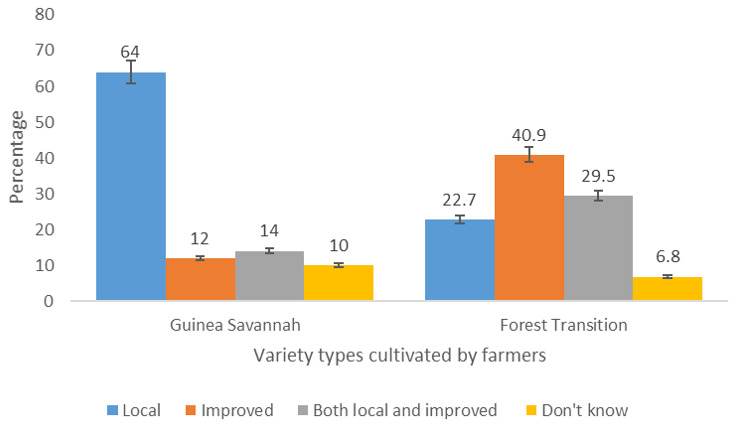
: Cassava is a major staple root crop in Ghana, which serves as a food security and an income generating crop for farming families. In spite of its importance, the crop is plagued with biotic factors such as pests and diseases, resulting in yield and income reductions. : Farmers' knowledge, attitudes and practices towards cassava pest and disease management were investigated. A mixed research questionnaire was used to collect both qualitative and quantitative data from 94 cassava farm households across two major cassava growing agro-ecologies. : Using descriptive statistics, parametric and non-parametric analysis, our study revealed that farmers' knowledge on cassava pests was high but low for diseases. Whiteflies ( Gennadius), grasshoppers ( ), aphids ( Glover), mealybugs ( ), termites ( ), and grasscutters ( ) were perceived as the most common damaging pests. Farmers' descriptions showed that disease pathogens attacked foliar tissues, stem and root tissues and caused leaf dropping and die back. Cassava mosaic disease and root rot were the most common diseases; however, disease descriptions suggested the incidence of viral, bacterial and fungal diseases. Some of the farmers observed mixed symptoms on their farms. The results also showed that only 25.5% cultivated improved varieties. Management actions applied included field sanitation practices and pesticide application. The effectiveness level of the control actions was rated moderately effective. : The analysis showed heterogeneity in personal and farm level characteristics of respondents across the two agro-ecologies, but agro-ecologies were independent of the management practices employed. There is a need to improve farmers' access to improved disease-free planting materials through efficient dissemination pathways and increase farmers' knowledge on cassava pests, diseases and integrated management through publfic awareness creation and capacity building by extension agents and research institutions. Continued government investment is needed to achieve sustainable outcomes.
木薯是加纳的主要主食块根作物,是农户的粮食安全作物和创收作物。尽管其很重要,但该作物受到病虫害等生物因素的困扰,导致产量和收入下降。对农民关于木薯病虫害管理的知识、态度和做法进行了调查。采用混合研究问卷从两个主要木薯种植农业生态区的94户木薯农户收集定性和定量数据。通过描述性统计、参数和非参数分析,我们的研究表明,农民对木薯害虫的了解程度高,但对病害的了解程度低。粉虱(烟粉虱)、蝗虫、蚜虫(棉蚜)、粉蚧、白蚁和蔗鼠被认为是最常见的有害害虫。农民的描述表明,病害病原体侵袭叶组织、茎和根组织,导致落叶和枯死。木薯花叶病和根腐病是最常见的病害;然而,病害描述表明存在病毒、细菌和真菌病害。一些农民在他们的农场观察到混合症状。结果还表明,只有25.5%的农户种植改良品种。采取的管理措施包括田间卫生措施和农药施用。防治措施的有效程度被评为中等有效。分析表明,两个农业生态区受访者的个人和农场层面特征存在异质性,但农业生态区与所采用的管理措施无关。有必要通过有效的传播途径,改善农民获取改良无病种植材料的机会,并通过推广人员和研究机构开展公众宣传和能力建设,增加农民对木薯病虫害及综合管理的了解。需要政府持续投资以实现可持续成果。