Department of Orthopaedics and Trauma-Surgery, Medical University of Vienna, Vienna, Austria.
Department of Paediatric Orthopaedics, Adult Foot and Ankle Surgery, Speising Orthopaedic Hospital, Vienna, Austria.
Foot Ankle Int. 2021 Sep;42(9):1115-1120. doi: 10.1177/10711007211002814. Epub 2021 Apr 10.
Insertional Achilles tendinopathy (IAT) is a painful pathology in which the strongest and thickest tendon of the human body is affected. Different conservative and operative treatments have been described to address this pathology. This study aimed to evaluate the medium-term clinical and radiological outcomes of patients who underwent a surgical therapy via a longitudinal tendon-splitting approach with debridement and double-row refixation.
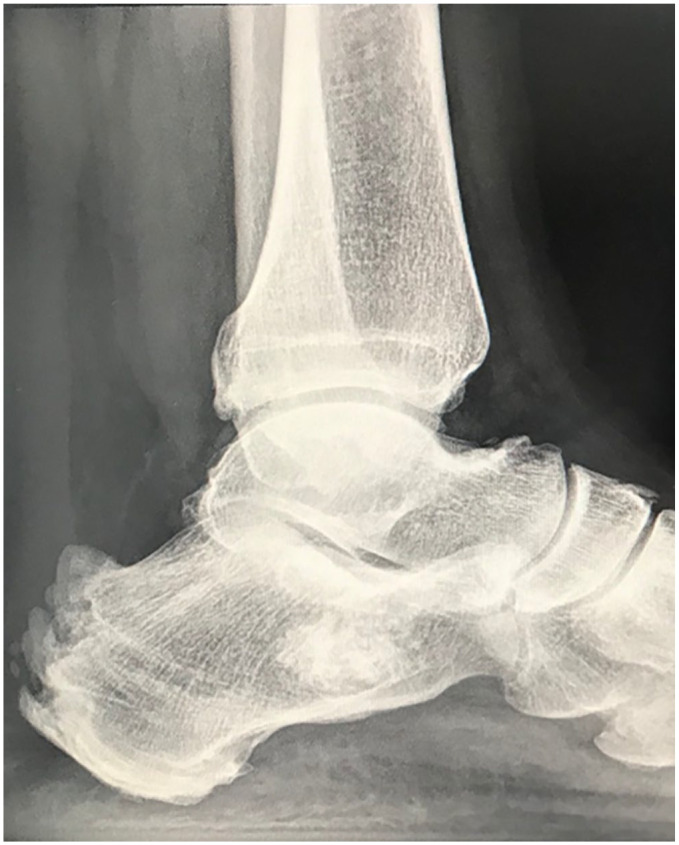
All patients were assessed pre- and postoperatively using a visual analog scale (VAS), the American Orthopaedic Foot & Ankle Society (AOFAS) Hindfoot Score, the Foot and Ankle Outcome Score (FAOS), and the Foot Function Index (FFI). Additionally, a lateral radiograph of the foot was performed to assess the postoperative result. Forty-two patients with confirmed IAT who underwent surgery between 2013 and 2017 with a longitudinal tendon-splitting approach and tendon refixation using a double-row refixation system were evaluated. The average follow-up was 32.8 (range, 18-52) months. We included 26 female and 16 male patients with an average age of 56.8 (range, 27-73) years.
The mean VAS improved from 8.91 ± 1.0 preoperatively to 1.47 ± 2.5 postoperatively ( .01). AOFAS scores improved significantly from 51.0 ± 12.5 preoperatively to 91.3 ± 14.3 postoperatively ( .01). All total and subscores of the FFI and FAOS saw a significant improvement at follow-up ( .01). Lateral radiographs showed recurrent calcification in 30 patients (71.4%).
We found that, at an average of 33 months posttreatment, insertional Achilles tendinopathy via a longitudinal tendon-splitting approach resulted in good outcomes for patients after failure of initial conservative therapy. Recurrent calcification seems to be very common but shows no association with inferior outcomes or the return of symptoms.
Level IV, retrospective case series.
插入性跟腱病(IAT)是一种累及人体最强壮和最厚的肌腱的疼痛性病变。已经描述了不同的保守和手术治疗方法来解决这种病变。本研究旨在评估通过纵向肌腱切开术进行清创和双排固定的手术治疗的患者的中期临床和放射学结果。
所有患者均在术前和术后使用视觉模拟量表(VAS)、美国矫形足踝协会(AOFAS)后足评分、足踝结果评分(FAOS)和足部功能指数(FFI)进行评估。此外,还对足部的侧位 X 线片进行评估以了解术后结果。评估了 2013 年至 2017 年间接受纵向肌腱切开术和双排固定系统肌腱固定手术的 42 例确诊的 IAT 患者。平均随访时间为 32.8(范围,18-52)个月。我们纳入了 26 名女性和 16 名男性患者,平均年龄为 56.8(范围,27-73)岁。
VAS 均值从术前的 8.91±1.0 改善至术后的 1.47±2.5(.01)。AOFAS 评分从术前的 51.0±12.5 显著改善至术后的 91.3±14.3(.01)。FFI 和 FAOS 的所有总分和子评分在随访时均显著改善(.01)。侧位 X 线片显示 30 例患者(71.4%)有复发性钙化。
我们发现,在平均 33 个月的治疗后,对于初始保守治疗失败的患者,通过纵向肌腱切开术治疗插入性跟腱病可获得良好的效果。复发性钙化似乎很常见,但与较差的结果或症状复发无关。
IV 级,回顾性病例系列。