Department of Pediatrics, Amsterdam UMC, Amsterdam, The Netherlands.
Department of Pediatrics, Radboud Center for Mitochondrial Medicine, Radboud University Medical Center, Nijmegen, The Netherlands.
Orphanet J Rare Dis. 2021 Apr 12;16(1):170. doi: 10.1186/s13023-021-01727-2.
The Treatable ID App was created in 2012 as digital tool to improve early recognition and intervention for treatable inherited metabolic disorders (IMDs) presenting with global developmental delay and intellectual disability (collectively 'treatable IDs'). Our aim is to update the 2012 review on treatable IDs and App to capture the advances made in the identification of new IMDs along with increased pathophysiological insights catalyzing therapeutic development and implementation.
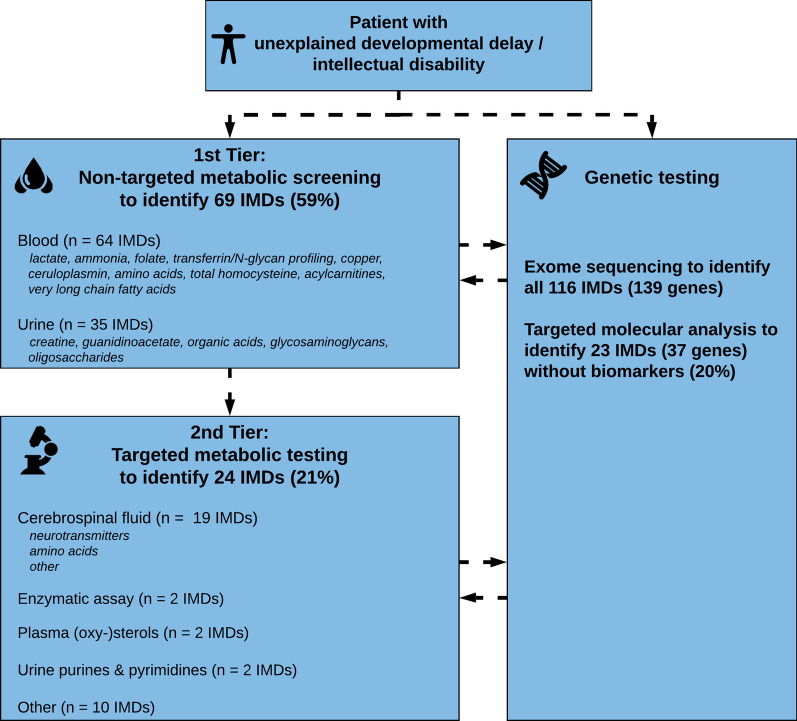
Two independent reviewers queried PubMed, OMIM and Orphanet databases to reassess all previously included disorders and therapies and to identify all reports on Treatable IDs published between 2012 and 2021. These were included if listed in the International Classification of IMDs (ICIMD) and presenting with ID as a major feature, and if published evidence for a therapeutic intervention improving ID primary and/or secondary outcomes is available. Data on clinical symptoms, diagnostic testing, treatment strategies, effects on outcomes, and evidence levels were extracted and evaluated by the reviewers and external experts. The generated knowledge was translated into a diagnostic algorithm and updated version of the App with novel features.
Our review identified 116 treatable IDs (139 genes), of which 44 newly identified, belonging to 17 ICIMD categories. The most frequent therapeutic interventions were nutritional, pharmacological and vitamin and trace element supplementation. Evidence level varied from 1 to 3 (trials, cohort studies, case-control studies) for 19% and 4-5 (case-report, expert opinion) for 81% of treatments. Reported effects included improvement of clinical deterioration in 62%, neurological manifestations in 47% and development in 37%.
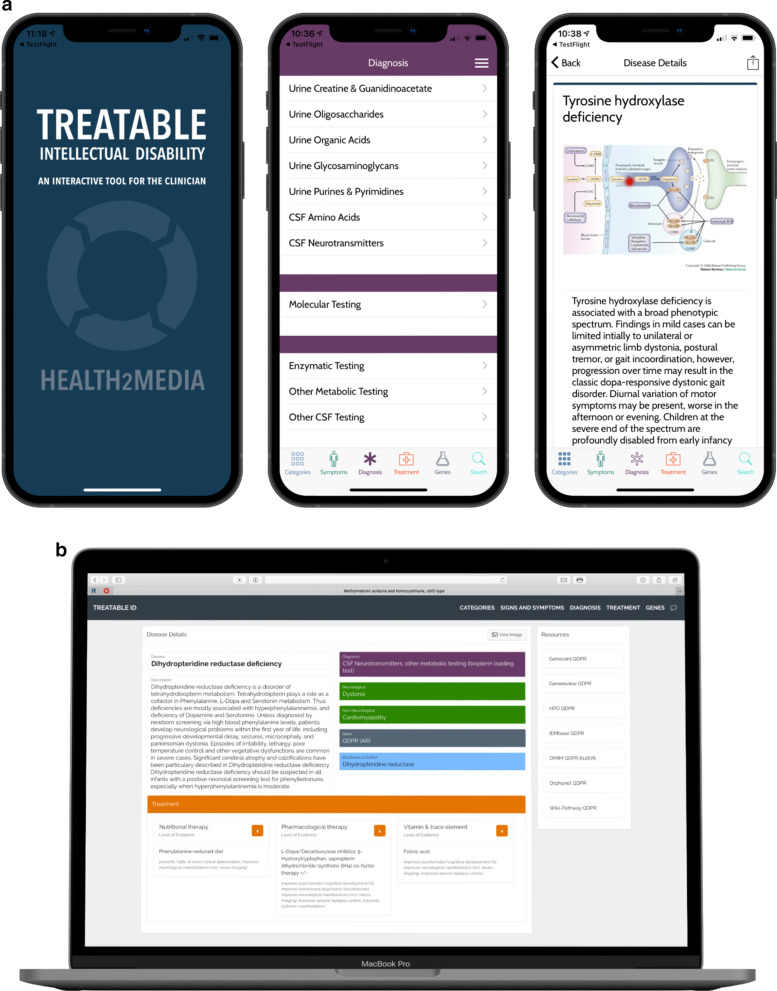
The number of treatable IDs identified by our literature review increased by more than one-third in eight years. Although there has been much attention to gene-based and enzyme replacement therapy, the majority of effective treatments are nutritional, which are relatively affordable, widely available and (often) surprisingly effective. We present a diagnostic algorithm (adjustable to local resources and expertise) and the updated App to facilitate a swift and accurate workup, prioritizing treatable IDs. Our digital tool is freely available as Native and Web App (www.treatable-id.org) with several novel features. Our Treatable ID endeavor contributes to the Treatabolome and International Rare Diseases Research Consortium goals, enabling clinicians to deliver rapid evidence-based interventions to our rare disease patients.
Treatable ID 应用程序于 2012 年创建,是一种数字工具,旨在提高对可治疗遗传性代谢障碍(IMD)的早期识别和干预,这些障碍表现为全球发育迟缓伴智力残疾(统称为“可治疗 ID”)。我们的目标是更新 2012 年关于可治疗 ID 和应用程序的综述,以捕捉新 IMD 鉴定方面的进展,以及增加促进治疗开发和实施的病理生理学见解。
两名独立的审查员查询了 PubMed、OMIM 和 Orphanet 数据库,重新评估了所有先前包括的疾病和疗法,并确定了 2012 年至 2021 年期间发表的关于可治疗 ID 的所有报告。如果这些报告被列入国际 IMD 分类(ICIMD),并以 ID 为主要特征,并且有治疗干预改善 ID 主要和/或次要结果的发表证据,则将其列入。对临床症状、诊断测试、治疗策略、对结果的影响以及证据水平的数据由审查员和外部专家提取和评估。生成的知识被转化为诊断算法和应用程序的更新版本,具有新功能。
我们的综述确定了 116 种可治疗 ID(139 个基因),其中 44 种是新发现的,属于 17 个 ICIMD 类别。最常见的治疗干预措施是营养、药理学和维生素及微量元素补充。19%的治疗方法的证据水平为 1 至 3(试验、队列研究、病例对照研究),81%的治疗方法为 4-5(病例报告、专家意见)。报告的效果包括 62%的临床恶化改善、47%的神经表现改善和 37%的发育改善。
我们的文献综述确定的可治疗 ID 数量在八年中增加了三分之一以上。尽管人们对基于基因和酶替代疗法给予了很多关注,但大多数有效的治疗方法是营养疗法,这些疗法相对负担得起、广泛可用且(通常)非常有效。我们提出了一个诊断算法(可根据当地资源和专业知识进行调整)和更新的应用程序,以促进快速准确的评估,优先考虑可治疗 ID。我们的数字工具以本地和网络应用程序(www.treatable-id.org)的形式免费提供,具有几个新功能。我们的可治疗 ID 工作有助于治疗组和国际罕见病研究联盟的目标,使临床医生能够为我们的罕见病患者提供快速的循证干预措施。